
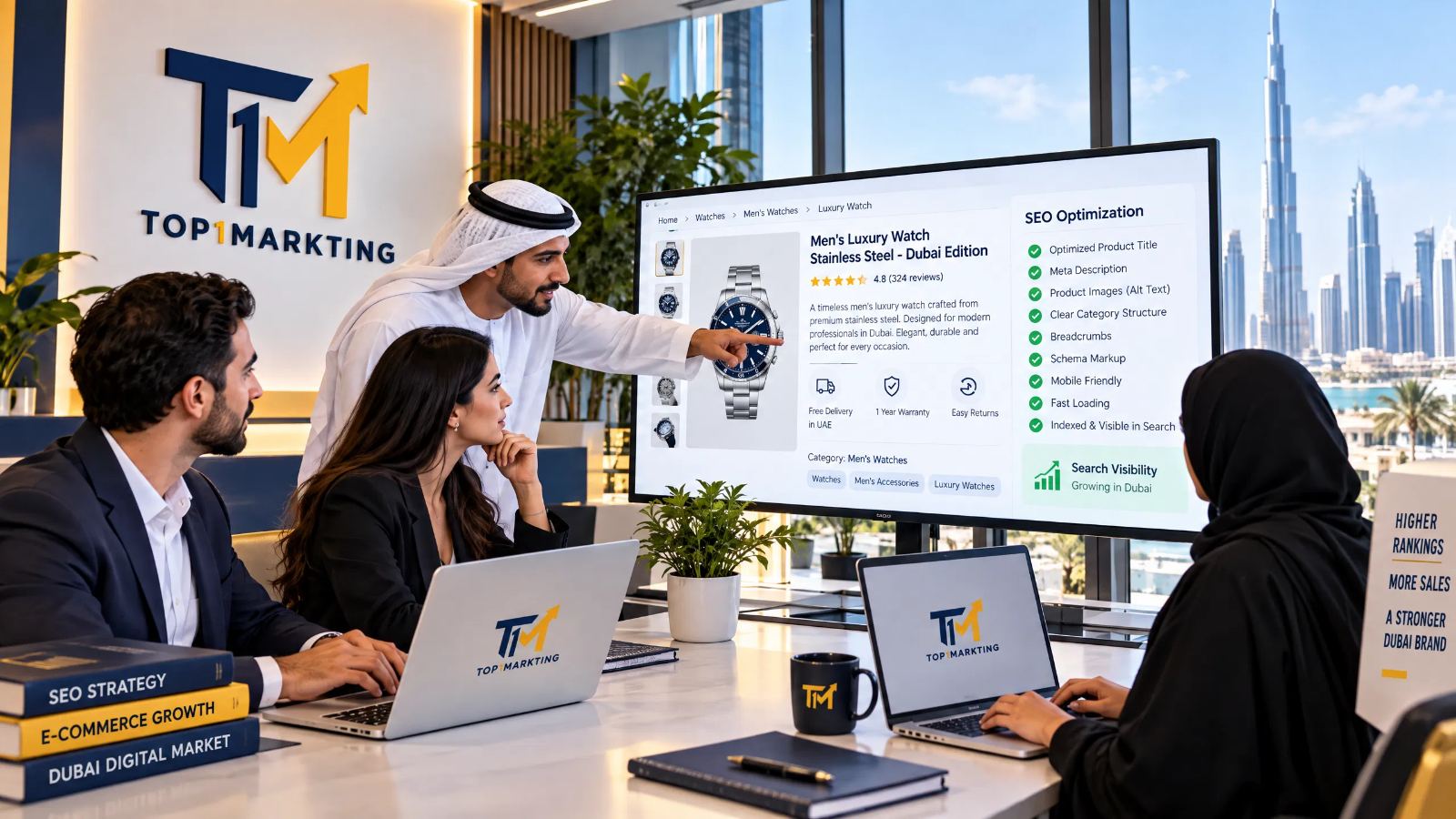
How Can You Make Your E-Commerce Store in Dubai SEO-Friendly? | SEO for E-Commerce Stores
Is Your E-Commerce Store in Dubai Really Ready to Appear on Google?

Before thinking about keywords or writing content, you need to make sure that your e-commerce store in Dubai is properly built from the inside so that search engines can access its pages and understand its products and categories easily. This is where e-commerce SEO services with Top1Markting begin: by auditing the store structure and the way products and links are organized, not simply by adding keywords.
Can Google Easily Access Your Products and Categories?
An e-commerce store targeting customers in Dubai needs a clear structure that helps Google discover important products and categories without unnecessary complexity. Therefore, the store structure, navigation, and page relationships should be reviewed to ensure that important products can be reached through menus, categories, and internal links.
This includes:
-
Auditing the structure of the e-commerce store in Dubai.
-
Ensuring that categories and products are easy to access.
-
Linking important products to the appropriate categories.
-
Making sure that important products are not isolated from the rest of the website.
-
Improving internal links between product and category pages.
-
Making it easier for Google to access pages targeting searches performed by customers in Dubai.
Through Top1Markting, these elements can be handled as part of optimizing the store for search engines, so the store is not simply a sales platform, but an organized website that can be discovered in Google results in Dubai.
Does Every Important Product Have an Independent Indexable Page?
If the store targets customers in Dubai, every major product should have an independent page that search engines can access and index. Having a product available only through a filter or dynamic list does not necessarily mean that its page is properly prepared to appear in search results.
Therefore, make sure there is:
-
A clear URL for every product.
-
A real, indexable product page.
-
A unique title that clearly identifies the product and its type.
-
A unique and useful description for customers in Dubai.
-
Content explaining the product specifications and benefits.
-
Appropriate images with relevant data when needed.
-
Internal links that help Google and customers discover related products.
-
No dependence on filter pages alone to reach important products.
This is especially important for stores with large numbers of products that want to target different searches in Dubai. Top1Markting can organize the structure of product and category pages so that the store is clearer to search engines and easier for customers to navigate.
Is the Store Built Only to Sell, or Also to Be Discovered?
There is a difference between an e-commerce store that works well when a customer visits it and an e-commerce store that is also prepared to be discovered through Google in Dubai.
A store may be fast and easy to use and offer payment and shipping options, yet receive insufficient search traffic because of a weak page structure, lack of suitable content, or poorly optimized products and categories.
Therefore, SEO should be considered from the store-building stage instead of waiting until launch and trying to fix the structure later.
With Top1Markting, an e-commerce store in Dubai can be built with Google visibility included in the planning from the beginning, starting with category and product structure and internal links, and continuing through content and technical elements that help the store compete in search results and reach customers in Dubai.
Start With How Customers in Dubai Search, Not With the Keywords You Want to Target
The success of an e-commerce store in Dubai does not begin simply by choosing a keyword and adding the word "Dubai" to it. It starts with understanding how customers in Dubai search for the products they want to buy.
Therefore, Top1Markting connects keyword research with customer behavior and search intent so that store pages are actually aligned with what customers in Dubai are searching for.
How Do Customers in Dubai Search for the Product They Want?
Customers in Dubai may search for a product in different ways depending on where they are in the buying process. They may start with the product name, search for a specific type, add a brand name, or use terms related to price, usage, purchase, and delivery.
Search patterns that can be analyzed when optimizing an e-commerce store targeting Dubai include:
-
The product name customers in Dubai search for.
-
The product type or category.
-
The brand name when searching for a specific brand.
-
The use case or problem the customer wants to solve.
-
Price-related searches or products within a certain budget.
-
Product or brand comparisons.
-
Phrases related to buying online in Dubai.
-
Delivery-related searches within Dubai when local delivery is actually part of the service.
The goal is not to place the word "Dubai" on every page, but to understand when location is genuinely part of the search intent.
When Is a Local Search Phrase Important for an E-Commerce Store?
Local phrases are useful when the store actually serves the Dubai market, rather than simply trying to gain local visibility.
Dubai-related phrases may be important when:
-
The store directly targets customers in Dubai.
-
Delivery within Dubai is part of the service.
-
Products are connected to the Dubai market and its customer needs.
-
The store competes for products with clear local demand.
-
Competition for broad keywords is strong and the store needs more specific search opportunities.
-
There is a genuine advantage to buying from the store within Dubai.
Top1Markting helps identify appropriate local keywords for each store according to its products, services, and actual sales area instead of repeating the name Dubai across every store page without a purpose.
How Should Keywords Be Distributed Across Store Pages?
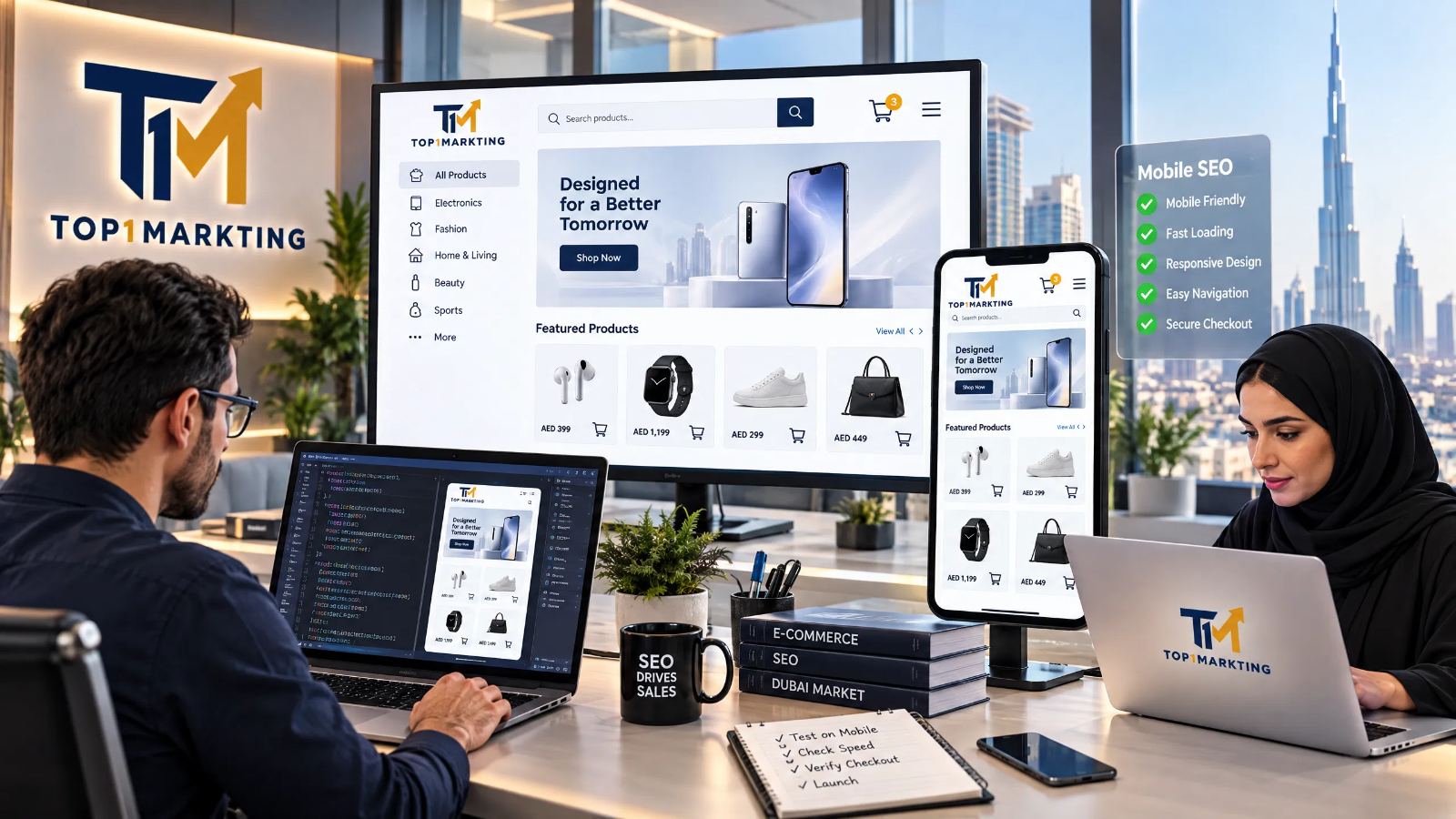
Not every page of an e-commerce store in Dubai needs to target the same keyword. Keywords should be distributed according to each page's purpose and the customer's search intent.
They can be distributed across:
-
Homepage: Keywords describing the store's business and what it offers customers in Dubai.
-
Category pages: Keywords related to major product categories.
-
Product pages: Product name, brand, model, and purchase-related phrases when appropriate.
-
Brand pages: Searches targeting a specific brand or group of products.
-
Supporting content: Questions, comparisons, and information customers search for before making a purchase.
The core idea is not to make every page compete for the same keyword. Every page should have a clear role in the store's SEO strategy in Dubai.
Build Your Store Structure Around the Products You Want to Sell in Dubai
Building an e-commerce store structure in Dubai should start with the products you want to reach customers with, rather than creating the largest possible number of pages.
Top1Markting believes that a strong store structure should help customers reach products easily while also helping Google understand the relationship between categories and products.
How Do You Choose the Main Store Categories?
A good category represents a real group of products and gives customers a clear way to find what they are looking for.
Therefore, a category should ideally be:
-
Representative of a real group of products.
-
Connected to a clear search demand in the Dubai market.
-
Easy for customers to understand.
-
Organized in a way that makes products easy to find.
-
Capable of being supported by useful and relevant content.
-
Connected to product pages that actually exist in the store.
When building a store targeting Dubai, categories should come from the products and customer behavior in Dubai, rather than from a list of keywords created purely for SEO purposes.
When Do You Need Subcategories?
Some e-commerce stores in Dubai may need subcategories when the number of products is large or when different groups of searches exist within the same category.
Subcategories may be appropriate when:
-
There are too many products to organize effectively under one category.
-
Different search groups exist within the same product category.
-
Customer intent differs between product groups.
-
A subcategory helps customers reach the desired product faster.
-
Each subcategory has real products and suitable content.
If subcategories do not provide genuine value to customers, there is no need to create them simply to increase the number of store pages.
Do Not Create Categories Just for Keywords
One mistake that can weaken the structure of an e-commerce store in Dubai is creating dozens of categories that provide no real value simply because they contain different search phrases.
Therefore:
-
Avoid empty categories or categories containing very few products without a logical reason.
-
Avoid creating similar categories that serve the same purpose.
-
Do not create a separate page for every variation of a keyword phrase.
-
Do not add "Dubai" to every category if it has no genuine meaning there.
-
Make sure every category has a clear role within the store.
Top1Markting builds category structures that serve both customer experience and SEO, keeping store pages in Dubai organized and connected instead of creating large numbers of similar pages.
The Product Page Is the Real Point of Contact With the Customer's Search
A product page is one of the most important pages in an e-commerce store targeting customers in Dubai because it represents the point where the customer moves from searching for a product to evaluating it and making a purchase decision.
Simply displaying a product name and price is not enough. The product page should be clear and useful to both search engines and customers in Dubai.
How Do You Write a Product Title That Makes Sense to Customers and Google?
The product title should immediately tell customers what the page offers and help Google understand the product without excessive keyword usage.
Depending on the product, the title may include:
-
The product name clearly.
-
The brand name when applicable.
-
The model or type when important for distinguishing products.
-
Essential information customers are searching for.
Avoid excessively long titles that combine dozens of keywords or repeat the product name and Dubai unnecessarily.
What Should a Product Description Include?
A good product description helps customers in Dubai understand the product before purchasing while giving Google real content through which it can understand the topic of the page.
A product description can include:
-
What is the product?
-
Who is it suitable for?
-
What are its main features?
-
How is it used?
-
What are its specifications?
-
What shipping or delivery information within Dubai is relevant?
-
What questions might customers ask before purchasing?
-
What makes the product different from other options?
This turns the product page into more than a page displaying an image and price. It becomes a page that answers questions customers in Dubai have and helps them make a purchase decision.
Why Should You Avoid Copying Product Descriptions From Suppliers?
Copying a supplier's product description as-is can make your store pages similar to pages on other stores using the same information.
Potential problems include:
-
Duplicate content across stores.
-
Lack of editorial value that differentiates your store.
-
Failure to provide additional information for customers in Dubai.
-
Reduced ability of the product page to compete against more useful pages.
-
Losing the opportunity to explain benefits and uses in a way that suits your customers.
Therefore, when optimizing e-commerce stores in Dubai, Top1Markting focuses on writing and organizing product-page content around the actual product and customer search behavior instead of relying on supplier descriptions as they are.
What Should You Do With Similar and Duplicate Products?
E-commerce stores targeting customers in Dubai may contain dozens of products that are similar in name, specifications, color, or size. The problem is not the existence of similar products itself, but how they are organized and which page should appear in Google.
When Do Similar Products Become an SEO Problem?
Similar products become an SEO problem when Google has difficulty identifying the real difference between pages or when multiple pages from the same store compete for the same search in Dubai.
Situations that require review include:
-
Very small differences between products.
-
Using the same description for multiple products.
-
Treating colors or sizes as separate pages without a genuine need.
-
Multiple products targeting the same search in Dubai.
-
Creating many pages that provide no different value to customers.
Therefore, Top1Markting begins by understanding the products and how customers in Dubai search before determining how pages should be organized. The goal is not simply to reduce the number of pages, but to make every page's role clear.
Does Every Variation Need a Separate Page?
Not every difference between products requires a separate page competing in Google.
The decision depends on how customers in Dubai search and the nature of the difference between products. If a color or size difference does not generate a separate search demand, it may be better to handle it as a variation within the main product page rather than creating multiple competing pages.
If the difference is genuine and has independent search demand, the best approach can be evaluated according to the store structure and products.
Top1Markting reviews the relationship between the product, search behavior, and customer intent before creating new pages, preventing the store from becoming a large collection of similar pages competing with one another.
How Do You Prevent Product Pages From Competing With Each Other?
When product pages are closely related, their relationship should be organized so Google understands which page represents the product or product group most appropriately.
This can involve:
-
Using Canonical when appropriate to identify the primary page.
-
Organizing variations properly within the product page.
-
Selecting the primary page when similar pages exist.
-
Building internal links toward important pages.
-
Avoiding multiple pages targeting the same search intent without a clear reason.
The goal is to make the structure of the e-commerce store in Dubai clearer to search engines while directing customers to the page that best serves their needs and completes the purchase.
Title, Description, and URL: Small Details That Help Google Understand a Product Page
After organizing products and categories, the next step is optimizing the core elements that help Google and customers understand each page. These elements should be handled at the level of every product and category within a store targeting Dubai.
Optimizing the Title for Every Product and Category
The page title should clearly explain what the page offers, whether it is a product page or category page.
Therefore:
-
Describe the product or category accurately.
-
Use important terms naturally.
-
Clarify the brand or type when necessary.
-
Avoid keyword repetition.
-
Do not add Dubai-related terms when they have no genuine connection to the page.
Top1Markting connects page titles to actual search intent instead of turning the Title into a list of keywords.
Writing Meta Descriptions That Encourage Clicks, Not Just Keywords
The short page description should help customers in Dubai understand what they will find when they click the result.
It can include:
-
A clear description of the product or category.
-
The main value the customer receives.
-
A genuine store advantage.
-
Dubai delivery information when it is actually relevant to the service.
-
Copy that encourages the customer to visit the page without keyword stuffing.
The goal of the Meta Description is not to repeat the keyword, but to provide a clear reason for the customer to choose the result.
Creating Clear URLs for Products and Categories
A good URL makes the store structure clearer to both customers and search engines.
Product and category URLs should ideally be:
-
As short as reasonably possible.
-
Understandable and representative of the page.
-
Stable and not changed without a reason.
-
Free of unnecessary symbols and parameters when they are not needed.
-
Organized according to the store structure.
When building a store targeting Dubai, URL structure should be considered from the beginning rather than changed after the store's pages have already spread across search engines.
Images Are Part of E-Commerce SEO, Not Just Product Design
Product images play an important role in the shopping experience of an e-commerce store in Dubai, especially when customers use mobile devices to browse and compare products before purchasing.
Therefore, images should be optimized both technically and visually.
Preparing Product Images Before Uploading Them
Before uploading product images, prepare them so they maintain suitable quality without adding unnecessary page weight.
This includes:
-
Compressing images before uploading.
-
Choosing an appropriate image format for the use case.
-
Using suitable product dimensions.
-
Avoiding unnecessarily large images.
-
Providing clear images that help customers evaluate the product.
Top1Markting helps improve how store images are displayed so they support both SEO and user experience in Dubai.
Using Alt Text Correctly
Alt text should genuinely describe the image rather than becoming a place for keyword stuffing.
Therefore:
-
Write a real description of the image.
-
Do not unnecessarily repeat keywords.
-
Keep the description relevant to the image.
-
Use different descriptions when images are genuinely different.
-
Do not add "Dubai" to Alt Text unless it is relevant to the image or its context.
How Do Heavy Images Affect the Customer Experience in Dubai?
A customer in Dubai may browse the store from a mobile device and be looking for a product quickly. Slow-loading product images can therefore affect browsing and purchasing behavior.
Important considerations include:
-
Optimizing images, especially for mobile browsing.
-
Reducing the time required for product content to appear.
-
Avoiding oversized images.
-
Maintaining page stability while images load.
-
Balancing image quality with store speed.
Speed therefore supports not only SEO, but also customer experience, conversions, and sales in Dubai.
Mobile First: How Should Your Store Work When Customers in Dubai Browse From Their Phones?
Mobile usage is a fundamental part of modern shopping, so an e-commerce store targeting customers in Dubai should be easy to use on small screens, from finding a product to completing an order.
Can Customers Quickly Reach the Product From Their Phones?
Customers in Dubai should not have to go through many steps to reach the product they are looking for.
This includes:
-
A clear and easy-to-use menu.
-
Fast and understandable internal search.
-
Filters that help narrow results.
-
Organized categories.
-
Easy-to-browse product pages.
-
Clear access to prices, specifications, and purchasing options.
The faster customers can reach a product, the fewer obstacles they face before continuing the purchase.
Mobile Checkout Experience
After a customer in Dubai finds the right product, checkout should be clear and easy on mobile.
Focus on:
-
Clear purchasing steps.
-
Easy entry of customer information.
-
Clearly displayed payment methods.
-
Reducing unnecessary steps.
-
Avoiding long and complicated forms.
-
Clearly displaying shipping and delivery information before the order is completed.
Top1Markting focuses not only on Google visibility, but also on the path customers take from searching in Dubai to reaching the product and completing the purchase.
Speed Is More Than a Number
E-commerce store speed is not simply one number. It includes the experience customers have while browsing.
Important areas include:
-
Page loading speed.
-
Layout stability during loading.
-
Speed of product image display.
-
Button and menu responsiveness.
-
Easy movement between categories and products.
-
Customer experience from browsing through checkout.
This is why Top1Markting treats store speed and mobile experience as part of an e-commerce SEO strategy in Dubai, ensuring the store is prepared to appear in search while also being ready to receive customers and turn visits into purchases.
Connect Your Store Pages in a Way That Helps Google and Customers
Internal linking is an important part of e-commerce SEO in Dubai because it helps Google discover pages and understand relationships between products, categories, and content. At the same time, it makes it easier for customers to move from one page to another until they find the product they need.
Top1Markting builds internal linking according to page importance and search intent, rather than simply adding as many links as possible.
What Should Internal Linking Look Like Inside an E-Commerce Store?
Every link should have a clear role in the customer's journey in Dubai.
Internal links can be structured as follows:
-
Category → Products: Link each category to the products within it.
-
Product → Category: Provide a clear link back to the relevant category.
-
Related Products: Display products related to the current product.
-
Alternative Products: Suggest other products when more than one suitable option exists.
-
Content → Products: Link articles and guides to the products they discuss.
-
Content → Categories: Direct customers from supporting content to the appropriate category.
This ensures store pages do not operate independently, but as one connected system serving customers in Dubai and helping Google understand the store structure.
Why Should You Not Rely Only on the Main Menu?
Having a product in the main menu does not mean this should be the only way customers can reach it.
Some products need contextual links within product descriptions, categories, or articles, especially commercially important products or products targeting valuable searches in Dubai.
Important pages should therefore be accessible through more than one logical path, provided the links are useful rather than added randomly.
How Do You Identify Products That Need More Internal Support?
Not every product has equal importance within an e-commerce store. Priority can be given to products that:
-
Have high commercial importance.
-
Have good potential to appear in Google in Dubai.
-
Receive search impressions but have weak rankings.
-
Represent core products the store wants to sell more of.
-
Need more internal links to make them easier to discover.
By analyzing store performance, Top1Markting can identify pages that need stronger internal support instead of distributing links equally across every product.
Can Google Understand Your E-Commerce Store Map?
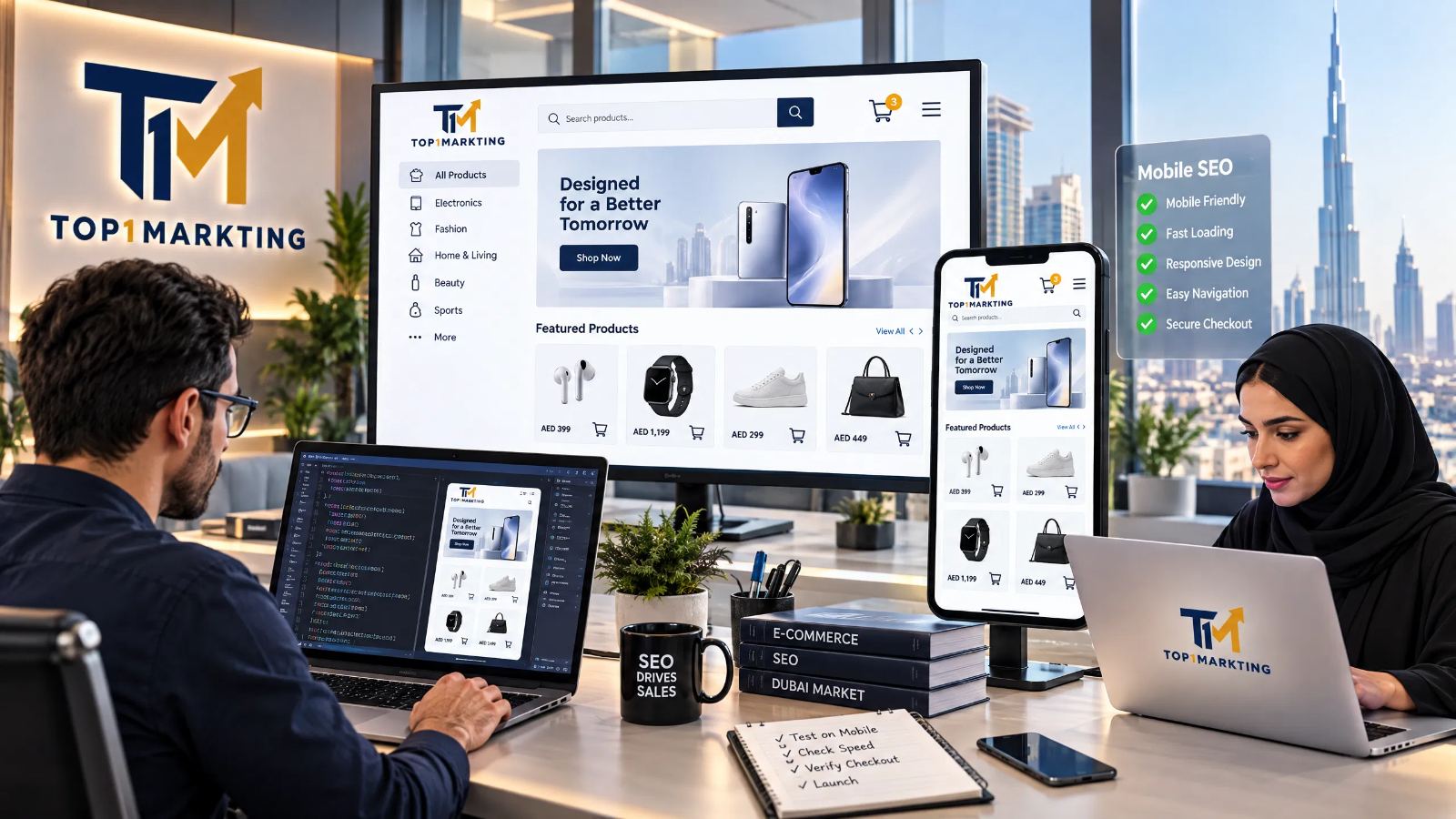
After building product and category pages and connecting them through internal links, you need to make sure Google can discover these pages and understand how the e-commerce store in Dubai is organized.
This is where elements such as Sitemap, Robots.txt, Canonical, and the management of filter and internal search pages become important.
Sitemap for Products and Categories
The Sitemap should reflect the important pages you want search engines to discover and index.
Important considerations include:
-
Ensuring important product and category pages are included.
-
Excluding useless pages or pages that do not need to appear in Google.
-
Updating the Sitemap when products or categories are added.
-
Making sure URLs in the Sitemap work and point to the correct pages.
For a store targeting Dubai, the Sitemap should help Google discover products and categories that provide genuine value to customers.
Robots.txt
Robots.txt should be used carefully because preventing Google from accessing an important page can affect its ability to discover and understand it.
Therefore:
-
Do not block pages Google needs to access.
-
Review Robots.txt when changing the store platform.
-
Make sure important products and categories are not blocked from crawling.
-
Review the file after major technical changes to the store.
Top1Markting reviews these settings as part of the technical audit of e-commerce stores in Dubai to reduce potential crawling and indexing barriers.
Canonical
When a store contains similar versions of pages, variations, or URLs with parameters, the primary page should be identified appropriately.
Canonical can help with:
-
Identifying the primary page when similar versions exist.
-
Handling some variation scenarios depending on the store structure.
-
Reducing conflicts between similar pages.
-
Directing search engine signals toward the primary page.
However, Canonical is not a solution to every e-commerce SEO problem and should be used as part of a clear page-structure strategy.
Managing Filter and Internal Search Pages
An e-commerce store can generate a huge number of URLs through filters, sorting options, and internal search.
If all of these URLs are left indexable without a strategy, the result may be millions of URLs that provide no meaningful value in Google Search.
Therefore, determine:
-
Which filter pages have genuine search value.
-
Which pages should remain outside the index.
-
How sorting and filtering parameters should be handled.
-
Which pages genuinely deserve visibility for customers in Dubai.
The goal is not to block all filter pages, but to identify those that provide real value to searchers and customers.
Product Schema: How Can You Give Google Clearer Product Information?
Schema markup helps provide structured information about products that actually exist in the store. Therefore, the data used should be accurate and consistent with the content on the page. Google notes that Product structured data can help product pages become eligible for richer search experiences, including information such as price, availability, and reviews when applicable.
Product Schema
Structured product data can include information such as:
-
Product name.
-
Product image.
-
Price.
-
Availability.
-
Actual product information displayed on the page.
This helps Google understand product information in a structured way, but the implementation should be based on real data available on the store.
Review and Rating When They Are Genuine
If the store contains genuine customer reviews and ratings, appropriate structured data can be used according to how they are actually displayed.
However:
-
Do not add reviews that do not exist.
-
Do not invent ratings to improve the appearance of the result.
-
Use real data only.
-
Make sure ratings shown in Schema actually exist and are understandable on the page.
Why Should Schema Data Match the Page?
Schema should reflect information actually available on the product page. Its purpose is to help Google understand the page, not provide information that differs from it. Google also recommends validating structured data and ensuring important product pages are accessible and not blocked by robots.txt, noindex, or login requirements.
Therefore:
-
Avoid conflicts between the price shown on the page and the price in Schema.
-
Keep availability information consistent.
-
Use real product data.
-
Do not add information that does not exist.
-
Do not use Schema as a way to stuff keywords or false information.
This is an important technical component that Top1Markting can implement as part of e-commerce SEO in Dubai.
Local Content for a Dubai E-Commerce Store: When Is It Useful and When Does It Become Keyword Stuffing?
Local content can be highly useful for an e-commerce store targeting Dubai when it is based on genuine customer needs. Simply repeating the name Dubai throughout pages does not make a store more relevant to the local market.
Therefore, local content should be connected to the products and services the store actually provides in Dubai.
When Does an E-Commerce Store Need Local Content?
Local content can be useful when the store has a genuine connection with the Dubai market, such as:
-
Product-related searches in Dubai.
-
Different customer needs within the local market.
-
Delivery within Dubai.
-
Questions or information related to purchasing products in Dubai.
-
Seasons or events that genuinely influence customer demand in Dubai.
Top1Markting helps identify local topics that can add genuine value rather than creating content simply to add the word Dubai.
What Type of Content Can Serve Customers in Dubai?
An e-commerce store can build supporting content that helps customers before making a purchase, such as:
-
Product selection guides.
-
Product comparisons.
-
Answers to purchasing questions.
-
Product usage guides.
-
Dubai delivery information when it is genuinely part of the service.
-
Content related to seasons and actual customer needs in Dubai.
-
Content explaining product differences and helping customers choose the right option.
This content should be connected to products and categories that actually exist in the store so it can be internally linked to important commercial pages.
What Should You Avoid?
To keep local content useful for an e-commerce store in Dubai, avoid creating pages purely to target local keywords.
Important things to avoid include:
-
Repeating the word "Dubai" dozens of times on a page.
-
Creating general articles unrelated to the store's products.
-
Creating area pages that provide no real customer value.
-
Copying the same content and changing only the location name.
-
Creating multiple pages targeting the same search intent without meaningful differences.
-
Adding local information that the store does not actually provide.
The rule Top1Markting follows is that every piece of local content should be connected to a real product, a real need, and a real search performed by customers in Dubai. This makes local content part of the store's SEO strategy rather than simple keyword stuffing.
Does Your E-Commerce Store in Dubai Need Local SEO?
Not every e-commerce store in Dubai needs the same level of focus on Local SEO. The decision depends on the business model, sales method, and whether the store has an actual physical presence in Dubai.
Before dedicating store pages to local keywords, determine whether customers choose the business because of its location in Dubai or because they are simply searching for the product itself.
When Is Local SEO Useful for an E-Commerce Store?
Local SEO is useful when the business has a genuine connection with customers in Dubai rather than simply adding "Dubai" to store pages.
If you have a physical location in Dubai that receives customers, it is important for location information to be clear and consistent across the website and other digital platforms.
The same applies to stores that have a showroom or physical store that customers can visit or use to collect orders.
Local targeting can also be important when there is a pickup point in Dubai or when the store provides a local service connected to the city, such as delivery within Dubai, installation, maintenance, or product-related services after purchase.
Local SEO becomes even more important when the business depends on customers near its physical location. In this situation, the goal is not simply to appear when someone searches for a product, but to appear in front of a customer in Dubai looking for a product or store they can deal with locally.
This can be supported by a strategy such as Local SEO in Dubai when the business is genuinely eligible for local search targeting.
When Is Local Targeting Not the Priority?
If the store operates entirely online without a genuine local presence, it does not make sense to build an entire SEO strategy around geography simply because the store wants visibility in Dubai.
Likewise, if the business targets a broader market and does not depend only on customers in Dubai, the priority may be improving product and category pages and building a strong structure that helps Google understand the store generally.
In some cases, the priority is simply the product pages themselves. If a customer in Dubai searches for a specific product, a well-optimized product page may be more valuable than creating many local pages.
Therefore, every page should not be converted into a Dubai-targeted page. Local signals should be used where they genuinely support the customer experience and business model.
Google Business Profile and an E-Commerce Store
If the business has a qualifying physical presence in Dubai, Google Business Profile can be an important part of its local presence.
Business information should be clear and consistent, including the business name, location, contact information, and website.
There should also be consistency between the information in Google Business Profile and the website, especially when the website provides a branch, store, or pickup-point address.
If the store operates online only and has no qualifying physical presence, it should not create a fake local presence or use an inaccurate address to gain local visibility.
With Top1Markting, Local SEO is treated as part of the store strategy when the nature of the business and its customers in Dubai actually require it, rather than as a superficial addition of local keywords.
How Can You Make Your Dubai Store Understandable in Search and AI?
Store visibility in search does not depend on keywords alone. Information within the store should be clear and organized so that search engines and AI systems can understand the business, products, categories, and target audience.
This is where GEO can complement SEO, particularly when the goal is to make store information easy to understand and retrieve across different search environments.
Where Does GEO Fit Into E-Commerce?
GEO begins with organizing product information clearly. Systems should be able to understand what the product is, what it is used for, which category it belongs to, and what information customers need before making a purchase.
The store should also clearly define categories instead of placing products in a random structure that makes relationships between products and categories difficult to understand.
It is also useful to provide direct answers to questions customers in Dubai may ask, such as how a product is used, how products differ, when a particular product is suitable, and what customers should know before purchasing.
This can be supported by creating useful content around products rather than writing general articles that add little value. The best content helps customers understand a product, compare options, or make a purchase decision.
Likewise, specialized pages that are easy to understand can clarify the store's subject, whether they are category pages, product pages, buying guides, or pages explaining product uses.
Is GEO a Replacement for SEO?
No. GEO is not a replacement for SEO. It builds on a technical and content foundation that helps search engines access and understand store pages.
The foundation starts with an organized, indexable website and store, clear product and category pages, strong internal linking, and accurate information.
The next step is developing content that is clear and useful across different search environments, whether the user searches traditionally on Google or uses AI-powered tools to obtain an answer or recommendation.
Therefore, creating GEO-specific content is not useful if the product pages themselves are weak or inaccessible to search engines. For Top1Markting, the goal is to build a strong store foundation and then improve how information is presented so that it is understandable to customers, search engines, and AI systems.
What Information Should Be Clear About the Store?
Any search system or customer should be able to understand the store quickly through clear and direct information such as:
-
What does it sell? Clearly explain the products and services offered.
-
Who does it sell to? Identify the type of customers the products target.
-
What are the categories? Organize products into understandable categories.
-
What are the main products? Highlight the products or categories that represent the core business.
-
Where does it serve? Clarify the service or delivery area, especially when targeting customers in Dubai.
-
What makes the store different? Explain genuine advantages such as specialized products, fast delivery, or a particular service.
The clearer and more connected this information is throughout the store, the easier it becomes for search engines and intelligent systems to understand the business and associate its pages with relevant queries.
You can explore this further through GEO in Dubai to understand how to build a clear digital presence suited to the evolution of search and AI.
Dubai Stores Do Not Compete on Google With Keywords Alone
When comparing an e-commerce store with other stores targeting customers in Dubai, you should not only look at the keywords competitors use. Real competition on Google begins with the quality of the store, how products are organized, the information customers receive, and how easy it is to complete a purchase.
Real Competition Starts With Product Page Quality
A competitor in Dubai may rank because it has better product pages, not simply because it uses a keyword more frequently.
A strong product page explains what the product is, its specifications, uses, price, availability, and answers the questions customers need to know before purchasing.
Another competitor may outperform the store because it has better-organized categories, making products easier for customers to find and helping Google understand the relationship between categories and products.
A store can also outperform competitors by providing more useful information. When customers can find the details they need on one product page without moving between several pages, that page can be more useful than a competing page containing a short and repetitive description.
Shopping experience and speed also matter. If a store in Dubai provides a faster and easier mobile experience, it may be better positioned to turn visits into purchases than a store with a complicated or slow experience.
Therefore, when developing a store targeting the Dubai market with Top1Markting, the goal is not simply to add keywords, but to improve the entire store so that it provides genuine value to customers.
What Should You Check When Analyzing a Competitor's Store in Dubai?
Competitor analysis should be practical rather than simply comparing keywords.
Start by reviewing categories to see how the competitor divides its products and whether customers can easily find what they need.
Then review the product pages themselves: title structure, amount of information, specifications, questions, prices, availability, and images.
Review page titles to understand how products are presented in search results, then examine the content to determine whether the competitor provides useful information or relies on short, repetitive descriptions.
Images are also important, especially for stores that depend heavily on visual product presentation. Review image quality, size, and placement.
Then examine internal linking between categories, products, and other pages, because the link structure shows customers and search engines how different parts of the store relate to each other.
Do not forget mobile experience, since a customer in Dubai may enter the store from a phone and need to reach the product and complete the purchase without complicated steps.
Finally, review the competitor's local content when the business has a genuine connection with the Dubai market, such as Dubai delivery pages or local service information.
Do Not Try to Copy the Competitor's Store Completely
The goal of competitor analysis in Dubai is not to copy a successful store, but to discover opportunities that can make your store better.
Start by finding content and product gaps: What information does the competitor not provide? What questions does it not answer? Are there products or categories that are not explained properly?
Then look for underserved search intent. A customer in Dubai may be looking for a comparison between two products, a product-use guide, or an answer to a question before purchasing, while the competitor provides no clear answer.
Then develop your pages based on genuine value. Do not add content simply to have more words. Every addition should help customers understand a product, find it, or make a purchase decision.
This turns competitor analysis into a way to discover new opportunities in the Dubai market rather than simply trying to appear in the same way as competitors.
E-Commerce Store Mistakes That May Prevent Products From Appearing on Google
Even with good products and suitable keywords, technical and content problems can make it harder for products to appear on Google.
Therefore, the entire store should be reviewed before relying on it to attract customers from Dubai.
All Products Use the Same Description
Using the same description for many products makes pages extremely similar and reduces their ability to provide unique information. Each product should have a description explaining its actual features, uses, and benefits.
Product Pages Are Not Connected to Categories
If product pages are isolated and there are no clear links between them and relevant categories, customers and search engines may have difficulty reaching them.
There should be a clear structure connecting categories to products and products to relevant categories.
Deleting Products Without Handling Links and Alternatives
Deleting a product permanently without considering links and traffic that previously reached it can create missing pages and cause the store to lose valuable opportunities.
When a product is discontinued, determine whether it will return, whether an alternative exists, or whether the URL needs an appropriate technical solution.
Frequently Changing Product URLs
Frequently changing product URLs can cause issues with internal links, redirects, and indexing.
It is better to choose a clear and stable URL structure from the beginning.
Allowing Filter Pages to Be Indexed Without a Strategy
Filter pages can generate large numbers of URLs and similar pages. Therefore, identify which pages deserve visibility on Google and which do not provide meaningful search value instead of allowing every possible combination to be indexed.
Having Many Products With Insufficient Content
A large number of products does not automatically make a store stronger in SEO.
If dozens of products contain little information or repetitive descriptions, increasing the number of pages alone will not be enough.
Slow Mobile Store
Slow-loading product pages can affect customer experience, especially when customers browse from mobile devices.
Heavy images, unnecessary software, and files loaded without need are among the elements that should be reviewed.
Blocking Google From Important Files or Pages
Some important product pages or files may become inaccessible because of Robots.txt settings, indexing errors, or other technical configurations.
Therefore, make sure the pages you want to appear are actually accessible to search engines.
Multiple Versions of the Same Product
Multiple URLs displaying the same product can create duplication and split signals.
The primary page should be identified and Canonical and internal links should be used consistently.
Creating Many Local Pages With No Value
Creating pages for every area or part of Dubai without genuinely different and useful content can turn local targeting into keyword stuffing.
A local page should be created only when there is a genuine reason and useful information for customers.
How Do You Prepare Your Dubai Store Before Launch?
Before publishing the store and targeting customers in Dubai, it is better to conduct a comprehensive audit covering store structure, technical SEO, product pages, mobile experience, and the searches customers perform.
Store Structure Audit
Start by reviewing Categories and making sure the main categories are logical and reflect the products the store sells.
Then review Subcategories where necessary and ensure products are placed in appropriate categories.
Next, inspect Products and make sure every important product can be reached through the store structure.
Review URLs to ensure they are clear and stable, then check Navigation to make sure customers can move from the homepage to a category and then to a product without unnecessary complexity.
Technical SEO Audit
Make sure a Sitemap exists and contains the important pages you want to index.
Review Robots.txt to ensure it does not prevent Google from accessing essential store pages or files.
Check Canonical, especially for products with Variations or multiple possible URLs.
Then review Indexability for all important pages and make sure important product or category pages do not have Noindex without a valid reason.
Finally, check Redirects to ensure old URLs or products whose URLs have changed are handled properly.
Product Page Audit
Every product page should undergo an individual review.
Make sure the Title is clear and accurately describes the product, and that the Description provides useful information rather than simply repeating the keyword.
Review Images to ensure they are clear and suitable for mobile display, then check Alt text so image descriptions are relevant to the actual content.
Schema should also be reviewed to ensure product information on the page is consistent with the structured data provided to search engines. Google recommends validating product structured data and monitoring it through Search Console after implementation.
Finally, price and availability information should be clear and updated, especially when the product is actually sold to customers in Dubai.
Mobile and Speed Audit
Do not only test page speed on desktop.
The store should be tested on mobile because a customer in Dubai may begin browsing from a phone and complete the purchase on the same device.
Review Core Web Vitals, then test Mobile UX to make sure menus, buttons, images, and product pages work comfortably.
Also check image sizes, since images are among the elements that can significantly affect product-page loading.
Then review JavaScript files, plugins, and functions loaded on the page and make sure unnecessary elements are not affecting performance.
Finally, test the entire Checkout process on mobile, from adding a product to the cart through completing the order, because speed alone is not enough if the purchasing process is complicated.
Keyword Audit for the Dubai Market
Before launching the store, review the keywords it is actually targeting.
Start with commercial keywords customers use when they are close to making a purchase, then review local keywords when the product or service has a genuine connection to Dubai.
Next, identify product-specific keywords describing what the store sells and distribute them across appropriate product and category pages instead of placing them all on the homepage.
Do not forget questions customers in Dubai search for before purchasing products. These questions can help improve product descriptions, buying guides, and supporting content.
With this review, Top1Markting can prepare the store before launch on the basis of a clear structure, strong product pages, sound technical SEO, and an experience suited to customers searching and purchasing from Dubai.
What Should You Do After Launching Your E-Commerce Store in Dubai?

Launching the store is not the end of the process. It is the beginning of the stage where real data shows how Google and customers in Dubai interact with the store.
After launch, products, pages, and organic search performance should be monitored continuously to understand what is working and what needs improvement.
Do Not Consider Store Launch the End of the Work
After launch, begin monitoring indexing to make sure Google can access important pages and include them in search results.
Then monitor products that appear to identify which products have started receiving impressions or clicks from searches in Dubai and compare that performance with their importance to the business.
At the same time, monitor pages that do not appear, especially product and category pages created to target important searches.
Failure to appear may be related to content, indexing, internal linking, or page quality.
You should also monitor search queries that trigger the store because real performance data may reveal keywords and phrases that were not part of the original plan. These can later be used to improve product and category pages.
With Top1Markting, the work does not end when the store is published. Performance data becomes the foundation for the next optimization decisions.
Which Pages Should Be Improved First?
It is not necessary to improve every store page at the same time. Priorities should be based on available data and opportunities.
Start with pages that receive impressions but few clicks. These pages may be close to generating real traffic, but their titles, descriptions, or search-result presentation may need improvement.
Then review pages that receive clicks but do not convert. At this point, move beyond SEO and examine user experience to determine whether the product page encourages customers to complete their purchase.
Also identify important product pages that receive little or no visibility. If a product represents an important part of store sales, determine why it has weak visibility and improve its content, structure, and internal linking.
Finally, review categories with growth potential and develop them through better content, internal linking, and product organization, especially when there are signs of relevant search demand in Dubai.
How Do You Know That Optimization Is Working?
Do not measure e-commerce SEO success based on the ranking of one keyword alone.
Important indicators include an increase in the number of important indexed pages. The goal is not to increase the number of pages randomly, but to ensure that pages deserving visibility are indexable.
Also monitor new search terms related to the products and categories targeted by the store.
Then track improvements in rankings for targeted commercial terms and searches customers in Dubai perform.
As visibility improves, you should begin to see more clicks from search results.
But the most important indicator for an e-commerce store is an increase in commercial traffic—traffic from people who have genuine interest in the product and can become customers.
Ultimately, this should be connected to improved conversions. If traffic increases without any improvement in orders, another part of the customer journey needs to be reviewed.
How Do You Connect SEO to Sales Instead of Traffic Alone?
The goal of SEO for an e-commerce store in Dubai is not to collect the largest possible number of visits. It is to reach customers searching for the products the store sells and turn those visits into purchases.
Does More Traffic Mean the Store Is Successful?
Not necessarily.
A store may receive thousands of visits from searches unrelated to the products it wants to sell. In that case, traffic increases while sales remain unchanged.
The more important objective is getting the right customer to the right product.
When a customer enters a product page from Google because they are genuinely searching for that product, the chance of conversion is higher than with a general visit that does not show clear purchase intent.
Therefore, evaluate keywords and pages not only by the amount of traffic they generate, but also by the quality of that traffic and how closely it relates to the products the store targets in Dubai.
Monitor the Customer Journey From Google to the Product
The entire customer journey should be considered rather than only the search result:
Google → Category or Product Page → Product View → Add to Cart → Checkout → Purchase
First, the customer searches Google for a product or category. Then they enter the category or product page that appears.
If the page matches search intent, the customer starts viewing the product, reading information, checking the price, images, and details.
Next comes Add to Cart, followed by Checkout and payment.
Each stage can reveal a different problem.
If traffic is low, the problem may be SEO.
If traffic is good but customers do not engage sufficiently with products, the issue may be the page.
If products receive views and cart additions but no purchases, the checkout process, trust, shipping, or offer should be reviewed.
What Should You Do If Visibility Improves but Sales Do Not?
If Google visibility improves and clicks from customers in Dubai increase but sales do not, this does not necessarily mean SEO failed. The problem may occur after the customer reaches the website.
Start by reviewing the product-page experience. Is the information clear? Are the images suitable? Does the customer understand what they will receive? Does the page answer questions that might prevent a purchase?
Then review price and offer, because the customer may arrive from Google and discover that the price or offer does not match expectations.
Next, review trust, including clear store information, return and exchange policies, contact details, and information customers need before payment.
You should also review shipping, especially if the store targets customers in Dubai. Clear shipping costs, delivery times, and service areas can directly influence purchasing decisions.
Then review payment and make sure checkout is clear, easy, and free from unnecessary steps.
Also test CTA elements and ensure buttons such as Add to Cart and Buy Now are clear and easy to access on mobile.
Finally, review store speed and the entire mobile experience. A customer may arrive from Google at a product page, but slow loading or complicated browsing and checkout can cause them to leave before completing the purchase.
For this reason, Top1Markting treats SEO as part of the complete sales journey rather than an isolated method for increasing traffic. The real result for an e-commerce store in Dubai is to bring the right customer to the right product and provide an experience that helps them complete the purchase.
How Can Top1Markting Optimize an E-Commerce Store in Dubai for Search Engines?
Optimizing an e-commerce store in Dubai for search engines does not begin by simply adding keywords to product pages. It starts with understanding the store structure and how customers reach products, then improving technical elements, content, and user experience as an integrated system.
With Top1Markting, the optimization process starts by auditing the store's current situation, identifying problems and opportunities, and then implementing improvements that help important products and categories appear in front of customers searching in Dubai.
Store Audit Before Optimization
Before making changes, the store structure is reviewed to understand how pages, categories, and products are organized and how easily customers can move between them.
Then products are reviewed to identify important pages, products that need improvement, and pages containing duplicate or insufficient content.
Next, categories are analyzed to make sure they are logical and help customers and search engines understand the products within each category.
Indexing is also reviewed to identify which pages appear in Google and which do not and to make sure there are no barriers preventing access to important pages.
The audit also includes speed and performance, followed by mobile usability, ensuring that customers in Dubai can browse products, add items to the cart, and complete purchases easily.
Improving the Store and Products From the Inside
After identifying problems, the internal optimization stage begins.
Category structure is organized so that categories are clear and scalable as the number of products grows.
Product pages are improved in terms of titles, descriptions, information, images, and the elements customers need before purchasing.
Keywords are distributed across appropriate pages according to how customers in Dubai search rather than repeating the same terms across every store page.
Content is developed to provide useful and unique information about products and categories while avoiding repetitive descriptions and keyword stuffing.
Internal linking is improved between categories, products, and related pages so customers and search engines can move easily through the store.
Product Schema and other important structured data are reviewed to ensure they match the page content. Google supports Product, merchant listing, and product-variant structured data for relevant e-commerce pages when the requirements are met.
Finally, Sitemap and Canonical settings are reviewed to ensure search engines can understand the store's primary pages and properly handle multiple versions, products, and categories.
Designing and Developing the Store With SEO From the Beginning
The best time to prepare an e-commerce store for search engines is during design and development, not after completion.
The store can therefore be built with a scalable structure capable of supporting new products and categories without becoming a collection of disorganized pages.
SEO is also considered during development, with attention to URL structure, indexing, performance, and access to important pages.
The product and category structure is prepared from the beginning to support organized growth as the business expands in Dubai.
The process is not limited to search engines. User experience is also improved because a successful store should be clear, fast, and easy to use on both mobile and desktop.
Top1Markting provides e-commerce store design and development and SEO optimization for e-commerce stores in Dubai, so search visibility is considered from the store-building stage rather than creating a store first and attempting to fix SEO problems after launch.
Contact: +971507662114
Practical Questions Before Optimizing Your E-Commerce Store in Dubai
Should I Start by Optimizing Products or Categories?
It depends on the store structure, product priorities, and the types of searches the business targets in Dubai.
If there are major products representing most of the business, product pages may be the priority.
If the main problem is store organization and access to products, work may begin with categories and internal structure.
The important point is not to optimize pages independently, but to build a structure where categories and products work together.
Does Every Product Need a Different Keyword?
Not necessarily.
Several products may target closely related searches, but pages should not compete with one another without a reason.
The better approach is to determine which page targets each search intent and then use content and internal linking to clarify the relationship between products and categories.
Does Deleting Old Products Affect SEO?
It can, depending on the page status, links, traffic, and available alternatives.
Therefore, old products should not all be deleted in the same way.
Determine whether the product will return, whether there is a replacement product, whether the page needs a redirect, or whether it can remain available in an appropriate way for search engines and customers.
Do I Need a Page for Every Area in Dubai?
Not simply to target area names.
Creating a page for every area in Dubai adds little value if all pages are similar and do not provide different information or satisfy a genuine search intent.
A local page should be created when there is an actual reason, such as a service, delivery, physical presence, or information customers in a specific area need.
Can a New Store Compete With Older Stores in Dubai?
Yes, but competition does not depend on the age of the website alone.
A new store needs clear structure, precise targeting, useful content, and a strong user experience, along with a focus on products and pages that offer genuine growth opportunities.
Instead of launching large numbers of pages without a strategy, start with the most important products and categories and develop the store based on actual search and customer data in Dubai.
Should SEO Start After the Store Launches?
It is better to start SEO during the store design and development stage.
When SEO is considered early, the product and category structure, links, speed, and indexing can be prepared correctly from the beginning instead of rebuilding parts of the store after launch.
How Do I Know if My Store Is Ready for Indexing?
This requires reviewing several essential elements, including store structure, indexing, links, products, Sitemap, Robots.txt, Canonical, and structured data.
You should also make sure important pages are accessible and that Google can discover products and categories and understand their relationships.
After that comes post-launch monitoring to determine which pages have been indexed, which products have started appearing, and which searches are bringing visits from customers in Dubai. These insights can then be used for continuous optimization.
Start Optimizing Your E-Commerce Store in Dubai With Top1Markting
If you want to build an e-commerce store in Dubai or improve an existing store so it performs better on Google and reaches customers searching for your products, Top1Markting can help you design and develop the store, prepare its structure, and optimize its SEO from the beginning.
Top1Markting — E-Commerce Store Design & Development and E-Commerce SEO in Dubai
Contact: +971507662114