
SEO Company in Madinah to Improve Website Visibility on Google | Top1Markting
Owning a website is not enough on its own to attract customers. Your website needs to achieve suitable visibility in search results so that people looking for your services or products in Madinah can find it. Your business may have a professionally designed website, yet it may fail to generate targeted traffic due to poor indexing, page structure issues, unsuitable keyword targeting, or content that is weaker than that of competing websites.
An SEO company in Madinah can help you address these challenges by analyzing your website, identifying optimization opportunities, and developing an action plan that suits your business and target audience. SEO management includes reviewing technical aspects, optimizing service and product pages, developing content, organizing internal links, analyzing competitors, and monitoring website performance on Google. The goal is not simply to add keywords, but to optimize the website as a whole so that it can reach people who are genuinely interested in what you offer.
Top1Markting provides search engine optimization and SEO management services for websites, online stores, and businesses. Our work begins with analyzing the current situation and identifying issues and opportunities, then proceeds to implementing improvements and monitoring performance according to a plan tailored to each project. We also consider content structure and optimization for search engines and AI-powered search experiences through GEO, based on the nature of the website and the business objectives.
If you are looking for a specialized company to improve your website's visibility in Madinah, contact Top1Markting at 0549881368 to request a website analysis, discuss opportunities for development, and identify the services that suit your business needs.
Choosing an SEO Company in Madinah to Manage Your Google Visibility
Choosing an SEO company in Madinah should not depend solely on price or promises of quick results. It requires evaluating the company's working methods, the services included, and how closely they align with your business objectives. Search engine optimization management requires an understanding of the website, target audience, and competitive landscape, followed by identifying the tasks that need to be completed and monitoring their impact on page performance.
When comparing SEO companies, it is important to find out whether the service provider starts by analyzing your website, develops a clear strategy, establishes implementation priorities, and provides reports that help you understand the work completed. The scope of the agreement should also be clearly defined so that you know which pages and tasks are included and what responsibilities your team will have.
Top1Markting identifies website requirements according to the nature of the business and its target services, organizing SEO activities into a plan covering technical aspects, content, keyword research, and performance monitoring. You can request an initial assessment of your website's needs before deciding which services are appropriate.
Criteria for Choosing an SEO Company in Madinah
When looking for an SEO company in Madinah, start by understanding how it approaches your website before signing an agreement. A professional company does not offer the same plan to every business. Instead, it reviews the current situation and identifies tasks that match the website's nature and objectives.
The most important evaluation criteria include:
-
Understanding your business: Make sure the company understands the services or products you offer, your target customers, and the competitive landscape in your industry.
-
Website analysis before implementation: Reviewing pages, indexing, technical structure, content, and internal links to identify issues and optimization opportunities.
-
Setting priorities: Explaining which issues need to be addressed first, which pages should be developed, and which tasks can be completed in later stages.
-
Clear scope of work: Understanding what the service includes, such as technical audits, content optimization, keyword research, and monitoring, as well as what requires your team's approval or involvement.
-
Understandable reports: Receiving reports that explain completed tasks, changes in performance indicators, and issues requiring further attention.
It is also useful to understand which tools are used to analyze the website, such as Google Search Console and performance and crawling tools. However, these tools only help collect data; they do not replace analyzing that data and making appropriate decisions.
The Difference Between a Full-Service SEO Company and a Limited Service Provider
There is a difference between hiring a provider for an individual task, such as analyzing a group of keywords or writing content for one page, and hiring an SEO management company in Madinah to coordinate multiple related optimization activities.
A limited service provider may be suitable when you need a specific task, such as fixing a technical error or optimizing a particular page. Full-service management, on the other hand, is more suitable for websites that require several areas of optimization to be monitored and coordinated within one strategy.
Comprehensive SEO management may include:
-
Auditing and analysis: Reviewing the website and identifying technical issues and weaknesses in its pages.
-
Technical optimization: Addressing crawling, indexing, links, and performance issues according to the website's requirements.
-
Keyword research: Selecting search terms related to your services and classifying them according to search intent.
-
Content optimization: Developing service pages, product pages, and supporting content according to website objectives.
-
Competitor analysis: Studying competing pages and identifying opportunities to stand out and fill content gaps.
-
Monitoring and reporting: Reviewing performance, evaluating completed tasks, and identifying the next steps.
Not every project necessarily needs all these services. A website may only require a specific technical fix or optimization of commercial pages. Therefore, the scope of management should be determined according to the analysis results, business objectives, and available budget.
Comparing SEO Company Proposals in Madinah Before Signing a Contract
When comparing SEO company proposals in Madinah, do not focus only on the final price. Review the service details and the deliverables you will receive. Two proposals with similar prices may include completely different scopes in terms of page numbers, tasks, reporting, and follow-up.
You can compare proposals by reviewing the following elements:
-
Number of included pages: Does the proposal cover the entire website or specific pages, such as the homepage, services, and products?
-
Auditing and analysis: Does it include an initial website audit, keyword research, and competitor analysis?
-
Adjustments and implementation: Does the proposal include implementing improvements or only providing recommendations? What are the limits of the available modifications?
-
Content optimization: Does it include reviewing existing content or developing new content? Which pages are covered?
-
Reports: Which indicators will be monitored, and what information will the reports provide?
-
Contract duration and scope: Which tasks will be completed during the contract period, and how will additional work be handled?
Ask for clarification about the expected deliverables at each stage. Make sure you understand which tasks are your company's responsibility, such as providing business information, approving content, or granting access to analytics tools. This approach helps you choose a proposal that suits your website's needs instead of relying on price alone.
Questions to Ask an SEO Company Before Signing a Contract
Before hiring an SEO company, it is useful to ask direct questions that help you understand the work plan, cooperation process, and performance measurement methods. Clear answers reduce differences in expectations and help you understand what you will receive within the agreed service scope.
Important questions include:
-
What tasks will be performed on the website during the contract period?
-
Will the plan include website analysis, keyword research, and competitor analysis?
-
Which changes can be implemented directly, and which require approval from our team?
-
Will the service include optimizing service and product pages, or only technical aspects?
-
Which performance indicators will be monitored, and how will changes be interpreted?
-
What reports will we receive, and what information will they explain?
-
How will new issues or changes that arise during the project be handled?
-
Which tasks are outside the scope of the current proposal?
It is also important to understand that SEO performance indicators are not limited to keyword rankings. They may include page impressions, clicks, organic traffic, user behavior, and conversions when suitable measurement data is available. Ask the company how these indicators will be connected to your business objectives.
SEO Services in Madinah to Improve Website Performance
Website requirements vary according to the nature of the business and the website's current condition. Therefore, SEO services include several activities that can be coordinated according to priorities rather than implemented randomly. These services help address issues that limit search engines' ability to discover and understand pages, while improving the content that presents your company's services or products to potential customers.
Top1Markting provides SEO services in Madinah for websites and online stores. The scope of work can be determined by analyzing the website and identifying target pages and keywords related to the business. Depending on the project's needs, the agreement may include a website audit, keyword and competitor analysis, page optimization, or ongoing SEO management and monitoring.
Website SEO Audit and Identification of Optimization Opportunities
An SEO audit is an important step in understanding a website's condition before implementing improvements. It helps identify issues that may affect crawling, indexing, user experience, and content organization.
A website audit may include:
-
Reviewing indexing status and identifying important pages that do not appear in search results.
-
Checking whether search engines can crawl essential pages and resources.
-
Reviewing page structure, headings, and internal links.
-
Analyzing content quality and its relevance to each page's topic.
-
Checking broken links, redirects, and technical errors.
-
Reviewing performance indicators and page loading speed.
-
Identifying opportunities to improve service pages, product pages, and supporting content.
Audit results provide a clearer picture of the website's condition. Issues can then be prioritized according to their importance and potential impact. Identifying an issue does not mean that implementing a change will automatically increase traffic. Results depend on the nature of the issue, competition, implementation quality, and other factors.
Keyword and Competitor Analysis
Keyword research helps identify the search terms customers use when looking for the services or products your business offers. Competitor analysis also reveals the types of pages appearing in search results, the topics they cover, and opportunities that can be explored to improve your website.
Analysis activities include:
-
Extracting keywords related to the business's actual services and products.
-
Studying the search intent behind each keyword group.
-
Distinguishing between informational, commercial, and transactional keywords.
-
Analyzing long-tail keywords that express more specific needs.
-
Reviewing competing pages and how their content is organized.
-
Identifying topics and search terms that your website does not cover adequately.
-
Assigning keywords to suitable pages to avoid unnecessary overlap.
Keywords are selected based on their relevance to the business, commercial value, and suitability for the target pages, rather than search volume alone. A keyword that attracts someone interested in a service your company provides may be more valuable than a general term that generates traffic unrelated to your website's objectives.
Optimizing Service and Product Pages
Service and product pages need organized content that explains what the company offers or what makes a product distinctive. They should also help search engines understand the page topic and its relevance to targeted search queries.
Page optimization may include:
-
Developing page titles that naturally reflect the page topic and target keyword.
-
Improving headings and organizing information within the page.
-
Reviewing service and product descriptions and clarifying important details.
-
Improving meta descriptions to support how pages appear in search results.
-
Reviewing images, filenames, and alt text when needed.
-
Adding internal links between related pages.
-
Organizing content to help visitors find information and take appropriate action.
Optimizing website pages is different from redesigning the website. A page may need improvements to its content, headings, and links without requiring changes to the website's appearance. Other issues may require design or programming work. The appropriate approach is determined after reviewing the page and its underlying structure.
SEO Management and Monitoring Optimization Activities
Website SEO management does not mean implementing a group of changes and then leaving the website without further review. It requires organizing tasks, monitoring completed work, evaluating data, and updating priorities when new requirements arise.
Management may include:
-
Preparing an action plan that explains tasks and implementation priorities.
-
Organizing technical auditing, optimization, and content activities.
-
Monitoring changes implemented on website pages.
-
Reviewing indexing status, visibility, and clicks through available analytics tools.
-
Monitoring priority pages and keywords.
-
Evaluating performance changes and identifying areas that need further development.
-
Preparing reports that explain completed tasks, observations, and next steps.
The effectiveness of SEO management depends on consistent implementation and cooperation between the parties responsible for the website, whether that involves approving content, providing access permissions, or implementing programming changes that require technical support.
Website Analysis in Madinah to Identify the Causes of Poor Google Visibility
If your website is not appearing as expected in search results, it is important to identify the reason before changing content or adding new keywords. The issue may be related to important pages not being indexed, crawling errors, poor mobile experience, overlapping page topics, or content that does not match search intent.
Website analysis for improving Google visibility helps examine these aspects and connect available data to actual issues instead of relying on assumptions. Top1Markting begins by reviewing the website's condition and identifying areas that deserve attention, then organizes them into an actionable optimization plan according to each issue's importance and the project's available resources.
Checking Website Page Indexing and Identifying Pages That Do Not Appear
Indexing reviews help identify which pages Google has included in its index and which pages have not been indexed or have been excluded for various reasons. This step is particularly important when a website contains essential service or product pages that do not appear in search results.
The indexing audit includes:
-
Reviewing the indexing status of important pages using Google Search Console.
-
Identifying indexed and excluded pages.
-
Reviewing the reported reasons for non-indexing or exclusion.
-
Ensuring that important pages can be crawled and indexed.
-
Reviewing indexing signals, such as noindex tags and XML sitemaps when necessary.
-
Verifying that pages that should not appear in search results are intentionally excluded.
Not every excluded page represents an error. Some pages may be duplicated or unnecessary in search results. Each case should therefore be evaluated according to the page's purpose and importance within the website before determining the appropriate action.
Identifying Crawling Errors, Broken Links, and Unavailable Pages
Search engines may have difficulty accessing certain website pages because of broken links, incorrect redirects, or server response errors. These issues can affect page discovery and website structure when they involve important pages or links.
Technical error reviews include:
-
Identifying 404 error pages and reviewing the links that lead to them.
-
Checking redirects and ensuring that old URLs point to appropriate destinations.
-
Reviewing broken internal links that prevent users and search engines from navigating between pages.
-
Checking HTTP response codes for important pages.
-
Reviewing server errors that may prevent access to the website or some of its resources.
-
Ensuring that links to essential service and product pages work correctly.
Each issue is handled according to its cause. Some cases may require fixing a link, while others may need an appropriate redirect or a review of server settings. Not all crawling errors should be handled in the same way, because some may relate to pages that are intentionally excluded or no longer needed.
Reviewing Website Speed and Mobile Experience
Page loading speed and ease of use affect visitor experience, especially when browsing from a mobile device. Therefore, SEO reviews include checking page performance and identifying elements that may cause delays or interfere with interaction.
Review activities include:
-
Analyzing Core Web Vitals for pages with available data.
-
Checking image sizes and loading methods.
-
Reviewing programming files and resources that affect loading time.
-
Checking elements that may delay content display or page responsiveness.
-
Reviewing design compatibility with mobile phones and tablets.
-
Testing important pages, such as the homepage, service pages, product pages, and contact forms.
Resolving performance issues may require optimizing images, modifying code, reviewing hosting, or reducing unnecessary resources. The appropriate action is determined according to the audit results. Improving speed alone does not guarantee a specific search ranking.
Analyzing Competing Pages and Content Gaps
A website may contain several pages covering similar topics, or it may lack pages addressing important services that customers are searching for. Analyzing pages and content gaps helps identify these situations before creating new content or modifying existing pages.
The review includes:
-
Identifying pages targeting similar keywords or topics.
-
Evaluating whether each page has a distinct purpose and content.
-
Identifying topics and services that are not adequately covered.
-
Comparing target-page content with competing pages.
-
Discovering opportunities to develop service pages and supporting content.
-
Checking for possible Keyword Cannibalization when multiple pages compete for similar search queries without clear differentiation.
Similar keywords or topics do not necessarily mean that pages are competing harmfully. More than one page may be necessary if each serves a different purpose. Decisions should therefore be based on search intent, page function, and content differences.
Setting Repair Priorities and Preparing an Actionable Optimization Plan
After completing the website analysis, the next step is to turn the findings into a clear action plan. The objective is not simply to provide a long list of errors, but to determine what should be implemented first, what can be postponed, and what requires approval or additional resources.
Priorities are organized according to several factors:
-
Issue importance: Its potential impact on essential pages or search engine accessibility.
-
Potential impact: How closely the fix is related to improving user experience, addressing a technical obstacle, or developing an important commercial page.
-
Implementation difficulty: The time and resources required to resolve the issue.
-
Dependencies: Whether implementation requires programming changes, approval from another team, or an external integration.
-
Business priority: How closely the page or service is connected to the company's commercial objectives.
Based on these factors, an SEO Roadmap is prepared, including proposed tasks, their order, and expected deliverables. It also clarifies which tasks require implementation by the website team and which can be handled by the SEO company. The plan remains open to review according to implementation results and new data, without promising a guaranteed ranking or fixed visibility timeline.
Keyword Research and Search Intent Analysis to Target the Right Customers
A successful SEO strategy does not depend on targeting as many keywords as possible. It depends on selecting the terms potential customers use when searching for the services or products your business offers. One person may be looking for general information, while another is comparing specialized companies or searching for a provider to carry out a specific service. Each situation requires a different page and content approach.
Keyword research services in Madinah help identify terms related to your business, classify them according to search intent, and distribute them across website pages in an organized way. The goal is to attract the right searcher to the page that addresses their needs and explains the service available to them.
Selecting Keywords Related to Your Business Services
Keyword Research begins with understanding what the business offers, then extracting the search terms customers may use to find those services. Keywords should not be selected based only on keyword research tools. Their actual relevance to the company's offering and target audience must also be verified.
The selection process includes:
-
Listing the services and products offered by the business.
-
Identifying the problems and needs customers are searching for solutions to.
-
Collecting the terms audiences use when searching for each service.
-
Reviewing keywords related to the business's specialties and target customer groups.
-
Studying search phrases that combine a service with a city or area when local intent is present.
-
Excluding keywords unrelated to the business or its website objectives.
This analysis helps build a list of genuinely relevant keywords instead of targeting broad terms that may generate traffic without producing inquiries or business opportunities.
Classifying Keywords According to Commercial and Transactional Intent
Search intent varies from one keyword to another, even when the terms relate to the same topic. Some users want basic information, others compare companies and solutions, while some are ready to contact a provider or purchase a service.
Search intent can be classified into:
-
Informational intent: The searcher wants to understand a topic or find an answer to a particular question.
-
Commercial intent: The searcher is comparing companies, services, or solutions before making a decision.
-
Transactional intent: The searcher is ready to contact a provider, request a quotation, or sign a service agreement.
-
Navigational intent: The searcher is looking for a specific website, company, or page by name.
Understanding Search Intent helps determine the appropriate page type. Transactional keywords generally require clear service pages containing implementation details and contact methods, while informational keywords may be better suited to articles explaining topics related to the business. High search volume does not necessarily mean that a keyword will generate customers. Search intent, service value, and relevance to business objectives must also be considered.
Building Keyword Clusters and Assigning Them to Website Pages
After collecting and classifying keywords, they are organized into topic groups to build a clear website structure. This process is known as Keyword Clustering. It helps determine which keywords can be targeted by one page and which require separate pages.
The organization process includes:
-
Grouping keywords that address the same service or similar needs.
-
Identifying the most suitable primary page for each group.
-
Assigning commercial keywords to service and product pages.
-
Allocating supporting articles to relevant informational topics.
-
Linking pages within topic groups through internal links.
-
Reviewing keyword and page overlap to avoid creating similar pages without a clear purpose.
This organization makes the website structure clearer to visitors and search engines. It also makes future content development easier without duplicating pages or scattering keyword targeting.
Analyzing Long-Tail Keywords and Lower-Competition Opportunities
Long-Tail Keywords are more specific search phrases than general keywords. They often express a clear need or a service with particular requirements. These terms may help reach searchers who have a more precise idea of what they want, especially when the phrases relate to a business type, service, or geographic location.
The analysis may include:
-
Identifying keywords related to specialized areas within the business.
-
Studying phrases that describe a specific problem or need.
-
Analyzing keywords that combine a service with a city or area.
-
Extracting terms that include a customer type or project requirements.
-
Reviewing whether each keyword matches an existing page or requires a new one.
A long keyword is not necessarily easy to rank for or guaranteed to achieve a particular position. Visibility opportunities are affected by content quality, competing website strength, and how well the page matches search intent. Each opportunity should therefore be evaluated according to available data and its relevance to business objectives.
Connecting Keywords to Business Objectives
A keyword strategy must be connected to the company's goals, whether it wants to increase contact requests, attract customers for a particular service, or support online store sales. Measuring success by the number of keywords targeted by website pages is not enough.
Keywords are connected to business objectives through:
-
Identifying services or products with commercial priority.
-
Evaluating how closely each keyword group relates to potential customer opportunities.
-
Assigning suitable pages to commercial and transactional keywords.
-
Optimizing landing pages to help visitors understand the service and take action.
-
Monitoring organic traffic, engagement, and contact requests when measurement tools are available.
-
Reviewing priorities according to performance data and changes in business needs.
This approach makes keyword research part of an SEO strategy connected to business objectives, rather than simply a list of terms distributed across website pages. Contact Top1Markting to discuss the priority keywords for your business and identify the pages that need improvement or development.
On-Page SEO in Madinah
On-Page SEO is an essential part of SEO services that helps clarify each page's content, organize the information it provides, and connect it to the needs of people searching for your company's services in Madinah. This work is not limited to adding keywords. It also includes reviewing titles, descriptions, content, images, and internal links while ensuring that each element supports the page's topic and purpose.
The optimization process begins by reviewing essential pages, such as the homepage, service pages, product pages, contact pages, and service request pages. We then identify the adjustments each page requires according to the business, competition, and target search intent. Top1Markting implements these improvements with a specialized approach, making pages clearer and better organized while providing visitors with the information they need before deciding to contact the company.
Optimizing Page Titles and Search Result Descriptions
Page titles and search result descriptions influence how a website appears on Google and help searchers understand a page before visiting it. Therefore, page optimization services include reviewing Title Tags and Meta Descriptions and writing them to reflect each page's topic and the service it actually provides.
We work on writing a clear and distinctive title that identifies the page topic, along with a concise description that explains what visitors will find when they open it. The title, description, and actual page content should be consistent so that searchers do not expect a service or information that the page does not provide.
The review includes several elements:
-
Clear page titles: Identifying the main service or topic without using vague phrases that do not explain the page content.
-
Distinct titles: Avoiding identical titles across multiple pages targeting different services.
-
Meta Description optimization: Writing a description that presents the page's value and encourages relevant searchers to visit it.
-
SERP Snippet review: Evaluating the expected appearance of the page in search results and the clarity of the displayed information.
-
CTR improvement: Making titles and descriptions more appealing to increase the likelihood of clicks from interested searchers.
We do not rely on excessive keyword repetition or marketing promises that the page content cannot support. The goal is to attract relevant visitors and provide an experience that matches what potential customers are searching for.
Organizing H1, H2, and H3 According to Each Page's Topic
Heading Structure helps divide page content into understandable sections and clarify the relationship between the main topic and its subtopics. Therefore, we review H1, H2, and H3 headings as part of On-Page SEO, taking into account the page's purpose and what visitors need to understand.
The process begins by identifying a main heading that represents the page topic, then distributing subheadings across the sections visitors need. For example, a website design service page may cover the project scope, available features, work stages, integrations, and how to request the service, without turning every heading into a repetition of the main keyword.
Improvements include:
-
Defining a clear primary topic for the page.
-
Dividing content into specialized and related subheadings.
-
Arranging headings according to the sequence and importance of information.
-
Addressing repeated headings or headings that add no new meaning.
-
Using service-related terms when they fit naturally into the context.
This structure makes content easier to read and navigate and improves its ability to communicate the page topic to visitors and search engines, without artificially repeating the primary keyword in every heading.
Optimizing Page Content to Match Search Intent
Content does not become valuable simply because it contains keywords. It must provide an appropriate response to what the searcher wants to find. Therefore, Content Optimization services include reviewing and developing page content according to Search Intent, with a focus on explaining the service, its details, and what customers need to know before requesting it.
Service pages may need to explain the scope of work, available functions, options, and contact methods. Product pages may require accurate descriptions, clear specifications, and information that helps customers compare and purchase. The optimization approach varies according to page type and purpose.
The development process includes:
-
Clarifying the service or product covered by the page.
-
Completing important details that help visitors understand the scope of work.
-
Addressing questions and objections that may influence contact decisions.
-
Improving information order and dividing content into readable sections.
-
Adding an appropriate Call to Action (CTA), such as requesting a quotation or contacting the company.
-
Removing repetition and generic statements that provide no practical value.
The objective is not to increase content length unnecessarily. It is to improve page quality and relevance to searchers' needs while maintaining a commercial focus when the page is intended to generate customer inquiries.
Optimizing Images and Alt Text on the Website
Images on website pages need organization and optimization according to each image's topic and purpose. This includes reviewing filenames, image sizes, display methods, and Image Alt Text, which describes image content when needed.
We review images used on service, project, and product pages and optimize them to support page loading speed and ease of use without unnecessarily compromising visual quality.
Tasks include:
-
Using descriptive filenames instead of random names.
-
Writing alt text that accurately describes the image's content or function.
-
Compressing images and optimizing their sizes according to where they are used.
-
Selecting suitable image formats when compatible with the website structure.
-
Reviewing image dimensions and how they appear on different screens.
-
Avoiding keywords unrelated to the image simply to target search traffic.
This work improves the organization of visual elements on the website and supports image accessibility and discoverability, in addition to improving page loading and usability.
Optimizing Internal Links Within Website Pages
Internal Links connect website pages that cover related services or topics and make it easier for visitors to navigate between information and commercial pages. They also provide search engines with additional signals for understanding relationships between website sections and important pages.
We review existing content links and identify pages that can be connected naturally, choosing Anchor Text that explains what visitors will find when they open the linked page.
The optimization process includes:
-
Linking service pages to topically related pages.
-
Directing visitors to pages that provide additional details about what they are reading.
-
Using clear anchor text that describes the destination page.
-
Supporting access to important commercial pages from appropriate locations.
-
Reviewing broken links or links leading to unsuitable pages.
-
Avoiding excessive linking or misleading anchor text that does not reflect the destination content.
If you have essential service pages that are not receiving suitable traffic or do not communicate their value clearly to searchers, you can request a review through our SEO services in Madinah to identify optimization opportunities and implement improvements according to clear priorities.
Technical SEO Services to Resolve Website Issues
Search engine optimization does not depend on content and headings alone. Technical factors also affect search engines' ability to access, display, and understand website pages. Therefore, Technical SEO services in Madinah include reviewing the website's technical structure and identifying issues that may prevent crawling or indexing or affect user experience.
The required work varies according to the website platform, development method, and size. One website may need adjustments to its XML Sitemap and Robots.txt settings, while another may require reviewing redirects, canonical tags, page performance, or the way JavaScript-dependent content is displayed.
Top1Markting begins with a technical audit, then classifies findings according to their impact and priority and determines which tasks can be implemented within the agreed scope. This helps direct efforts toward actual problems instead of making random technical changes.
Reviewing the XML Sitemap and Robots.txt File
An XML Sitemap helps communicate the URLs intended to be available to search engines within the website structure, while Robots.txt provides crawling instructions for different paths. We review both files to ensure they are consistent with the website's actual structure and indexing objectives.
The review includes:
-
Ensuring that the sitemap contains important pages that can be indexed.
-
Reviewing listed URLs and excluding unsuitable ones when necessary.
-
Ensuring that the sitemap is updated after adding pages or changing the website structure.
-
Checking paths blocked by Robots.txt.
-
Reviewing crawling instructions and ensuring they do not conflict with website requirements.
-
Checking whether the sitemap should be referenced in Robots.txt when appropriate.
A blocked path does not automatically need to be opened. Similarly, files or resources required to display pages and understand their content should not be blocked without proper assessment. Crawl Directives should therefore be handled according to each path's function and the website's structure.
Managing Canonical Tags and Duplicate Pages
A website may contain different URLs displaying similar or identical content, which requires reviewing how the preferred version of each page is identified. Canonical Tags help communicate the preferred URL to search engines when multiple versions need to be handled.
Canonicalization activities include:
-
Reviewing URLs that display similar content.
-
Determining whether URL differences are necessary or caused by website settings.
-
Checking existing canonical tags and comparing them with target pages.
-
Addressing conflicting signals between pages when identified.
-
Reviewing product pages, category pages, and versions generated by certain URL parameters.
Canonical tags should not be added randomly or used to point every page to a single URL. The selected canonical version must reflect the actual relationship between pages. Similar content also does not necessarily mean that every page needs to be deleted or merged.
Reviewing Redirects and HTTP Status Codes
Redirects and response codes affect how visitors and search engines access website pages. Therefore, technical audits include reviewing Redirects and HTTP Status Codes to identify links that lead to errors or pass through unnecessary redirect chains.
Key elements include:
-
301: Ensuring permanent redirects are used when a page has been permanently moved.
-
302: Reviewing temporary redirects and whether they suit their intended purpose.
-
404: Identifying unavailable pages and checking whether suitable alternatives exist.
-
5xx: Detecting server errors that may prevent access to pages.
-
Redirect Chains: Reducing unnecessary chains of redirects.
-
Reviewing internal links that point to old or invalid URLs.
Not every unavailable page should be redirected to the homepage. An appropriate destination should be selected when a genuine alternative exists; otherwise, the page should be handled according to its actual status. This helps maintain clear browsing paths and reduces errors visitors may encounter.
Improving Core Web Vitals and Page Loading Speed
Technical performance reviews include analyzing Core Web Vitals, which help evaluate loading experience, interactivity, and visual stability. The work is not limited to measuring website speed with a single number. It also involves identifying the elements affecting page performance and how they can be improved.
The main indicators include:
-
LCP: Measures how long it takes for the largest main content element within the page to appear.
-
INP: Evaluates how quickly the page responds to user interactions.
-
CLS: Measures the visual stability of page elements while loading.
Potential improvements may involve reviewing image sizes, resource loading methods, CSS and JavaScript files, fonts, and elements that delay content display or cause layout shifts during loading.
We also review performance tool results alongside page testing and usability checks because a single tool result does not always represent the full picture of website performance. Priorities vary according to page type, device, and loading conditions. Adjustments are therefore determined using actual audit data.
Reviewing Website Mobile Compatibility
A website needs to provide a clear user experience on smaller screens, particularly because many visitors access company and service pages through mobile phones. Therefore, Mobile Usability reviews examine how content is displayed and how easily users can interact with essential elements.
The review includes:
-
Ensuring that text is clear and readable without uncomfortable zooming.
-
Checking menus, how they open, and navigation between website sections.
-
Reviewing button sizes and suitable interaction spacing.
-
Ensuring that forms and contact fields display correctly.
-
Checking pop-ups and elements that may obstruct content.
-
Ensuring that important information does not disappear or that essential content does not differ between devices.
We consider Responsive Design requirements and the concept of Mobile-First Indexing, while distinguishing between fixing display and usability issues and completely redesigning the website. A redesign is not required in every case, and some issues can be fixed within the scope of Technical SEO.
Reviewing Structured Data and Schema Markup
Structured Data helps provide additional information in a format search engines can understand, provided that the data is accurate and consistent with the content visible on the page. We therefore review Schema Markup and identify the types suitable for the website and its pages.
Depending on applicability, suitable types may include:
-
Organization: To clarify information about the organization or company.
-
WebSite: To provide data related to the website itself.
-
Service: To describe a service offered by the company when the data is appropriate.
-
BreadcrumbList: To clarify navigation paths between website sections.
The review includes verifying that the properties used are correct, consistent with the actual content, and free of information that does not exist or is inaccurate. Errors and warnings shown by appropriate testing tools are also checked.
It is important to understand that implementing structured data does not guarantee Rich Results or enhanced search listings on Google. Eligibility depends on search engine requirements, evaluation, page suitability, and the type of structured data used.
Auditing JavaScript-Dependent Pages
Some websites use JavaScript to display content, handle interactions, or load data. This may require reviewing how pages appear to search engines. JavaScript SEO aims to ensure that important content and links can be accessed and understood when necessary.
The audit includes:
-
Reviewing content displayed after JavaScript execution.
-
Ensuring that important internal links can be accessed.
-
Checking how essential page elements are loaded.
-
Comparing content visible to users with what search engines can render.
-
Reviewing the impact of loading and interactions on crawling and indexing.
-
Determining whether the content display or loading method needs adjustment.
Using JavaScript does not automatically mean that a website has a problem. Its structure may be sound and function properly. The work therefore begins with testing and verification, followed by recommending technical fixes only when an actual obstacle affects content accessibility or understanding.
Content Optimization and Semantic Entities Using NLP and LSI
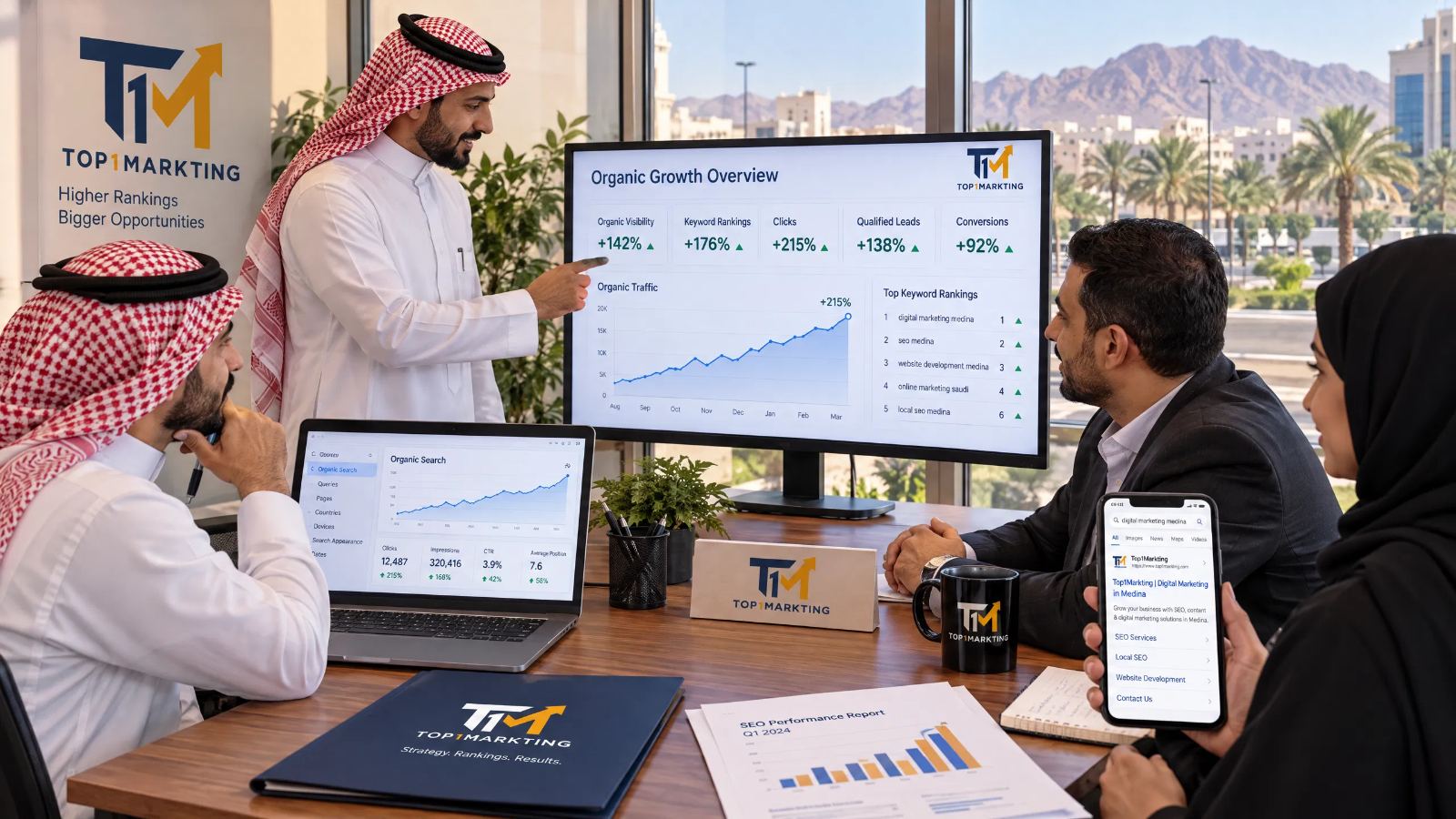
Website pages need to cover their topics in a connected way. They should not simply repeat a primary keyword but should explain the service, related concepts, and questions that matter to searchers. Therefore, SEO content optimization services include reviewing topics, semantic entities, and specialized terms and organizing them according to the nature of the business.
This process relies on understanding Search Intent and evaluating existing content quality, then identifying gaps and topics that need further coverage. Concepts such as Semantic SEO and NLP Entities can also help explain relationships between services, terms, and topics without treating them as lists of keywords that must be inserted automatically.
Top1Markting develops content to support commercial pages and improve clarity around the services offered, while building a strategy that connects core pages with supporting content and reduces topic overlap.
Analyzing Existing Content Quality and Identifying Pages That Need Development
Content development begins by reviewing published pages to determine their accuracy, completeness, and alignment with search intent. Some pages may need additional service details, while others may require restructuring, removal of repetition, or clarification of information that visitors may find confusing.
A Content Audit includes several aspects:
-
Accuracy: Ensuring that information correctly represents the service or product.
-
Usefulness: Evaluating whether the page provides information that helps searchers understand the topic.
-
Repetition: Identifying repeated sections that do not add new value.
-
Service clarity: Ensuring that visitors can understand what the company offers.
-
Search intent alignment: Reviewing whether the page addresses what the user is searching for.
-
Completeness: Identifying important details or questions that need to be addressed.
We do not rely on word count alone to evaluate content quality. A short, direct page may be more suitable than a long page containing repeated information. What matters is how completely the page addresses the topic and how well it serves its purpose and the customer's needs.
Using Semantic Entities and Terms Related to the Business
Semantic SEO helps clarify a topic by naturally incorporating related concepts and terms. When a page discusses a specialized service, its terminology should reflect the service's nature, components, and relationships rather than simply repeating the service name.
We review the main topic and related entities, then identify terms that add meaning and help explain the service. NLP Entities analysis and Entity Recognition can also help identify the concepts and topics that content should cover.
Examples of possible activities include:
-
Adding professional terms related to the service when necessary.
-
Explaining relationships between service components and their associated functions.
-
Using system and technology names accurately.
-
Standardizing terminology when discussing the same topic.
-
Improving the context surrounding keywords instead of repeating them.
-
Linking related topics within a page or across website pages.
We do not treat LSI as a mandatory list of words that must be added, nor do we use semantic terms simply to increase keyword density. We select terms that improve topic understanding and provide genuine value to the content.
Building Connected Content Clusters Around Company Services
Organizing content into connected groups (Content Clusters) helps build a clear structure for the topics covered by a website. The concept involves having a core page covering a main service or specialty, alongside supporting pages that discuss specific related aspects, with logical links connecting them.
For example, a website services content cluster may include a main page about website design, alongside specialized pages about website programming, system development, SEO, and user experience, provided that each page has its own independent topic and purpose.
The process includes:
-
Identifying the core page for each service or specialty.
-
Selecting supporting topics the website needs to cover.
-
Assigning keywords and topics to pages according to search intent.
-
Defining appropriate relationships between pages.
-
Adding internal links that help visitors navigate between topics.
-
Reviewing the cluster periodically to prevent duplication and overlap.
This structure helps clarify the website's areas of specialization and supports the development of Topical Authority through useful, connected content rather than publishing large numbers of similar articles.
Addressing Repetition and Weak Topic Coverage
A website may contain pages discussing the same topic in different ways or pages that do not adequately cover the target service. Therefore, content optimization includes Content Gap Analysis and reviewing overlap between pages to determine whether content needs to be developed or topics redistributed.
The process includes:
-
Identifying pages targeting similar search intent without clear differences in purpose.
-
Reviewing headings and content to identify actual repetition.
-
Identifying important topics that the website does not cover adequately.
-
Addressing page overlap when there is genuine targeting conflict.
-
Completing information that searchers need.
-
Reviewing pages before deciding whether to merge, modify, or remove them.
Similar terminology does not necessarily mean that pages compete with each other. Each page may target a different service or stage of the customer journey. Therefore, page function, intent, and content must be studied before making changes. Useful pages should be preserved rather than deleted simply because they share some similarities.
Developing Service Pages to Communicate Commercial Value
A service page needs to explain what the company offers, what can be implemented, and what customers need to know before contacting the company. We therefore optimize Service Pages to make them clearer and more capable of supporting customer decisions, rather than turning them into lengthy informational articles that do not guide visitors toward the intended action.
Service Page Optimization may include:
-
Providing a clear description of the service and its scope.
-
Explaining deliverables and functions that can be implemented.
-
Clarifying available options according to business requirements.
-
Addressing questions and objections that may affect contract decisions.
-
Organizing information and headings to make details easier to find.
-
Adding suitable calls to action for contacting the company or requesting a quotation.
-
Reviewing contact forms and service request paths when relevant to the page.
This work is connected to Lead Generation and Conversion Rate Optimization. The goal is not simply to attract visits, but to help relevant visitors understand the service and take a clear next step. You can request a review of your website's content to identify pages that need development and improvements that may support your business objectives.
Optimizing Internal Links and Website Structure to Support Important SEO Pages
Website structure and internal link distribution affect how easily visitors can access pages and understand the relationships between different services and topics. Therefore, an internal linking strategy includes reviewing Website Architecture, identifying important pages, and organizing navigation paths to serve both visitors and search engines.
A website may contain good service pages, but they may be far from the main sections or lack clear links from supporting content. Other pages may receive many links without having an importance level that justifies this distribution. We therefore review the structure and links as a whole instead of simply increasing the number of links on pages.
Organizing Website Architecture According to Services and Specialties
Organized Website Architecture clarifies the relationship between main and secondary pages and makes it easier for visitors to move from a general section to the service or specialty they need. We review the website structure and determine whether its page organization reflects the nature of the business and the services offered.
Organization activities include:
-
Reviewing existing main sections and categories.
-
Identifying the relationship between service pages and subpages.
-
Organizing specialty pages according to their actual topics.
-
Reviewing URL structure and clarity.
-
Making important commercial pages easier to access.
-
Reducing unnecessarily deep navigation levels.
This does not mean that a website needs a complex structure or multiple levels. The objective is to create a clear, direct organization that helps visitors understand the website and find the information they need without unnecessary steps.
Choosing Appropriate Anchor Text for Linked Pages
Anchor Text should reflect the topic of the page the visitor is navigating to. We therefore review the text used in internal links and improve it to ensure that it is clear and relevant to the context in which it appears.
The review includes:
-
Using anchor text that describes the destination page.
-
Ensuring that the link text is relevant to the linked topic.
-
Varying anchor text naturally when necessary.
-
Avoiding generic phrases when a more specific description is possible.
-
Reviewing links whose text does not accurately represent their destination.
We do not automatically repeat one anchor text across every location on the website. The selection should support content clarity and usability while maintaining a topical relationship between pages.
Linking Service Pages to Supporting Content
Connecting service pages with supporting content creates clear paths for visitors, allowing them to move from an article explaining a particular aspect to the related service when needed. This is an important part of an Internal Linking Strategy, especially for websites offering multiple services.
Links can be organized by:
-
Directing supporting articles to related service pages.
-
Linking service pages to complementary guides or details when available.
-
Adding links to questions and topics that help customers understand the service.
-
Organizing links within Content Clusters.
-
Considering the Customer Journey when choosing link placement and destination pages.
The relationship between pages must be genuine. Links should not be added merely to increase their number or direct visitors to pages unrelated to what they are reading.
Identifying Orphan Pages and Improving Their Accessibility
Orphan Pages are pages that do not receive internal links from other website pages or lack clear navigation paths within the website structure. Some of these pages may be commercially important but do not benefit from proper internal linking.
The audit includes:
-
Identifying pages that have no incoming internal links.
-
Determining the importance of each page to the business's services.
-
Reviewing how easily visitors can access it from the main sections.
-
Checking Crawl Depth to determine how many steps are needed to reach important pages.
-
Identifying suitable pages where internal links can be added.
-
Reviewing navigation paths after implementing changes.
We do not add links to every page randomly. Instead, we identify pages that deserve internal support according to their importance and relationship with the rest of the website content. You can request an internal linking review to identify pages that need better accessibility.
SEO Management for Companies, Organizations, and Online Stores in Madinah
SEO management requirements vary according to website type and business model. A company website that presents services and projects requires a different approach from an online store containing hundreds of products and categories. Professional and multi-specialty websites also have different requirements.
We therefore do not rely on one plan for every website. Instead, the scope of work is determined according to business type, existing pages, and commercial objectives. SEO services for companies in Madinah include reviewing website structure, optimizing pages and target keywords, improving content, and organizing internal links according to each project's requirements.
SEO for Company and Organization Websites in Madinah
Company and organization websites need clear pages that present the business, services, specialties, projects, and contact methods. SEO optimization for these websites aims to improve the visibility of pages potential customers search for while accurately communicating what the organization offers.
Optimization activities include:
-
Reviewing the homepage and how clearly it communicates the business.
-
Optimizing essential service pages and specialties.
-
Organizing project and portfolio pages when available.
-
Selecting suitable commercial keywords for each page.
-
Developing content that explains service scope and deliverables.
-
Improving internal links between important sections and pages.
If your company needs a new website or wants to develop its core structure, you can explore our website design service in Madinah for companies and organizations. However, website design and preparation are different from SEO management. The former involves building the website, pages, and functions, while SEO management focuses on improving existing page performance and developing search visibility.
SEO Management for Service-Based and Professional Websites
Service-based and professional websites need to target searchers who want to identify suitable service providers and contact them. Therefore, SEO strategies focus on specialty and service pages and explain the scope of work and information customers need to evaluate the service.
Activities include:
-
Organizing service pages and professional specialties.
-
Identifying keywords that reflect commercial search intent.
-
Optimizing content to explain the nature of each service.
-
Adding details and questions customers need answered.
-
Developing Landing Pages when each page has a clear purpose.
-
Improving contact paths and consultation requests.
When targeting neighborhoods or geographic areas within Madinah, each page should provide relevant content and genuine value instead of creating repeated pages that differ only by neighborhood name. The goal is to reach relevant searchers without weakening website quality through duplicated content.
SEO for Online Stores and Product Pages
Online stores need an SEO strategy that considers the number of products, categories, URL management, and content, in addition to addressing duplicate pages and indexing issues that may appear as the number of products increases.
Ecommerce SEO services include:
-
Optimizing product descriptions to make them accurate and useful.
-
Organizing category pages according to product types.
-
Reviewing titles and descriptions for products and categories.
-
Checking duplicate pages and versions generated by product options or filters.
-
Reviewing indexing and internal links between categories and products.
-
Improving content that helps customers understand products and make purchasing decisions.
If you need to create an online store or develop its structure and functions, you can explore our online store design service in Madinah. Store SEO management, on the other hand, focuses on improving the visibility of product and category pages and addressing related technical and content requirements according to the store's needs and product range.
Developing SEO for Websites with Multiple Services and Specialties
Websites offering multiple services face challenges in organizing pages and selecting target keywords for each specialty, especially when a company offers different services under one domain. An unclear structure may lead to overlapping pages or multiple services being targeted through one page without sufficient coverage of each topic.
The optimization strategy includes:
-
Dividing services into clear sections according to the business.
-
Creating separate pages for services that require independent explanations and targeting.
-
Preparing Keyword Mapping to assign keywords and topics to pages.
-
Reviewing titles and content to prevent unnecessary overlap.
-
Organizing links between related services.
-
Identifying core pages and supporting pages for each specialty.
This organization helps visitors understand the scope of each service and gives the website a more consistent structure for covering its topics. Top1Markting determines the optimization scope according to the number of services and the nature of existing pages rather than applying one structure that may not suit every business.
If you manage a company, organization, or online store in Madinah, you can identify your website type and request an assessment of its requirements to determine the appropriate SEO activities and priorities.
Ongoing SEO Management and Monitoring Website Performance on Google
SEO management does not stop after fixing technical issues or optimizing website pages at the beginning. Performance needs ongoing monitoring to understand how pages respond to changes, track search result fluctuations, and identify new opportunities. Therefore, website SEO management relies on an action plan that can be reviewed and developed according to performance data and business objectives.
Top1Markting monitors projects by reviewing target keywords and pages, analyzing Google Search Console and Google Analytics data when suitable measurement settings are available, and preparing reports explaining completed work, observations, and suggested tasks for the next period.
Within the agreed management scope, clients receive clear monitoring that covers priority tasks, available performance indicators, and recommendations for website development. Monitoring details vary from one project to another according to website size, page count, technical condition, and competition.
Preparing an SEO Action Plan According to Website Priorities
After analyzing the website and identifying optimization opportunities, the next stage is converting audit findings into a clear implementation plan (SEO Roadmap). The objective is to determine what the website needs first, what can be postponed, and how each task relates to business objectives.
The action plan includes several elements:
-
Identifying tasks: Such as optimizing service pages, resolving indexing errors, developing content, and organizing internal links.
-
Setting priorities: Addressing issues that affect important pages or prevent access before lower-impact improvements.
-
Defining responsibilities: Clarifying which tasks are handled by the SEO provider and which may require the developer, content team, or website administrator.
-
Defining project scope: Agreeing on the pages, services, and tasks included in the contract.
-
Agreed schedule: Organizing implementation and review stages according to project size and required resources.
We do not use one fixed schedule for every website. A website requiring extensive technical repairs differs from one that only needs content optimization for a limited number of pages. The plan is therefore prepared according to the actual diagnosis, with priorities reviewed when new needs arise.
Monitoring Target Keywords and Pages
Keyword monitoring helps explain how searchers reach website pages, but performance should not be evaluated based on a single keyword ranking. A page may achieve good visibility for multiple queries, while another may need improvements to its content, title, or alignment with search intent.
Monitoring includes reviewing:
-
Search Queries: The queries through which the website appears in search results.
-
Landing Pages: Pages receiving impressions and clicks from target queries.
-
Clicks: The number of clicks reaching the website.
-
Impressions: The number of times pages appear in search results.
-
Average Position: The average position for queries or pages according to the tool's data.
-
Performance changes across target pages and keywords during comparison periods.
We also review how well keywords match their assigned pages and identify opportunities to target additional service-related queries or redistribute certain topics.
This monitoring helps evaluate performance more comprehensively because success depends on traffic quality and its relevance to target services, not simply an improvement in the ranking of one search phrase.
Analyzing Google Search Console Data
Google Search Console is one of the essential tools for reviewing website performance in Google search results. It provides data that helps explain which queries generate impressions, which pages receive impressions and clicks, and how performance changes across different periods.
The analysis includes reviewing the following indicators:
-
Impressions: The number of times website pages appear in search results.
-
Clicks: The number of clicks the website receives from search results.
-
CTR: The ratio of clicks to impressions, which helps evaluate how appealing a search result is to users.
-
Average Position: The average position of the website for queries and pages during the selected period.
We do not review these numbers separately. Instead, we connect them to page type, search query, and comparison period. For example, impressions may increase without a corresponding increase in clicks. This may require reviewing search queries, titles, descriptions, and how well the page matches user intent.
We also consider seasonal changes, industry characteristics, competition, and website modifications to avoid interpreting increases or decreases without understanding their context.
Reviewing Organic Traffic and Conversions
Evaluating SEO is not limited to knowing how many visitors arrive from Google. It is also important to understand whether this traffic is relevant to business objectives. Therefore, we review Organic Traffic alongside engagement and conversion indicators when suitable tracking settings are available.
Using Google Analytics and related website measurement tools, it is possible to monitor indicators such as:
-
The number of organic visits during the selected period.
-
Pages through which visitors begin their sessions.
-
Visitor behavior and navigation paths.
-
Interactions with contact buttons and service request forms when tracking has been configured.
-
Contact requests or commercial actions recorded as conversions.
-
Pages that contribute to attracting traffic related to target services.
Conversion Tracking helps identify actions visitors take after reaching the website, such as submitting a form or clicking a contact method, based on correctly configured and measured events.
It is important not to attribute every contact request to SEO without clear measurement of the traffic source and conversion path. A customer may arrive through more than one channel or interact with the website during multiple visits. We therefore rely on available data to understand the contribution of organic traffic to Lead Generation rather than presenting unsupported percentages or results.
Developing the SEO Plan According to Performance Data
An SEO plan needs periodic review to remain aligned with the website's condition, search changes, and business needs. Monitoring is therefore not limited to repeating the same tasks every month. It includes evaluating completed work and identifying the next steps based on results and new findings.
The development process includes:
-
Reviewing pages whose visibility indicators have improved and identifying further opportunities.
-
Analyzing pages that do not achieve expected performance and identifying possible causes.
-
Discovering new queries related to business services.
-
Reviewing content that needs updating or completion.
-
Monitoring technical issues that appear after changes or website updates.
-
Evaluating internal links and the structure of important pages.
-
Updating priorities according to available data and opportunities.
SEO reports include completed activities, available indicators, issues requiring attention, and suggested tasks for the next period. This makes monitoring part of actual website development rather than simply sending monthly figures without explanation.
If you are looking for a company to manage SEO for your website in Madinah, contact Top1Markting to discuss a suitable scope of work and identify the pages, objectives, and performance indicators that can be monitored according to your project.
SEO and GEO in Madinah to Improve Content Readiness for AI-Powered Search
Search and information discovery methods continue to evolve. Searchers no longer rely only on traditional result lists; they also interact with AI-powered search experiences and generative answer engines. Therefore, it is useful to develop content so that it is clear, well organized, and accurately explains the business identity, services, and related information.
An SEO and GEO strategy in Madinah combines website optimization for traditional search engines with improvements to information structure and semantic entities to support understanding across modern search environments. This includes optimizing pages, clarifying relationships between services, organizing answers and information, and using structured data when appropriate.
Top1Markting treats GEO as a supporting extension of search visibility strategy, not a replacement for SEO or a method that guarantees the company will appear in AI-generated answers. The primary focus is building accurate, connected content that is easy to understand and use across different search channels.
The Difference Between Traditional SEO and GEO
SEO focuses on optimizing website pages, structure, and content to increase their chances of appearing in traditional search engine results. GEO (Generative Engine Optimization), on the other hand, focuses on developing content and information presentation to help generative search and answer systems understand topics, entities, and relationships.
The differences appear in several areas:
-
SEO: Focuses on website page visibility in search results and improving titles, content, technical structure, and links.
-
GEO: Focuses on information clarity, organization, and providing sufficient context about the business, services, and related concepts.
-
AI Search: Includes search experiences that use artificial intelligence to provide summaries, answers, or aggregated information.
-
Information sources: Answer experiences may rely on multiple sources, making accuracy, clarity, and consistency important.
Examples of modern search environments include AI Overviews and generative answer experiences that help users access information in formats different from traditional search result lists.
This does not mean GEO replaces SEO. A technically organized website with quality content and clear pages remains an important foundation, while GEO adds greater attention to how information is written and how entities and relationships are explained so that modern search systems can understand them.
Organizing Information and Semantic Entities Within the Website
A website needs to clarify the business identity and the services it offers, using consistent names and information that explain the relationship between the company, its specialties, and its pages. Therefore, Semantic Entities optimization includes reviewing how semantic entities and business information are presented within content.
The organization process includes:
-
Standardizing company, service, and specialty names when they are mentioned.
-
Providing clear descriptions of the services and products displayed on the website.
-
Clarifying relationships between services, components, and related functions.
-
Using specialized terms in their correct context.
-
Reviewing information across different pages to reduce inconsistencies.
-
Organizing content so that each topic can be understood without losing its related context.
Concepts such as Entity Recognition and Semantic SEO can help analyze the entities and concepts covered by the website and improve how they are presented within pages.
For example, when a company offers administrative system programming, the content should explain the system's nature, functions, and the groups that may benefit from it, rather than simply repeating the service name. This helps build more specific content that is closely connected to the business.
Optimizing Content Structure to Answer Searchers' Questions
Modern search experiences rely heavily on understanding questions, topics, and surrounding context. Therefore, it is useful to organize content in a way that provides clear answers to searchers' actual needs.
AI Search Content Optimization includes:
-
Identifying questions related to the services and topics covered by the website.
-
Writing direct and clear answers without omitting necessary details.
-
Using descriptive headings that clarify each section's topic.
-
Providing sufficient context to explain terms, functions, and relationships.
-
Organizing information into paragraphs, lists, and tables when appropriate.
-
Relying on trustworthy sources when information requires documentation.
-
Reviewing answer consistency with the rest of the website content.
This approach also improves the experience of visitors using Conversational Search, who may ask naturally phrased and specific questions instead of entering a short keyword.
We do not create artificial answers simply to try to appear in AI search results. Instead, we develop content that answers genuine questions, provides useful and accurate information, and clearly relates to the services offered by the business.
Using Structured Data When Suitable for the Content
Structured Data helps clarify the type of information on a page and some of its properties through organized markup that search engines can read. It can therefore be part of SEO and GEO development when the data type suits the page content and business.
Activities include:
-
Selecting the appropriate Schema Markup type for each page.
-
Using properties that apply to the actual content.
-
Reviewing data accuracy and markup implementation.
-
Ensuring that structured data matches the information visible to visitors.
-
Fixing technical errors and warnings shown by testing tools.
-
Reviewing markup when content is updated or page structure changes.
Incorrect data or properties that do not reflect the page content should not be added. The objective is to provide accurate, organized information rather than simply increasing the number of Schema types used.
Structured data also does not guarantee Rich Results or AI Overviews, nor does it automatically mean that a page will be used as a source for a generative answer. Content quality, relevance, and accuracy remain essential factors in website development.
Monitoring Developments in AI-Powered Search
Search interfaces and information presentation methods change continuously. Therefore, a GEO strategy requires periodic review to keep pace with these changes while maintaining SEO fundamentals and avoiding content changes simply because a new trend has appeared.
Monitoring includes:
-
Reviewing developments in AI Search, Generative Search, and new answer experiences.
-
Monitoring the types of questions searchers ask within the business's industry.
-
Evaluating content clarity and the accuracy of published information.
-
Reviewing how the company identity and services are presented across website pages.
-
Updating topics that need completion or restructuring.
-
Evaluating the quality of sources and information used when documentation is needed.
-
Developing content structure according to actual changes in search behavior.
Brand visibility, referral sources, and available traffic data can also be reviewed when such information can be measured. However, this should not be presented as a complete measurement of every appearance of content within AI systems.
Top1Markting does not guarantee that the company will be mentioned in ChatGPT or any other answer engine. Instead, we focus on developing the website, its content, and its data to make them clearer, more organized, and better prepared for developments in search.
If you want to develop your website's search visibility strategy in Madinah, discuss SEO and GEO opportunities with Top1Markting and identify the pages, content, and entities that need review according to your business and commercial objectives.
SEO Company Prices in Madinah and the Cost of Search Engine Optimization Management
SEO prices in Madinah vary according to the website's condition and the amount of work required. The cost of optimizing a company website with a limited number of service pages is not the same as managing an online store containing hundreds of products and categories. The cost of a technical audit also differs from ongoing SEO management because each service has a different scope and deliverables.
Top1Markting therefore does not use one fixed price for every project. The cost of SEO services is determined after understanding the website and reviewing its requirements and the tasks that need to be completed. This approach helps provide a quotation that reflects the actual workload instead of setting a price that does not match the website's condition or the client's expectations.
What Factors Determine the Cost of SEO Services?
SEO costs depend on several factors that determine the amount of work, time, and resources required to implement improvements. The most important include:
-
Website size: The number of pages, sections, and products that need review and optimization.
-
Number of target pages: The scope of implementation changes as the number of service or product pages increases.
-
Competition: The work varies according to competitor strength, keyword difficulty, and how competitive the industry is.
-
Website technical condition: A website may need indexing, redirect, speed, or page structure repairs before moving to other stages.
-
Content volume: The cost of content development and review varies according to the number of pages and required depth of coverage.
-
Agreed service scope: There is a difference between optimizing selected pages, conducting a comprehensive audit, and providing full SEO management covering technical work, content, and monitoring.
Reviewing these factors helps determine the appropriate SEO Scope and whether the project needs only a Website Audit or a complete optimization, implementation, and ongoing monitoring plan. Costs are therefore determined after assessing the requirements, without providing figures unsupported by an actual quotation.
The Difference Between the Cost of an SEO Audit and Ongoing Website Management
SEO Audit and SEO Management differ in terms of work, objectives, and deliverables. An audit focuses on examining the website and identifying issues and optimization opportunities, while ongoing management includes monitoring implementation, developing performance, and following an agreed plan.
SEO Audit:
-
Examining the website's technical condition.
-
Reviewing indexing, crawling, and links.
-
Analyzing keywords and target pages.
-
Identifying content issues and page overlap.
-
Preparing findings and recommendations organized by priority.
Ongoing SEO Management:
-
Implementing agreed optimization tasks.
-
Developing service pages and content.
-
Monitoring target keywords and pages.
-
Reviewing newly emerging technical issues.
-
Analyzing performance indicators and preparing reports.
-
Updating the action plan according to monitoring results.
An audit may be the appropriate starting point for a website that needs a clear diagnosis before implementation decisions are made. Ongoing management may be more suitable for companies that want to monitor and develop their websites regularly. The right service depends on project requirements. The proposal should also clarify whether the audit includes implementing fixes or only providing findings and recommendations.
Do SEO Prices Differ Between Online Stores and Company Websites?
Yes. SEO costs for online stores may differ from those for company websites because page types, website size, and required tasks are not the same.
A company website may focus on a limited number of service, specialty, and project pages. An online store, however, may require managing product and category pages and reviewing duplicate content and indexing issues caused by product variations and display options.
Factors affecting the scope of Ecommerce SEO include:
-
The number of products and categories requiring optimization.
-
The quality and uniqueness of product descriptions.
-
The organization of Category Pages and their relationship with product pages.
-
Similar titles or multiple versions of product pages.
-
How filters, browsing options, and URLs are managed.
-
Website size and indexing and internal linking requirements.
For company websites, work may focus on optimizing service pages, organizing specialties, clarifying commercial value, and targeting keywords related to the organization's activities.
There is therefore no single price that applies to all website types. Project costs are determined according to page count, technical structure, and the required level of optimization.
What Should an SEO Company Quotation Include?
A clear quotation helps you understand what you will receive for the service cost, which tasks are the company's responsibility, and which require your involvement or cooperation from your team.
When reviewing an SEO quotation, make sure it includes:
-
Project Scope: Identifying the website, pages, and services covered by the agreement.
-
Required tasks: Explaining auditing, technical optimization, content development, internal links, and other agreed activities.
-
Deliverables: Identifying what will be provided, such as an audit report, action plan, or optimized pages.
-
Priorities: Explaining which issues and tasks will be addressed first.
-
Reports: Clarifying the type of performance reports and indicators that will be reviewed.
-
Client responsibilities: Explaining which approvals, permissions, or cooperation with developers and content teams are required.
-
Service limitations: Defining included and excluded activities to avoid differences in expectations during implementation.
The quotation should also clarify whether technical changes and content implementation are included or require a separate agreement, especially when certain tasks need the website developer or an external service provider.
How to Compare SEO Company Prices in Madinah
When comparing SEO company prices in Madinah, do not make the lowest price your only selection criterion. Two proposals with similar costs may differ significantly in the number of tasks, analysis quality, implementation level, and monitoring.
You can evaluate proposals according to several criteria:
-
Service clarity: Does the proposal specify the tasks to be completed in detail?
-
Analysis quality: Is it based on website, keyword, and competitor analysis, or does it offer only a general plan?
-
Actual implementation: Does it include page optimization and issue resolution, or only recommendations?
-
Monitoring: Is there a clear process for reviewing progress and updating priorities?
-
Reports: Do reports present understandable indicators and explain their meaning?
-
Deliverables: Can you identify exactly what will be completed and delivered within the agreement?
This comparison helps you choose a company offering services that suit your website's needs and budget, rather than paying for unclear tasks or choosing a low-cost proposal that does not cover the required work.
Contact Top1Markting to request a quotation based on your website's condition, after identifying your business type, target pages, and optimization priorities.
SEO Reports and Measuring Website Search Engine Optimization Results
SEO monitoring requires measurable indicators that explain what is happening to a website in search results, how organic traffic is changing, and whether pages are attracting relevant searchers. Therefore, SEO reports rely on analyzing available data instead of making general promises about improving rankings or increasing traffic.
Tools such as Google Search Console and Google Analytics help monitor different aspects of website performance, from impressions and clicks to visits and user actions when appropriate tracking settings are available.
Top1Markting aims to connect performance reports to completed work so that clients can understand progress, observations, and next steps and evaluate how well the optimization plan aligns with their business objectives.
Monitoring Clicks, Impressions, and CTR
Clicks and impressions data explain how often website pages appear in search results and how searchers interact with the displayed results. Google Search Console provides these indicators for queries, pages, and selected periods.
The review includes:
-
Clicks: The number of clicks reaching website pages from search results.
-
Impressions: The number of times pages appear in search results.
-
CTR: The ratio of clicks to impressions.
-
Pages: Identifying pages that received impressions and clicks.
-
Titles and descriptions: Reviewing opportunities to improve Title Tags and Meta Descriptions when a low click-through rate requires further investigation.
-
Time-based changes: Comparing performance across suitable periods to understand visibility and engagement trends.
For example, a service page may receive many impressions without a corresponding number of clicks. This may require reviewing the queries for which the page appears and evaluating whether its title and description match search intent.
An increase in Impressions alone does not mean the website has achieved its final objective. Clicks, traffic quality, and the page's commercial purpose must also be considered, along with the keywords and comparison period.
Analyzing Page and Keyword Performance in Search Results
Reviewing page and query performance helps identify topics that are progressing and pages that need development or reassessment. We therefore do not simply prepare a separate keyword ranking report. Instead, we connect each query to the pages appearing for it and the results those pages achieve.
The analysis includes:
-
Reviewing Search Queries through which the website appears.
-
Identifying Landing Pages receiving impressions and clicks.
-
Monitoring Average Position at the query and page levels.
-
Comparing performance trends across suitable periods.
-
Identifying pages targeting similar search intent.
-
Discovering opportunities to improve titles, content, or internal links.
-
Reviewing pages with declining performance to identify possible causes.
This data helps support more accurate decisions. One page may need content optimization, while another may require fixing a technical issue or clarifying the service it provides.
We also consider that Average Position is not a fixed ranking for every user or search, and it does not independently reflect a page's commercial value. It should therefore be evaluated alongside impressions, clicks, traffic, and conversions when available.
Measuring Organic Traffic and Lead Quality
It is important to understand whether traffic from search engines is relevant to target customers and whether it leads to useful business actions. Therefore, we review Organic Traffic alongside engagement and conversion indicators using Google Analytics and available measurement tools.
The review includes:
-
Identifying traffic sources to understand visits coming from organic search.
-
Analyzing entry pages through which visitors begin their sessions.
-
Reviewing visitor behavior and navigation paths.
-
Monitoring interactions with contact forms and call buttons when tracking is configured.
-
Measuring conversions recorded according to the website's defined goals.
-
Evaluating how closely traffic relates to the services offered by the business.
This data helps explain traffic quality and how closely it contributes to Lead Generation goals, such as requesting a quotation, sending an inquiry, or contacting the company about a particular service.
Conversion Tracking can record these actions when events and conversions are configured correctly. However, it is not appropriate to guarantee a specific number of customers or consider every contact request a direct result of SEO without analyzing the traffic source and customer journey.
Preparing Clear Reports to Review the Optimization Plan
Numbers alone are not enough to evaluate website performance. Reports should explain what was implemented, what changed, and what needs further attention. SEO reports should therefore be connected to the action plan and agreed tasks.
Performance reports may include:
-
Completed work: Showing the optimizations implemented during the reporting period.
-
Indicators: Reviewing available clicks, impressions, CTR, visits, and conversions.
-
Page performance: Identifying pages that improved or require further review.
-
Issues: Recording technical or editorial observations discovered during monitoring.
-
Analysis: Explaining important changes and connecting them to pages and queries.
-
Next steps: Identifying proposed tasks for the next period according to priorities.
Reports can also be connected to the SEO Roadmap to show completed tasks compared with planned activities and whether priorities need to be adjusted.
The objective of a Performance Report is to provide an understandable picture of the project's condition, not to fill the report with numbers without explaining their meaning or relationship to business objectives. You can ask which performance indicators are suitable for your website before starting the agreement so that the work and evaluation methods are clear.
Contracting an SEO Company in Madinah and Implementing the Action Plan
Hiring an SEO company in Madinah begins with understanding the website and business, then evaluating requirements and defining the scope of work and tasks that can be implemented. Clear stages help you understand what your project needs, from the first contact through optimization monitoring and performance measurement.
Top1Markting follows organized steps that begin with receiving website information, followed by the appropriate analysis, preparing a proposal for the required work, and defining deliverables and implementation responsibilities before starting the agreed tasks.
Receiving the Website URL and Understanding the Business
The first step is receiving the website URL and basic business information to understand the services offered, target audience, and pages that are most important to the client.
The required information usually includes:
-
Website URL.
-
Business industry and type of activity.
-
Services or sections the client wants to improve in search results.
-
Target audience and geographic area served by the business.
-
Main challenges the website faces from the client's perspective.
-
Commercial priorities, such as increasing service requests or improving the visibility of specific pages.
This information helps create an initial Business Profile and understand project requirements before defining the audit scope. There is no need to share passwords or sensitive login details during initial contact. Any technical permissions required for implementation can be discussed through secure methods at the appropriate stage.
Auditing the Website and Analyzing Keywords and Competitors
After understanding the business, the next stage is evaluating the website and identifying optimization opportunities. This stage includes reviewing pages, technical structure, keywords, and competitors according to project size and the required audit scope.
SEO Audit activities include:
-
Reviewing essential pages and the services presented on the website.
-
Checking indexing and crawling and identifying potential technical issues.
-
Analyzing keywords and their relevance to search intent.
-
Reviewing titles, content, and internal links.
-
Studying competitors and pages targeting the same topics.
-
Identifying content gaps and opportunities for improvement.
Some aspects may require deeper investigation or access to website measurement tools before a final assessment can be issued. Therefore, comprehensive findings or final conclusions are not provided before the required audit is completed.
Defining the Scope of Work and Preparing a Quotation
After analyzing the requirements, the Project Scope is defined to explain the tasks the company will perform, the expected deliverables, and each party's responsibilities.
Preparing the quotation includes:
-
Identifying the pages and services covered by optimization.
-
Prioritizing technical and editorial tasks.
-
Clarifying whether the work includes auditing only or also implementation and monitoring.
-
Defining the Deliverables.
-
Explaining the reporting and performance review process.
-
Identifying approvals, permissions, or client cooperation required for implementation.
-
Agreeing on the scope and suitable timing for project stages.
This step prevents unclear commitments and ensures that clients understand what the service includes before implementation begins. Additional tasks that require separate agreements are also clarified rather than automatically assumed to be included.
Implementing Improvements and Following Up on Recommendations
After agreeing on the scope of work, the SEO strategy is implemented by addressing the tasks identified in the plan. This stage may include technical improvements, page and content optimization, or internal link organization according to the website's requirements.
Possible tasks include:
-
Resolving agreed Technical SEO issues.
-
Optimizing page titles, descriptions, and heading structure.
-
Developing service and product page content.
-
Reviewing images and alt text.
-
Improving internal links and website structure.
-
Monitoring technical recommendations and verifying implemented changes.
Some adjustments may require client permissions, intervention from the website developer, or content approval before publication. Tasks are therefore completed according to available permissions and the agreed cooperation process. It should not be assumed that every change can be implemented immediately without review or approval.
Reviewing Performance and Developing the Action Plan
After implementing improvements, project monitoring continues by reviewing available indicators, analyzing how pages respond to changes, and identifying new priorities based on the data.
This stage includes:
-
Reviewing Google Search Console reports and impression and click data.
-
Analyzing the performance of target pages and keywords.
-
Monitoring organic traffic and conversions when tracking is available.
-
Evaluating completed tasks and tasks still in progress.
-
Identifying issues or opportunities discovered during monitoring.
-
Updating the SEO Roadmap according to the website's condition.
This process supports ongoing development without linking success to a fixed date or promising a specific ranking. Search results are affected by multiple factors, and project progress should be evaluated through actual work and measurable indicators.
If you are ready to start an SEO project for your website in Madinah, send your website URL and business information to Top1Markting to discuss your initial requirements and determine the appropriate next step.
SEO Company in Madinah to Improve Customer Targeting Within the Area
When a business provides services within Madinah, geographic location becomes an important part of its SEO strategy, especially when searchers use phrases containing the city or neighborhood name to find a nearby service provider or a company operating within a specific area.
Therefore, a geographic SEO plan includes reviewing local keywords and pages targeting the business's services in Madinah while identifying the areas the client actually serves. The goal is to improve service page visibility for relevant searchers without adding neighborhood names randomly or creating pages that provide no unique information.
Top1Markting considers that geographic targeting should reflect the actual business model, whether the business serves customers within Madinah or covers multiple areas.
Targeting Keywords Related to Business Services in Madinah
Geographic keywords help clarify the relationship between a service and the location where customers are searching. For example, someone may search for a company offering a specific service in Madinah. We therefore review local keywords and determine their relevance to the services offered by the business.
The targeting process includes:
-
Identifying services the business wants to attract customers for within the city.
-
Selecting keywords that combine a service and location when appropriate search intent exists.
-
Reviewing the types of customers searching for the service.
-
Identifying the actual service area.
-
Assigning geographic keywords to suitable pages.
-
Reviewing how well page content matches local searchers' expectations.
The city name should not be added automatically to every keyword. Geographic targeting must reflect genuine search intent, and the page must be able to provide relevant service information.
Developing Geographic Service Pages with Genuine Content
Some businesses may need dedicated pages for different geographic areas, especially when service requirements, customer needs, or implementation methods differ from one area to another. In such cases, Location Pages can be developed to provide real information that distinguishes each page.
Suitable geographic page elements include:
-
Explaining the service provided by the business in the area.
-
Identifying the actual coverage area.
-
Presenting information relevant to customers in that area.
-
Explaining genuine differences in service delivery or requirements.
-
Providing a clear way to contact the company and request the service.
-
Linking the page to related main service pages.
We do not recommend copying one page and changing only the neighborhood name, because this does not add value for searchers. There is also no need to create separate pages for every area if the business provides the same service in the same way without any local content or requirements that justify the distinction.
Naturally Distributing Neighborhood and Area Names Across Website Content
Website pages may include the names of neighborhoods and areas served by the business within the city when this information is relevant to the service and helps searchers understand the coverage area.
Areas that may be mentioned when genuinely relevant include Al Awali, Quba, Al Aziziyah, Shuran, Al Jamiah, Qurban, and other areas of Madinah.
These names should be distributed naturally within the content, such as when explaining service coverage or the areas from which customers can request the service. The following considerations apply:
-
Mention areas the business actually serves.
-
Use neighborhood names in sections related to the service.
-
Avoid repeating area names in every heading and paragraph.
-
Do not create a separate heading for every neighborhood without meaningful content.
-
Do not imply that a branch or office exists in an area where there is no actual location.
The goal is to make geographic information useful to searchers, not turn it into a repeated keyword list.
Aligning the SEO Strategy with the Actual Service Area
A geographic SEO strategy begins by identifying the areas where the business can genuinely provide its services. Some companies operate only within Madinah, while others provide services remotely or cover a wider geographic area.
We therefore review the Service Area and determine whether geographic keywords and pages suit the actual business model by:
-
Identifying the areas where the business provides services.
-
Distinguishing between the physical business location and the service coverage area.
-
Selecting suitable pages for geographic targeting.
-
Avoiding targeting areas the business cannot serve.
-
Clarifying service delivery methods when work is remote or requires an on-site visit.
-
Reviewing content when the service area changes or new areas are added.
This review helps direct SEO efforts toward searchers the business can actually serve and avoids unsuitable traffic resulting from geographic targeting that does not match the company's capabilities.
If your business targets customers in Madinah, you can identify your services and coverage areas when requesting a website assessment from Top1Markting. This helps us develop a geographic SEO plan that matches your actual business operations.
Request a Website Analysis and Contract SEO Services with Top1Markting
If you are looking to hire an SEO company in Madinah to review your website and improve its visibility on Google, contact Top1Markting to discuss your business requirements and identify the services suitable for your website's condition. We begin by understanding the project and its objectives, then evaluating the areas that need improvement, whether they involve technical structure, pages, content, or keyword strategy.
You can contact us directly to request an SEO Audit or ask about SEO management services and discuss the expected Project Scope before determining the cost. Send us your initial project information so that we can understand your requirements and discuss suitable next steps without committing you to a service your website does not need.
What Information Is Required to Start a Website Assessment?
To begin evaluating your website, we need some basic information that helps us understand your business and identify optimization priorities. This includes:
-
Website URL: To review existing pages and how services or products are presented.
-
Business type: Such as a company, organization, online store, clinic, restaurant, or service office.
-
Main services: Identifying the products or services you want to improve in search results.
-
Target areas: Madinah or specific neighborhoods within the city, according to your actual service area.
-
SEO objectives: Such as increasing organic traffic, improving service page visibility, attracting contact requests and inquiries, or supporting online store sales.
This information helps us prepare an initial assessment of your website's needs through the Website Audit process and identify your Business Goals. You do not need to send passwords or dashboard login details in your first contact message. If implementation requires access permissions to certain tools or systems, we can discuss how to provide them securely at a later stage.
Do You Need an SEO Audit Only or Ongoing Management?
Choosing between an SEO Audit and SEO Management depends on your website's condition and the purpose of the agreement. Not every website necessarily needs ongoing monthly management. Sometimes, a technical review or a specific optimization plan is the most suitable starting point.
-
SEO Audit: Suitable for website owners who want to understand the reasons for poor visibility or review indexing, technical structure, content, and keywords and receive a list of issues and priorities for addressing them.
-
Optimization Implementation Services: Suitable for businesses with identified issues that want to resolve them, such as optimizing pages, fixing technical problems, or developing content and internal links.
-
Ongoing SEO Management: Suitable for websites that require regular monitoring of target keywords, pages, and organic performance, along with continuous development of the optimization plan according to results and competitive changes.
Cooperation can begin with an SEO audit, after which you can decide whether the website needs a specific set of improvements or ongoing SEO management. The objective is to select a service scope that matches the project's requirements and budget, rather than imposing one package on every client.
Request a Quotation for SEO Services in Madinah
If you want to request an SEO quotation or hire a website optimization service, contact Top1Markting and send your website URL, business type, and the services whose search visibility you want to improve. We will discuss the Project Scope and required tasks, whether you need a website audit, optimization of specific pages, or SEO management and performance monitoring.
You can start the conversation using the following details:
-
Company: Top1Markting
-
Service: SEO Services – Search Engine Optimization and SEO Management
-
Saudi Contact Number: +966549881368
-
Website: Top1Markting
Start Reviewing Your Website with Top1Markting
Send your website URL, business type, and the services you want to improve on Google. We will discuss your website's requirements, identify the appropriate SEO service scope, and prepare a quotation that matches your project's needs.
Frequently Asked Questions About SEO Companies in Madinah
How Do I Choose the Best SEO Company in Madinah?
Choose an SEO company based on its ability to analyze your website, understand your business and competitors, and provide a clear scope of work explaining the required improvements, implementation methods, and performance measurement. Ask about its monitoring and reporting process, and make sure its recommendations are related to your project's actual needs. Do not make promises of reaching the number-one position or guaranteed results your main selection criterion, because Google rankings are affected by multiple changing factors.
What Services Does an SEO Company Provide?
SEO services may include website audits, keyword and competitor analysis, page title and content optimization, technical issue resolution, internal link organization, website structure optimization, performance monitoring, and reporting. The service scope is determined according to the website's condition, business objectives, and the tasks agreed upon before implementation begins.
How Much Does It Cost to Hire an SEO Company in Madinah?
The cost depends on website size, page count, technical condition, competition, target keywords, content volume, and required tasks. It is therefore preferable to conduct an initial website assessment before determining the cost so that the quotation is based on a clear scope of work instead of a fixed price that may not suit every project.
Does an SEO Company Provide Ongoing Website Management?
SEO company services may include ongoing website management, such as monitoring keywords and page performance, implementing technical and content improvements, reviewing competitors, and developing the action plan according to available data. This depends on website requirements and the agreed scope. Some projects may only need an audit or specific optimization tasks without requiring monthly management.
What Is the Difference Between Technical SEO and Content Optimization?
Technical SEO focuses on aspects that help search engines crawl, understand, and index website pages, such as website structure, performance, indexing settings, links, and Schema signals. Content optimization focuses on information quality, heading organization, topic coverage, and aligning pages with search intent. A website may need both areas to address its issues and improve its visibility opportunities.
How Are Website Keywords Analyzed?
Keyword research begins with understanding the company's business, services, and target audience. It then involves studying search phrases related to each service and analyzing search intent and competition. Keywords are subsequently grouped and assigned to suitable pages according to each page's purpose to avoid unnecessary repetition and competition between website pages.
Can an Existing Company or Organization Website Be Optimized?
Yes. An existing company or organization website can be optimized without necessarily creating a new website. The process begins by examining current pages, content, technical structure, and indexing, then identifying development opportunities and issues that need to be addressed. The decision depends on the assessment results. Improvements to the existing website may be sufficient, or certain essential sections may require development.
Do SEO Services Include Online Store Optimization?
Yes. Online store SEO services may include optimizing product and category pages, reviewing page titles and descriptions, organizing internal links, and auditing indexing, store structure, and content. The scope varies according to the number of products and categories, how the store is built, and the issues it contains.
How Can I Tell Whether an SEO Strategy Is Making Progress?
Progress can be monitored through indicators such as clicks, impressions, click-through rate (CTR), page and query performance, organic traffic, and conversions when suitable tracking settings are available. These data should be reviewed in comparison with business objectives and previous periods rather than relying on the ranking of a single keyword to evaluate the strategy's success.
What Reports Does an SEO Company Provide?
SEO reports may include tasks completed during the reporting period, Google Search Console indicators, page and keyword performance, changes in clicks and impressions, issues discovered or resolved, and upcoming optimization priorities. Reports may also include Google Analytics data and conversions when the measurement tools are properly configured, according to the agreed service scope.
How Long Does It Take to See SEO Results?
The time required to see SEO improvements varies according to website condition, competition, the scale of changes, implementation quality, and how quickly recommendations are applied. Some improvements may need time before their impact becomes visible in indexing and organic performance. Therefore, it is not possible to specify a fixed date or guarantee a particular ranking within a certain period before assessing and monitoring the website.
Can Anyone Guarantee the Number-One Position on Google?
No one can guarantee the number-one position on Google or maintain a specific ranking. Search results are affected by competition, page quality, ranking system updates, and other factors outside the control of any SEO company. It is better to hire a provider based on clear tasks, measurable indicators, and work that improves website quality and visibility opportunities among relevant searchers.
What Is the Difference Between SEO and GEO?
SEO focuses on optimizing a website to increase its chances of appearing in traditional search engines through content, technical structure, pages, and keywords. GEO focuses on improving information organization, entity clarity, relationships, and content so that AI-powered search and generative answer systems can understand and use the information. Both areas can be developed together without guaranteeing website visibility or brand mentions on any specific AI platform.
How Can I Request a Quotation for Website Optimization?
You can request a quotation by sending your website URL, business type, and the services whose Google visibility you want to improve, along with your target areas if your business serves a local market. It is also useful to clarify whether you need only an SEO audit, specific optimization tasks, or ongoing management. Your requirements can then be reviewed to discuss the appropriate scope and cost.
Can I Start with a Website Audit Before Hiring Monthly SEO Management?
Yes. You can discuss conducting an independent website audit first to identify technical issues and review pages, content, and keywords. After reviewing the findings, you can decide whether to implement the required improvements or hire ongoing SEO management if your project and objectives require it.
Do All Websites Need the Same SEO Services?
No. SEO requirements vary according to website type, size, business activity, technical condition, and industry competition. A company website may need service page and content optimization, while an online store may require product and category page reviews and indexing improvements. Another website may need technical issue resolution or structural reorganization. Services should therefore be selected after evaluating each website individually.
Does SEO Optimization Only Mean Increasing Website Traffic?
Not necessarily. The objective is not limited to increasing traffic numbers. It also includes attracting searchers who have genuine interest in the business's services or products. Traffic quality and relevance to the target audience should therefore be evaluated, along with resulting calls, quotation requests, sales, and measurable conversions according to the project's nature and objectives.