

Hospital and Medical Center Management System Development Company in Jeddah | Design and Development of Integrated Medical Software Solutions

If you manage a hospital, medical complex, or specialized medical center in Jeddah and are looking for a hospital management system development company in Jeddah, you need a software solution tailored to your facility’s operations and designed to organize workflows across different departments, rather than relying on generic software that may not cover all your operational requirements. Managing patients, appointments, medical records, invoices, insurance, laboratories, and radiology requires a system that connects the required functions within a clearly structured working environment, with defined user permissions and data exchange mechanisms between modules.
Top1Markting provides medical software development and customized management solutions. The process begins with analyzing your facility’s workflows and identifying its requirements, followed by designing and developing a hospital or medical center management system according to the project scope. The system can include modules such as patient management, Electronic Medical Records (EMR), appointment scheduling, doctor and clinic management, billing and insurance claims, laboratories, pharmacies, and reporting. Integration with external systems through APIs can also be evaluated when the necessary technical requirements are available.
Whether you need a Hospital Management System (HMS) for a multi-department hospital or Clinic Management Software for a medical center or group of clinics in Jeddah, the system design depends on the facility’s size, number of users and branches, and required functions—not on a one-size-fits-all template. The solution can be developed in phases according to operational priorities, while allowing for future expansion and the addition of new modules.
Explore Top1Markting’s custom software development services and contact the team to discuss your medical facility’s requirements in Jeddah and receive a technical proposal and quotation tailored to your project.
Best Hospital and Medical Center Management System Development Company in Jeddah for Customized Medical Solutions
When searching for the best hospital management system development company in Jeddah, it is important not to limit your choice to a provider offering ready-made software or a long list of features. Instead, focus on a team capable of understanding your facility’s workflows and transforming them into a practical software solution. The needs of a private hospital differ from those of a medical complex or specialized clinic, and the way patients, appointments, medical records, and invoices are managed varies from one facility to another.
Top1Markting develops customized software solutions that begin with analyzing the requirements of the hospital or medical center and identifying the departments, users, and processes the system needs to manage. The development process includes examining the patient journey, defining the required modules, designing user interfaces, building databases, programming internal functions, and testing the system before delivery. This approach supports Custom HMS Development that matches the project scope instead of imposing a uniform operating method on every healthcare facility.
When choosing a software development company, it is also important to assess its ability to handle different technical aspects, including:
-
System Analysis: Analyzing workflows and defining system requirements.
-
Frontend Development: Developing the interfaces used by reception staff, doctors, and administrators.
-
Backend Development: Programming server-side functions and operational logic.
-
Database Architecture: Designing databases and relationships between patients, visits, appointments, and departments.
-
UI/UX Design: Creating practical user interfaces and improving the user experience.
-
API Integration: Evaluating integration with external systems when required and when the necessary technical capabilities are available.
Medical Software Programmer and Developer in Jeddah for Custom Hospital Software Development
If you are looking for a medical software programmer in Jeddah to develop a dedicated application for a hospital or medical complex, the first step is to identify the operations you want to convert into software functions. The goal is not simply to create data-entry screens, but to build a system that connects information and procedures according to the facility’s workflow.
The development team can analyze the project requirements and divide them into interconnected interfaces and modules. A hospital may need a patient registration module, a visit management module, an appointment scheduling module, and additional modules for invoices, attachments, and reports. The required modules depend on the facility’s nature and whether it needs an administrative and operational system only or a solution that also includes medical documentation functions.
Software development work may include several technical tasks, such as:
-
Backend Development: Programming internal functions and business rules that control how operations are performed.
-
Frontend Development: Designing and developing the screens used by reception staff, doctors, and management.
-
Database Architecture: Building the database structure and relationships between patients, visits, appointments, and departments.
-
Business Logic: Converting the facility’s procedures into clear operational steps and rules within the system.
-
API Integration: Evaluating integration with external systems when suitable interfaces and technical requirements are available.
A medical system can be programmed from scratch, or an existing solution can be enhanced and customized according to the project’s technical condition and the availability of access to its current system and databases. Therefore, if you need a hospital software developer or Medical Software Engineer to build a multi-specialty clinic management system, it is best to begin with a technical assessment that defines the requirements, functions, and priorities before estimating the development timeline and cost.
Do you need a programmer to develop a private hospital management system or software for managing multiple specialized clinics? Ask the Top1Markting team to assess your system concept and identify the required modules before development begins.
Medical Technology Solutions Development Company for Hospitals and Medical Complexes in Jeddah
A medical facility may need more than one separate application to manage each department. Using independent tools for patients, appointments, billing, and employees can lead to duplicate data entry and make it difficult to monitor workflows between departments. For this reason, some hospitals and medical complexes choose to develop an interconnected digital operating environment that brings the required functions together within one system, while assigning each department its own interface and permissions according to its responsibilities.
Top1Markting provides hospital technology solutions development in Jeddah based on each facility’s operational requirements. This may involve developing a Centralized Management System that includes multiple modules and organizes the flow of data and tasks between departments. Depending on the agreed project scope, the software architecture can include functions for patient management, reception, appointments, clinics, billing, and reporting.
For multi-specialty medical complexes or facilities with multiple branches, the system can also be designed to support Multi-Branch Management. This allows the facility to organize each branch’s data, users, working schedules, and available services, while providing central management with access to the information permitted by the system’s defined permissions.
Functions that can be considered within Hospital Digital Solutions include:
-
Connecting reception, patient, and appointment modules within an integrated workflow.
-
Assigning user permissions according to department and job role.
-
Organizing medical and administrative departments through separate modules.
-
Providing operational reports that help management monitor recorded data.
-
Coordinating operations between branches when centralized management is required.
-
Evaluating the automation of repetitive procedures through Workflow Automation, based on the facility’s approved business rules.
A unified system does not mean that all employees can access all information. Access permissions must be designed according to roles and responsibilities, with clear definitions of which information each user can view or modify. Data exchange and integration with external systems should also be assessed separately according to the technical requirements.
If you manage a hospital or medical complex in Jeddah and need a digital system that connects multiple departments or branches, you can discuss your current workflows with the Top1Markting team to determine the appropriate architecture and the modules required for your project.
Difference Between a Medical Software Development Company and a Hospital Website Design Company
It is important to distinguish between a hospital website and a hospital management system because each serves a different purpose. Depending on its objectives, a healthcare facility may need one or both.
A Hospital Website is the public-facing platform through which visitors learn about the facility, its services, specialties, doctors, and contact details. It may include pages for medical departments, doctor profiles, branch information, and contact or appointment request forms, depending on the required functionality.
A Hospital Management System (HMS) is an internal operational software solution that helps manage procedures and data across departments and users. Its functions may include patient registration, visit management, appointments, medical records, billing, and reporting, depending on the modules included in the project.
| Comparison | Hospital Website | Hospital Management System |
|---|---|---|
| Purpose | Introducing the facility and its services | Organizing internal operations and data |
| Users | Visitors, patients, and the public | Facility employees and authorized users |
| Content and functions | Specialties, doctors, services, and contact information | Patients, visits, appointments, records, and operations |
| Usage | Online platform for communication and information | Internal operational and management environment |
| Development | Page design and user-friendly browsing experience | Workflow analysis, software modules, and database development |
If your goal is to showcase medical specialties, services, doctor information, and contact details, you may need a hospital website that presents this information in an organized way. However, if you want to organize patient registration, visits, medical records, appointments, and departmental procedures, a medical management system is the more suitable solution. Both can be developed together when required, with the connection between the website and the internal system defined separately.
Top1Markting also provides professional hospital and medical company website design services for facilities that need an online platform to present their services in an organized manner.
Before requesting a quotation, determine whether your facility needs an informational website, an internal operational system, or a project that combines both. This will help define the scope of work and estimate the cost more accurately.
Patient Management, Reception, and Electronic Medical Records System Development for Hospitals in Jeddah
A patient’s journey inside a hospital or medical center begins with registration and reception, followed by creating a patient file and linking visits, appointments, and recorded information to it. For this reason, patient management system development in Jeddah is one of the essential functions for healthcare facilities that want to organize patient data and reduce reliance on paper files or scattered records.
Top1Markting develops patient management software according to each facility’s operational requirements. The system can create an electronic file for every patient containing basic information, a medical record number, visit history, and related attachments. Registration, reception, and medical records modules can also be connected within one system, allowing authorized users to access the information they need according to their permissions.
The scope of a patient management system varies depending on the facility’s size and services. A small medical center may need patient registration, patient search, and visit management functions, while a multi-department hospital may require a more detailed structure that includes medical records, attachments, documentation forms, and information links to different clinics and departments.
Patient file management software can include functions such as:
-
Creating a separate electronic file for each patient and linking it to a Medical Record Number (MRN).
-
Recording basic information, contact details, and other operational data.
-
Maintaining previous visit history and linking each visit to the patient’s file.
-
Organizing medical information included within the system’s scope.
-
Attaching reports, results, and documents to the appropriate patient file or visit.
-
Providing patient search functionality using available information.
-
Managing viewing and editing permissions according to user roles.
-
Recording important actions and changes through an audit log when included in the project scope.
Related terms for this type of solution include Patient Registration, Patient Records, Patient Profile, and Electronic Medical Records (EMR). During project analysis, it is important to distinguish between a patient’s administrative information and clinical medical documentation so that reception staff permissions are not confused with those of users responsible for medical records.
Patient Registration and Medical Reception System Development
Reception staff need an organized way to register new patients and access existing patient files without creating duplicate records during every visit. A hospital patient registration system can therefore be developed to organize the patient reception process, from arrival until the patient is directed to the appropriate clinic or service.
A Patient Registration module can include a form for entering basic information, such as the patient’s name, contact details, and identification information defined by the facility. It can also generate a unique Medical Record Number (MRN) for each patient. A separate Visit Number can be created whenever a patient returns for another appointment, ensuring that all visits remain linked to the same primary file.
Functions that can be implemented within a medical reception system include:
-
Registering new patients through an organized form.
-
Searching for registered patients using their medical record number or available information.
-
Checking for an existing file before creating a new record, according to the facility’s matching rules.
-
Recording contact details and required basic information.
-
Creating a visit number and linking it to the patient’s file.
-
Updating patient information according to user permissions.
-
Directing patients to the relevant clinic or department as part of the operational workflow.
Registration interfaces can be designed in Arabic and English if required, with customizable fields based on the facility’s workflow and reception requirements. Registration can also be connected to the appointment scheduling system to make booking information easier to access when patients arrive.
This gives the facility a reception system that helps organize patient registration and file searches instead of relying on separate data entry in every department.
Do you need a registration system that supports both new and existing patients? Define the required registration fields, search method, medical record numbers, and visit numbering process for your facility.
Electronic Medical Records (EMR) Development and Medical History Management
An Electronic Medical Record differs from a patient’s administrative information file. It is designed to organize medical information documented during visits according to the specialty and the facility’s approved procedures. An Electronic Medical Record (EMR) can be developed and linked to the patient’s primary file, allowing information recorded during each visit to be stored in a clear sequence and accessed by authorized users.
The record design depends on the forms and fields required by the facility. It may include medical history, recorded allergies, clinical notes, vital signs, diagnoses documented by healthcare professionals, and attachments or reports associated with the visit. The components of the record vary according to the specialty and documentation methods used.
Functions that can be considered when developing an EMR include:
-
Creating a medical record linked to the patient’s primary file.
-
Organizing medical history and recorded information chronologically.
-
Saving Clinical Notes within the appropriate visit.
-
Adding Allergies and related information according to the facility’s forms.
-
Recording Vital Signs when required.
-
Linking reports, results, and attachments to the patient file or visit.
-
Defining access permissions for medical data.
-
Recording additions, modifications, and reviews in an audit log according to project requirements.
The project must also define the type of medical record required. Does the facility need an EMR for managing records internally, or does it require broader health information exchange between different organizations or systems? An Electronic Health Record (EHR) may involve a broader concept than an internal medical file and requires an assessment of data exchange and technical interoperability requirements when such functions are requested.
Documentation forms, permissions, data storage methods, and relevant regulatory requirements should be reviewed before approving the final design. Developing an electronic record does not automatically mean that all regulatory or clinical requirements have been met.
If your facility needs an organized electronic medical file, the Top1Markting team can assess the required record components and documentation forms, then determine how to connect them to patient files and visits within the system.
Patient Visit, Diagnosis, and Treatment Plan Management System
Hospitals and medical centers need to organize information associated with each visit so that recorded details can be retrieved without confusing them with previous visits. A Patient Encounter Management System can be developed to link each appointment or visit to the patient’s file, doctor, clinic, and scheduled visit date.
The process usually begins by creating a visit record and then providing the documentation forms defined by the facility. These forms may include Physician Notes, recorded information about the patient’s condition, diagnoses entered by the relevant specialist, a Treatment Plan, and required follow-up information, depending on the system scope and approved permissions.
Possible functions in this module include:
-
Creating a separate record for each visit and linking it to the patient’s file.
-
Recording the visit date, clinic, and responsible doctor.
-
Designing customizable documentation forms for different specialties.
-
Saving physician notes and information recorded during the visit.
-
Linking diagnoses and treatment plans to the visit according to the approved documentation process.
-
Recording follow-up appointments and linking them to previous visits.
-
Allowing authorized users to review previous visits.
Customizable forms are important because the requirements of a dental clinic differ from those of a dermatology, ophthalmology, or physiotherapy clinic. Therefore, using one fixed form for every specialty may not be suitable when each department follows different procedures and requires different fields.
The system should remain a tool for organizing and documenting information entered by healthcare professionals unless the project explicitly includes additional functions that have been technically and regulatorily reviewed. Programming diagnosis and treatment plan forms does not mean that the software independently makes medical decisions.
If you need software for documenting patient visits and physician notes, define the visit forms, specialties, and fields you want to use within your facility.
Medical Reports, Files, and Attachments Archiving System
Healthcare facilities handle various types of documents, including medical reports, test results, official documents, images, and files attached to patient records. When these files are stored in separate locations or are not clearly linked to the relevant patient and visit, retrieving and tracking them becomes more difficult.
A Medical Document Management System can therefore be developed to organize documents and link them to the appropriate patient file, visit, or department. The archive design depends on the types of files used by the facility, their classification method, access policies, and retention requirements.
Electronic archiving functions may include:
-
Attaching PDF files, documents, and images to the appropriate patient file.
-
Linking medical reports to the visit date or relevant department.
-
Classifying attachments by document type or specialty.
-
Searching for and retrieving files using patient or visit information.
-
Defining viewing, downloading, and editing permissions.
-
Managing file versions when multiple copies need to be retained.
-
Recording access and modification activities according to the approved auditing process.
For projects involving radiology and medical imaging, it is important to distinguish between ordinary document archiving and a Picture Archiving and Communication System (PACS). Managing medical images and their associated data may require specific technical requirements, formats, and integrations. These must be defined within the project scope rather than assuming that a standard attachments module provides full PACS functionality.
The Top1Markting team can assess the types of documents used by your facility and determine how to classify and link them to medical records, while designing suitable user permissions. Define the required file types and archiving method so that a technical proposal can be prepared according to your data volume and usage requirements.
Hospital Appointment, Doctor, and Medical Clinic Management System Development in Jeddah
Appointment management directly affects daily operations in hospitals and medical complexes. Different doctor schedules, specialties, consultation durations, and branch appointments can lead to booking conflicts or difficulties tracking available time slots. Healthcare facilities therefore need a system that helps manage doctor schedules, bookings, and clinics through clearly defined operational rules.
Top1Markting provides medical appointment management system development in Jeddah based on each facility’s workflow. The system can include a calendar connecting doctors to their specialties, clinics, branches, and available time slots. Functions for modifying and canceling appointments and managing waiting lists can also be added according to project requirements.
An appointment management system should do more than display a calendar. It must account for the facility’s booking rules, such as consultation duration, doctor working days, unavailable periods, booking limits, and procedures for cancellations and rescheduling. Appointments can also be linked to patient files and visit numbers when these functions are included in the system scope.
Modules that can be developed include:
-
Managing doctor schedules, working days, and available time slots.
-
Organizing appointments by specialty, clinic, and branch.
-
Defining appointment duration according to the service type.
-
Recording new bookings, modifying appointments, and canceling them.
-
Organizing waiting lists and tracking patient attendance.
-
Displaying daily and weekly appointments for management and reception staff.
-
Evaluating notifications and reminders through available communication channels.
-
Linking appointments to patient files when required.
These solutions are suitable for hospitals, independent clinics, and multi-specialty medical complexes. Support for multiple branches can also be evaluated through a centralized calendar or separate schedules, depending on how the facility operates.
Doctor Appointment Booking and Medical Schedule Management System Development
If your facility receives a large number of patients or has doctors working on different days and shifts, a doctor appointment booking system can help organize available time slots and simplify booking management through a unified calendar or separate calendars for each clinic.
A medical booking system can connect every appointment to a doctor, specialty, and branch while defining available Time Slots, consultation duration, and permitted booking limits. Rules for Rescheduling and Cancellation can also be added, with appointment statuses displayed to reception staff and authorized users.
Customizable functions may include:
-
Creating a separate schedule for each doctor based on working days and hours.
-
Defining the specialty, clinic, and branch associated with each schedule.
-
Setting consultation duration and intervals between appointments when required.
-
Preventing bookings during unavailable periods according to system rules.
-
Modifying or canceling appointments and updating their statuses.
-
Supporting a Recurring Schedule when required by the facility’s workflow.
-
Displaying daily and weekly bookings by doctor or clinic.
The system can also be designed to allow patients to book through an external interface, restrict appointment management to reception staff, or combine both methods. The choice depends on the facility’s policies and booking procedures.
If a doctor works at more than one clinic or branch, the system can organize working hours and service locations within a single schedule while preventing appointment conflicts between branches.
If you need an appointment booking system for multiple doctors and specialties, ask the Top1Markting team to design a schedule that matches your consultation durations, working days, and actual booking rules.
Patient Queue and Waiting Management System (Queue Management)
In hospitals and medical centers that receive large numbers of patients, organizing waiting times can become a daily challenge, especially when multiple clinics and service points are involved. A Queue Management System can be developed to organize patient order and track each queue status within the department.
The process can begin by issuing a waiting number after the patient checks in or completes reception procedures, then linking that number to the relevant clinic or service point. Reception staff can update the patient’s status, while a waiting display shows the numbers or statuses the system is configured to make visible to the public.
Possible queue management functions include:
-
Issuing queue numbers according to clinic or department.
-
Recording patient status, such as registered, waiting, or called.
-
Organizing separate waiting lists for each service.
-
Displaying queue numbers on a dedicated screen inside the facility.
-
Updating queue status as patients move between service stages.
-
Providing a monitoring dashboard for reception staff and management.
-
Preparing operational reports on the number of waiting patients and recorded waiting times, if included in the project scope.
Queue rules can be customized according to the facility’s operations, such as arrival order or priority rules defined by management. These rules must be clearly established before development. The queue system can also be connected to appointment scheduling and reception modules to avoid entering the same information multiple times.
This function is not limited to large hospitals. Medical complexes, multi-specialty clinics, and diagnostic centers with several reception or service points may also benefit from it.
If you want to organize patient waiting inside your facility, request a system proposal tailored to the number of reception points, clinics, and the way patients move between departments.
Doctor, Specialty, and Medical Branch Management
Medical complexes with multiple specialties or branches need to organize doctor information, work locations, and schedules in an interconnected way. A doctor working at more than one branch, or a clinic serving several specialties, requires a system that helps management access each doctor’s information, appointments, and service location.
A doctor and clinic management system can include doctor profiles, medical specialties, clinics associated with each specialty, working schedules, and the branches where each doctor provides services. User permissions can also be customized according to branch or department in line with the facility’s administrative structure.
Functions that can be included are:
-
Creating a profile for each doctor with the required professional and administrative information.
-
Classifying doctors by medical specialty.
-
Linking each doctor to one or more clinics according to the operating structure.
-
Defining the branches where each doctor works.
-
Managing working schedules, shifts, and available time slots.
-
Connecting doctor information to the appointment booking module.
-
Assigning data management permissions according to responsibilities.
-
Generating reports on doctor distribution, specialties, and branches.
For multi-branch facilities, a Centralized Management structure can be developed to monitor branch information through defined permissions while maintaining separation between the information and operations belonging to each location. The system can support Multi-Branch Management, with separate doctor schedules based on their work locations.
It is also important to determine whether management needs a unified view of all doctors or separate management for each branch. Can branch managers modify doctor schedules, or should this permission remain with central management? These details affect database design, permissions, and system operation.
If you manage a multi-specialty medical complex or a group of clinics in Jeddah, discuss the number of doctors, specialties, and branches with the Top1Markting team to determine the system structure and modules that suit your facility.
Hospital Department Management System Development in Jeddah
Hospitals need more than patient registration and appointment scheduling. Each department has its own operational procedures, data, and functions. General and specialized hospitals therefore need a system that can be developed as a set of interconnected modules to manage inpatient services, beds, emergency departments, laboratories, radiology, pharmacies, and operating rooms according to the facility’s services.
Top1Markting provides hospital department management system development according to the project scope. The process begins by analyzing each department’s workflow and identifying its users and required data, followed by designing modules, databases, and interfaces that connect the departments. Each department can have its own module, permissions, and screens, while shared information can be linked to the patient file or visit whenever required by operational procedures.
The required modules depend on the hospital’s size and specialties. One hospital may need inpatient, emergency, laboratory, and radiology management, while another may also require pharmacy, operating room, and internal referral management. Not all modules need to be implemented at once. The project can be divided into phases according to priorities, budget, and the agreed scope of work.
Examples of modules that can be considered when developing a hospital management system include:
-
Inpatient, admission, room, and bed management (Inpatient Management).
-
Organizing case reception and monitoring emergency department procedures (Emergency Department System).
-
Managing laboratory test requests, samples, and results (Laboratory Information System – LIS).
-
Managing radiology requests and reports and evaluating medical imaging system integration (RIS/PACS).
-
Organizing medications, inventory, and dispensing transactions within the pharmacy.
-
Managing operating room schedules and related procedures.
-
Organizing internal referrals and patient transfers between departments.
-
Linking service results and permitted data exchanges to patient files.
It is important to determine whether the facility needs internal operational modules only or integration with existing medical devices and systems. For example, integration with laboratory or medical imaging equipment requires an assessment of the communication protocols, formats, and integration interfaces supported by the systems in use.
Inpatient, Bed, and Hospital Admission Management System Development
Hospitals providing inpatient services need to monitor room and bed occupancy and organize patient admissions, discharges, and transfers between departments. An Inpatient and Bed Management System can be developed to organize these operations through a clear administrative interface that helps staff monitor room and bed statuses according to recorded information.
The system can begin by recording an admission request and linking it to the patient’s file, then assigning the relevant department, room, and bed according to the facility’s allocation rules. After admission is completed, occupancy status can be monitored and updated when the patient is discharged or transferred to another department.
Functions that can be implemented include:
-
Recording patient Admission procedures and linking them to the patient’s file.
-
Managing room and bed information and classifying them by department.
-
Displaying each bed’s status, such as available, occupied, or unavailable, according to the statuses defined by the facility.
-
Monitoring room and bed occupancy through an administrative dashboard.
-
Recording patient Discharge procedures.
-
Documenting patient transfers between departments or rooms (Patient Transfer).
-
Maintaining a record of patient movements and occupancy status changes.
-
Preparing reports on bed occupancy and admission and discharge activity.
The system can be customized to match the hospital’s structure, whether it has multiple wards, different inpatient departments, or rooms with specific classifications. The inpatient module can also be connected to reception, medical records, and billing if these functions are included in the project scope.
The system’s role is not limited to displaying available beds. Its data must reflect actual operational status, and permissions for updating occupancy, transfers, and discharges must be assigned to the users responsible for these procedures.
If you manage a hospital providing inpatient services in Jeddah, ask the Top1Markting team to analyze your current bed and room management procedures, including admission and discharge workflows, to determine the functions required in the system.
Emergency Department and Urgent Reception Management System Development
Work in an emergency department differs from standard clinic reception. The department needs to register cases and monitor their movement through service stages according to the hospital’s approved procedures. An Emergency Department System can be developed to organize case information, arrival times, and each case’s status within the department.
The module begins by recording case information upon arrival and documenting the required details before assigning the case to the workflow defined by the facility. Functions may include recording arrival time, reception information, case status, and movement between service points, with authorized users able to update information.
Functions that can be included are:
-
Registering emergency cases and linking them to the patient’s file when available.
-
Creating a case record when a new patient arrives.
-
Documenting arrival time and the start time of service stages.
-
Organizing initial triage information (Triage) according to the forms and procedures approved by the hospital.
-
Monitoring the case status within the department (Case Status).
-
Recording transfers between service points or departments.
-
Documenting case handovers between teams or users (Clinical Handover) when included in the system scope.
-
Linking the record to inpatient, visit, or billing modules when required.
The system design must reflect the nature of emergency department operations and the need for rapid information entry, with the essential screens and fields defined for each stage. Triage and priority rules must be established and reviewed by the facility’s qualified professionals. The system organizes documentation and operational data; it does not replace medical assessment or clinical decision-making.
If you need to develop an emergency department management system, define the department’s workflow from the moment a case arrives until it is transferred or its procedures are completed. This helps ensure that the module reflects actual operations.
Medical Laboratory Management System Development and Test Result Integration
Medical laboratories handle a workflow that begins with receiving a test request, registering the sample, and monitoring its status, followed by documenting, reviewing, and approving the result according to laboratory procedures. A Laboratory Information System (LIS) can be developed to organize these stages and link requests to patient files and the departments that issued them.
The system can receive laboratory test requests from clinics or departments, record the test type and associated information, and create a sample record to track its processing stages. After results are entered, the system can organize their review and approval according to the permissions and workflow defined by the laboratory.
Possible laboratory system functions include:
-
Registering Lab Orders and linking them to the patient and visit.
-
Managing test types and laboratory services.
-
Creating sample identification records and monitoring their movement (Specimen Tracking).
-
Recording sample status and processing stages.
-
Entering test results and linking them to the original request.
-
Managing Reference Ranges according to approved test settings.
-
Organizing result review and approval by authorized users.
-
Issuing laboratory test reports.
-
Making results accessible through the patient file according to system permissions.
-
Evaluating integration with laboratory equipment when suitable interfaces and communication protocols are available.
It is important to distinguish between laboratory management software and direct integration with laboratory analyzers. Managing requests, samples, and results can be developed as a software module, while automatically receiving results from devices requires knowledge of the equipment types, communication methods, and supported formats.
The laboratory can also be connected to the hospital management system so that test requests and results appear within the records associated with each patient, with viewing, editing, and approval permissions defined for each role.
If you manage a laboratory inside a hospital or medical center in Jeddah, define the test types, sample workflow, result review stages, and required integrations so that a technical proposal can be prepared for an LIS module suited to your operations.
Radiology and Medical Imaging System Development (PACS / RIS)
Radiology departments and medical imaging centers need to organize examination requests, appointments, patient information, and result reports, in addition to managing medical images when this function is included in the project scope. A Radiology Information System (RIS) can be developed to organize request processing, registration, tracking, and reporting, with integration with a Picture Archiving and Communication System (PACS) evaluated when required.
The two systems must be distinguished. RIS focuses on managing radiology department workflows, including requests, appointments, examination information, and reports. PACS handles the storage, management, and retrieval of medical images according to the adopted technical architecture.
Functions that can be considered within the project include:
-
Registering Imaging Orders and linking them to patient information.
-
Organizing examination appointments according to service type and equipment availability.
-
Tracking radiology requests from registration to procedure completion.
-
Managing Radiology Reports.
-
Linking reports to the patient file and visit.
-
Organizing examination, equipment, and department information.
-
Evaluating integration with imaging devices and PACS systems.
-
Handling the DICOM medical imaging format when the necessary integration requirements are available.
-
Defining access permissions for medical images and reports.
If the facility wants to connect the system to radiology equipment, a technical assessment of the existing devices is required to determine their supported protocols, formats, and communication interfaces. It should not be assumed that every imaging device supports integration in the same way, or that programming an interface for managing requests creates a complete PACS system.
Radiology requests and reports can also be connected to the hospital management system so that each service is linked to the relevant patient file and visit, according to user permissions and the agreed data exchange method.
If you manage a radiology department or medical imaging center in Jeddah, provide details of your current equipment and systems, along with the required integration type, to evaluate the possibility of developing RIS or connecting to PACS.
Pharmacy and Medication Inventory Management System Development
A hospital’s internal pharmacy needs to monitor medication items, quantities, dispensing and supply transactions, and expiration dates, while organizing prescription-related or dispensing request information according to the approved workflow. A Hospital Pharmacy Management System can be developed to bring medication inventory functions and item movements together within an organized database.
Pharmacy requirements vary according to the facility’s size, number of departments, medication items, and storage locations. The system can therefore be customized to manage products, units, batches, quantities, dispensing, and receiving transactions, with the option to connect it to other modules when required by the project.
Functions that can be implemented include:
-
Creating a database of medicines and pharmaceutical items.
-
Recording available quantities and stock additions and dispensing transactions.
-
Tracking Batch Numbers.
-
Recording Expiry Dates.
-
Setting alerts for low stock or approaching expiration dates.
-
Managing supply and receiving requests according to approved procedures.
-
Recording medication dispensing and linking it to prescriptions or patients when this function is included.
-
Monitoring item balances by warehouse or pharmacy.
-
Generating inventory movement and consumption reports.
The pharmacy can be connected to billing, medical records, or electronic prescriptions, but this depends on the existing modules and the required integration scope. Prescription handling methods, dispensing permissions, and relevant procedures must also be defined and reviewed before the system is approved.
A pharmacy management system should do more than record medication names and quantities. It must reflect the actual inventory cycle, from receiving and storage to dispensing and stock adjustment, with each operation assigned to authorized users.
If you need a pharmacy management system for a hospital or medical complex, define how items, warehouses, batches, and dispensing are managed so that a module can be designed to meet your facility’s requirements.
Operating Room and Medical Procedure Management System Development
Hospitals with operating rooms need to organize schedules and administrative procedures related to room preparation, appointment allocation, and the teams involved. An Operating Room Management System can be developed to monitor surgery scheduling and operating rooms and link procedure information to the patient’s file, according to the required functions.
The module begins by organizing operating room information and available time slots, then recording the procedure and assigning its date, room, and related administrative information. Additional stages for monitoring before and after the procedure can be added if they are part of the facility’s procedures and the agreed project scope.
Functions that can be considered include:
-
Managing operating room information and availability.
-
Creating Surgery Scheduling calendars.
-
Recording procedure information and linking it to the patient’s file.
-
Organizing information about the team and departments involved in the procedure.
-
Monitoring schedule status, modifications, and cancellations.
-
Documenting administrative procedure stages (Procedure Records).
-
Organizing surgery lists by day, room, or department.
-
Linking procedure information to inpatient, appointment, and billing modules when required.
The system can be customized according to the number of operating rooms, booking methods, schedule approval procedures, and information management needs. Clinical forms and medical documentation related to procedures must be defined in cooperation with the facility’s specialists to ensure they reflect actual workflows.
If you want to develop software for managing operating rooms and scheduling medical procedures, define the administrative workflow stages, rooms, teams, and information you need to record within the system.
Hospital Billing, Accounting, and Medical Insurance Management System Development in Jeddah
The financial side is an essential part of hospital and medical complex operations. Facilities need to record services provided, issue invoices, track payments and collections, and manage insurance transactions. A hospital billing and medical insurance management system in Jeddah can therefore be developed to connect recorded services with financial data and organize the revenue cycle according to approved procedures.
Top1Markting analyzes the facility’s billing cycle before defining system functions. Billing a clinic visit differs from invoicing laboratory or radiology services, calculating an inpatient’s account, or managing claims associated with insurance companies. Separate modules can be developed for these processes and connected to patient files, services, and departments when included in the project scope.
The system may include functions such as:
-
Recording medical services and their prices according to facility settings.
-
Creating invoices and linking them to patients and visits.
-
Recording payments, receipts, and collection methods.
-
Monitoring balances and outstanding amounts.
-
Managing discounts and adjustments according to approved permissions.
-
Recording insurance company information and related policy details.
-
Tracking insurance approvals and claims.
-
Organizing settlements and financial reports.
-
Displaying revenue reports by period, department, or branch.
-
Connecting billing modules to other systems when required.
These functions are related to Revenue Cycle Management (RCM), a process that includes service registration, documentation, billing, collection tracking, claims, and settlements. The extent to which the system covers this cycle depends on the modules selected by the facility.
Medical Billing, Payment, and Collection System Development
Healthcare facilities need software that organizes invoice issuance and tracks payments associated with the services patients receive. A hospital medical billing system can be developed to create an invoice for each visit, service, or group of services according to the facility’s approved pricing policy.
The system allows users to record invoice details, amounts, and included services, then monitor payments, receipts, and remaining balances. Rules for discounts, adjustments, or refunds can also be designed according to the financial department’s permissions.
Possible functions include:
-
Creating an invoice linked to the patient’s file or visit number.
-
Adding medical services, tests, and procedures to the invoice.
-
Applying approved prices and discounts according to facility settings.
-
Recording Payments and issuing Receipts.
-
Supporting multiple payment methods if included in the project requirements.
-
Monitoring the Outstanding Balance.
-
Recording Refunds and adjustments according to permissions.
-
Generating invoice and collection reports by period, department, or branch.
Invoices can be connected to services recorded in clinics, laboratories, radiology, and pharmacies so that service information is transferred to the accounting module instead of being entered manually again, provided that these modules are interconnected within the system design.
During the analysis stage, the project must define how service prices are calculated, who is responsible for approving prices and adjustments, and how partial, outstanding, or fully paid invoices are handled.
If you need billing and payment software for a clinic, medical complex, or hospital, define the invoice types, services, payment methods, and collection procedures required before development begins.
Medical Insurance, Approvals, and Claims Management System Development
Hospitals and medical complexes that work with insurance companies need to organize insurer information, policies, approvals, and claims, while tracking each transaction from registration through processing or settlement. A Medical Insurance Management System can be developed to organize these operations and link them to patient files and provided services according to the facility’s requirements.
Functions that can be included are:
-
Registering insurance companies and related contract information.
-
Organizing insurance policy details and dates.
-
Recording insurance coverage information included within the system scope.
-
Documenting Eligibility Checks when the required verification mechanism is available.
-
Tracking Pre-Authorization requests.
-
Registering Insurance Claims.
-
Monitoring claim status, such as under review, accepted, rejected, or requiring additional information.
-
Recording notes, rejection reasons, and modification requests.
-
Preparing reports on claims, their statuses, and settlements.
It is important to distinguish between recording insurance information and tracking claims within the system, and direct integration with insurance companies or external platforms. Electronic integration requires identifying the target organization, available API interfaces, data exchange requirements, and technical approval procedures. The system should not be assumed to submit claims or obtain approvals automatically without evaluating these requirements.
Insurance information can also be linked to the patient’s file, invoice, and provided service so that all information associated with each claim is organized and accessible to authorized users.
If your facility works with more than one insurance company, ask the Top1Markting team to analyze your current insurance workflow and identify the required registration, approval, claims, and integration procedures.
Revenue, Expense, and Financial Reporting Management System Development
In addition to invoicing and collections, the finance department needs to monitor revenue and expenses and classify data by department, branch, or time period. A hospital accounting and financial reporting system can be developed to display recorded information in an organized format and help management monitor the indicators it needs.
The module may include functions such as:
-
Recording revenue associated with services and departments.
-
Organizing expenses according to classifications approved by the facility.
-
Monitoring recorded receipts and payments.
-
Classifying revenue by department, branch, or service type.
-
Preparing monthly, weekly, or daily reports.
-
Displaying financial indicators through an administrative dashboard.
-
Exporting reports in the formats included in the project scope, according to permissions.
-
Evaluating integration with an external accounting system when required and technically available.
Terms associated with this module include Revenue, Expenses, Cash Flow, Cost Centers, and Financial Reports.
The project must define whether the facility needs a financial and operational reporting module connected to billing, or a complete accounting system that includes journal entries, general ledger accounts, reconciliations, and other accounting functions. These are not the same scope, and defining the requirements early helps estimate the development effort more accurately.
If you need to monitor revenue and expenses by branch or department, define the financial reports and indicators management wants to review regularly so that the module can be designed around your requirements.
Clinic and Multi-Specialty Medical Complex Management System Design and Development in Jeddah
Not every healthcare facility needs a system as extensive as a multi-department hospital solution. An independent clinic or medical complex may need software focused on patient registration, appointments, doctors, visits, and invoices without adding modules that are not relevant to its operations. For this reason, a medical center management system in Jeddah can be designed according to the facility’s size, number of specialties and branches, and services provided.
Top1Markting develops customized clinic management systems by identifying the essential required functions and allowing additional modules to be added as the business expands. The system may include patient file management, doctor bookings, clinic schedules, visit records, invoices, reports, and employee permissions.
Each specialty has different requirements. A dental clinic may need dedicated dental charts and procedure planning forms, while a dermatology and aesthetics center may need session and service management. A physiotherapy center may need to track treatment sessions and specialist appointments. Therefore, it is not always suitable to impose one interface or a fixed set of fields on every specialty.
Functions that can be customized for medical centers include:
-
Managing patient information, files, and visits.
-
Recording appointments and assigning them to doctors and specialties.
-
Managing working schedules and clinics.
-
Documenting specialty-specific information and forms.
-
Tracking services, invoices, and payments.
-
Managing user accounts and permissions.
-
Generating reports on appointments, visits, and services.
-
Managing branches when the facility operates at multiple locations.
-
Evaluating the addition of an online portal or application connected to the system.
Dental Clinic and Doctor Appointment Management System Development
Dental clinics need to organize patient information, doctor appointments, visits, and the procedures documented for each patient. A dental clinic management system can be developed with a dedicated patient file and visit history, along with customizable forms suited to the clinic’s services.
Functions that can be considered include:
-
Registering patients and creating electronic files.
-
Organizing dental appointment schedules and working hours.
-
Linking visits to patient files.
-
Designing a Dental Chart form according to clinic requirements.
-
Recording Treatment Plans documented by the relevant specialist.
-
Tracking procedure history and previous visits.
-
Managing invoices and payments associated with services.
-
Preparing reports on appointments and services.
Customization is important because each clinic may organize information differently. Some facilities may need detailed forms for documenting dental conditions and procedures, while others may focus primarily on appointments, visits, and billing.
The appointment module can also be connected to patient files and procedure records, allowing authorized users to access information associated with each visit without entering it repeatedly in separate modules.
If you manage a dental clinic in Jeddah and need software to organize patients, appointments, and procedure records, define your current workflows and documentation forms so that a system can be designed to suit your clinic.
Dermatology and Aesthetic Clinic Management System Development
Dermatology and aesthetic centers provide different services, consultations, and treatment sessions, and may need to organize bookings, visit records, services, and invoices within one system. A dermatology and aesthetic clinic management system can be developed according to the services offered by the center and the way sessions are recorded and monitored.
The system may include:
-
Managing patient files and contact information.
-
Recording consultations and visits and linking them to patient files.
-
Managing doctor and specialist appointments.
-
Organizing services, procedures, and sessions.
-
Tracking Treatment Sessions associated with each service.
-
Recording notes documented by specialists according to the facility’s forms.
-
Managing invoices, payments, and packages when included in the project scope.
-
Generating reports on bookings, services, and sessions.
Different forms can be designed according to the service type, with the information required for each visit defined by the facility. Packages and remaining session balances can also be organized when this function is needed, according to the center’s approved sales and usage rules.
Not all dermatology and aesthetic centers operate in the same way. Development therefore begins with analyzing actual services and procedures, then determining whether the center needs session management only or a broader system that includes reception, appointments, billing, and patient records.
If you manage a dermatology or aesthetic center in Jeddah, define the services, sessions, and follow-up forms you want to organize within the system.
Physiotherapy and Rehabilitation Center Management System Development
Physiotherapy and rehabilitation centers often rely on recurring sessions, follow-up appointments, and specialist schedules. Organizing sessions, patient files, and appointments is therefore an important part of daily operations. A physiotherapy center management system can be developed to organize this information and link it to each patient’s file.
Possible functions include:
-
Creating patient files and linking them to visits.
-
Managing specialist schedules and appointments.
-
Recording Therapy Sessions and their dates.
-
Organizing Rehabilitation Plans recorded within the facility.
-
Documenting Progress Notes according to approved forms.
-
Tracking the number of sessions associated with a service or package.
-
Managing invoices and payments.
-
Preparing reports on bookings, sessions, and operational activity.
The system can be customized to display each specialist’s schedule and associated sessions, while allowing staff to monitor upcoming appointments, completed sessions, and remaining sessions when this function is included in the project scope. Documentation forms can also be designed differently according to the service or rehabilitation program.
The method of recording notes and rehabilitation plans should be defined in cooperation with the relevant specialists to ensure that the forms reflect the center’s actual practices without assuming that all specialties require the same fields.
If you manage a physiotherapy or rehabilitation center in Jeddah, define your session booking and patient follow-up procedures to develop software that matches your operational workflow.
Multi-Branch and Multi-Specialty Clinic Management System Development
Medical complexes with multiple specialties or branches need a system that organizes shared information while controlling each location’s access permissions. A centralized management system can be developed to monitor doctors, clinics, appointments, patients, and invoices, while defining what each branch is allowed to view or modify.
System functions may include:
-
Managing branch information and service locations.
-
Linking doctors to the specialties and branches where they work.
-
Creating separate or shared appointment schedules according to operational requirements.
-
Managing patient files and defining how they are shared between branches.
-
Assigning user accounts and permissions for each branch.
-
Displaying operational reports by location or specialty.
-
Providing a centralized management dashboard.
-
Organizing services and invoices according to each branch’s settings.
The facility’s patient data-sharing policy must be defined before system design begins. The organization may prefer a unified patient file accessible from all branches, or it may choose to restrict access to certain information according to location or job role. This decision affects database architecture, permissions, and information exchange methods.
A Central Dashboard can also be developed to monitor branches, with separate permissions for branch managers and other users. This ensures that centralized management does not automatically give every employee access to all data.
If you manage a multi-branch or multi-specialty medical complex in Jeddah, define the number of branches, patient file-sharing method, and required permissions so that a system can be designed to match your facility’s operational structure.
Programming the Hospital Dashboard, Employee Management, Permissions, and Medical Reports
A hospital management system is not complete simply by programming patient, appointment, and department modules. Hospital management also needs a dashboard that enables administrators to monitor operational data and manage users, permissions, employees, and reports. The hospital dashboard can be developed according to the facility’s organizational structure, displaying the information and functions relevant to each user’s responsibilities.
Top1Markting designs custom admin dashboards connected to the system’s modules, allowing management to monitor operational indicators and the data recorded throughout the facility. The interface for an executive director may differ from that of a department manager, receptionist, or IT administrator, depending on each user’s role and permissions.
The dashboard can include:
-
A main dashboard for monitoring hospital and department data.
-
User account and job-role management.
-
Permissions for viewing, adding, editing, and deleting records.
-
Employee, physician, and shift management, where included.
-
Monitoring login records and data modifications.
-
Operational reports by department, branch, or time period.
-
Key Performance Indicators (KPIs) based on available data.
-
Management of system settings and individual modules.
The dashboard should be designed around the facility’s actual management needs, rather than simply adding numerous charts. The priority is selecting indicators that help decision-makers monitor operations while ensuring that displayed information comes from records managed by the system.
Developing a Unified Administrative Dashboard for Hospitals
A centralized dashboard can be developed to bring operational data summaries together in one interface. This allows authorized managers and administrators to monitor departments, appointments, visits, services, and invoices according to their access permissions.
The dashboard may include:
-
A summary of patient visits during a selected period.
-
An overview of scheduled, upcoming, and canceled appointments.
-
Bed occupancy indicators, if the inpatient management module is included.
-
A summary of laboratory or radiology requests, depending on the available modules.
-
Monitoring recorded invoices and payments.
-
Department and branch performance indicators.
-
Administrative alerts related to specific statuses or tasks.
Dashboard components can be customized according to the facility’s operating model. A hospital with inpatient departments, a laboratory, and radiology services will need different indicators from a medical complex that primarily relies on appointments, visits, and outpatient services.
Filters can also be provided by date, department, branch, or service type, allowing management to view the required information without accessing details outside its authorized permissions.
If you need an administrative dashboard for your hospital, identify the indicators you want to see daily and the reports required by management so the interface can be designed around your operational priorities.
Hospital Employee, Physician, Shift, and Permission Management System
Hospitals have multiple user roles, including physicians, receptionists, administrators, accountants, and laboratory, radiology, and pharmacy staff. The system should therefore support user account management and define what each person can access and perform.
A User Roles module can be developed based on job responsibilities, with available functions assigned to each account according to the user’s department and role. Role-Based Access Control (RBAC) can be used to organize permissions systematically.
Possible functions include:
-
Creating user accounts and defining their information.
-
Classifying users by job role, department, and branch.
-
Assigning view, add, edit, and delete permissions.
-
Managing physician and employee accounts according to the approved organizational structure.
-
Organizing shift rosters when this function is included.
-
Monitoring account status and updating permissions.
-
Recording login and logout activities.
-
Maintaining an audit log of important operations and modifications.
Users can also be linked to work schedules and branches so that they see the functions and information relevant to their workplace. Access to medical data must be carefully separated and restricted. Users should not be allowed to view information they do not need to perform their assigned duties.
A permissions matrix can also be designed to define the responsibilities of each user category, such as system administrator, department manager, physician, receptionist, and accountant. The matrix can be adjusted according to the facility’s organizational structure.
If you need to organize employee and physician accounts, request a permissions and shift-management matrix based on your hospital’s administrative and medical structure.
Programming Hospital Reports and Operational Performance Indicators
Hospital management needs reports that help monitor workloads across departments and identify changes in appointments, visits, services, revenue, and recorded operations. A hospital reporting system can be developed to retrieve information from connected system modules and display it by period, department, branch, and service type.
Possible report categories include:
-
Patient and visit volume reports for selected periods.
-
Appointment, attendance, cancellation, and rescheduling reports.
-
Clinic, specialty, and physician operational reports.
-
Bed occupancy and admission/discharge reports, if inpatient management is available.
-
Laboratory request and result reports, according to access permissions.
-
Radiology request and status reports.
-
Invoice, payment, and revenue reports.
-
Branch and department performance reports.
-
User activity and system operation reports.
Operational KPIs can be added according to management’s reporting requirements, with filters by date, department, or branch. A Report Builder can also be developed if the facility needs to create custom reports using specific fields and criteria.
Reports must reflect the information actually recorded in the system, with each indicator’s calculation method and data source clearly defined. For example, the number of appointments is different from the number of completed visits, while bed occupancy indicators differ from inpatient admission counts.
If you need operational and administrative reports for a hospital or medical complex, identify the reports management requires daily, weekly, or monthly so they can be designed around the available data and approved performance measurement methods.
Developing a Patient and Physician Portal or Mobile App Connected to the Hospital System
A medical management platform can extend beyond internal use to include web portals or applications that allow patients and physicians to access specific services through dedicated accounts and permissions. This type of project differs from a hospital’s informational website because it focuses on interactive functions connected to the internal system’s data.
Top1Markting can assess the development of a Patient Portal, Physician Portal, or mobile application and connect these interfaces to the hospital management system through Application Programming Interfaces (APIs), where the required technical capabilities are available.
The portal’s scope depends on the services the facility wants to provide. It may be limited to booking and tracking appointments, or it may include access to selected patient-file information, reports, and results that the facility permits users to view. A physician portal may focus on clinic schedules, appointment lists, and information the physician is authorized to access.
Possible functions include:
-
Creating online accounts for patients and physicians.
-
Logging in and managing account information.
-
Viewing available appointments and previous bookings.
-
Submitting appointment booking or modification requests according to the facility’s policies.
-
Receiving service-related notifications and alerts.
-
Providing physicians with an interface for monitoring their schedules.
-
Connecting the portal to internal system modules through APIs.
-
Defining the data and services accessible to each user category.
The integration architecture and permissions must be planned from the beginning. Providing a service through an online portal does not mean opening access to the entire hospital database. Instead, the information each user category needs must be identified, along with the authentication process and the measures required to protect accounts and data.
Programming a Patient Portal
A Patient Portal allows patients to access selected online services without contacting reception every time. A portal can be developed and connected to the hospital system so patients can log in and use the functions the facility makes available.
The Patient Portal may include:
-
Patient account creation and login.
-
Viewing basic account information and updating details permitted by the facility.
-
Tracking upcoming and previous appointments.
-
Submitting appointment booking or modification requests according to booking policies.
-
Receiving appointment notifications and alerts.
-
Viewing selected results or reports if the facility permits access.
-
Tracking certain services and requests associated with the account.
-
Providing a contact method or inquiry submission form, if included in the project.
The portal can be connected to the appointment and patient-record modules through APIs, allowing the required information to be retrieved from the internal system without creating separate, disconnected records.
The project must define how user identities are verified, how accounts are linked to patient records, and which information can be viewed or updated. It should also address shared accounts and situations that require special permissions under the facility’s policies.
If you want to provide patients with online services, determine whether the portal will be limited to appointments or include additional services so it can be designed around a clearly defined scope.
Programming a Physician Portal and Managing Schedules and Authorized Records
Some hospitals need a dedicated online interface for physicians to monitor work schedules, appointments, and information related to their responsibilities. A Physician Portal can be developed as part of the medical system, with each physician’s permissions determined by their specialty, clinic, or department.
The portal may include:
-
A dedicated account for each physician.
-
Clinic schedules and upcoming appointments.
-
Patient lists associated with the physician’s schedule, subject to permissions.
-
Access to authorized medical information.
-
Recording visit notes through approved forms, if included in the system.
-
Monitoring appointment modifications.
-
Receiving notifications related to schedules or assigned tasks.
-
Viewing branch information relevant to the physician’s work, where required.
The physician interface can be customized according to the operating model. An outpatient physician may need appointment and visit information, while a physician working in an inpatient department may require different functions related to that department and its responsibilities.
Viewing and editing permissions must be defined according to the physician’s role and relationship with the patient and department. Important operations should also be recorded according to the system’s requirements. The portal can connect to the system database through APIs instead of duplicating data in a separate application.
If you need an online portal for physicians, specify the tasks they need to perform through their accounts and the information that should be available to them.
Developing a Hospital Appointment and Service Tracking Application
A hospital mobile application can give patients access to selected services from their phones, such as searching for available appointments, submitting booking requests, tracking reservations, and receiving notifications. The application’s design depends on the services the facility wants to provide and how it will connect to the internal system.
Possible application functions include:
-
Patient account registration and information management.
-
Viewing available specialties, physicians, and services.
-
Browsing available appointments and submitting booking requests.
-
Tracking appointments and submitting modification or cancellation requests according to approved policies.
-
Sending push notifications.
-
Displaying information or documents the facility permits users to access.
-
Connecting the application to the hospital management system through APIs.
-
Supporting Arabic and English if the facility requires two languages.
From a technical perspective, a mobile application can be developed and connected to backend services that interact with the appointment system and user data. This includes defining authentication, session management, and measures to protect communications and information.
The required platforms must be identified, such as Android and iOS, along with the functions available to patients and whether the application will be limited to appointments or include additional services. The project should also determine whether an administrative dashboard is needed to manage application content, notifications, and services.
If the facility needs a broader online interface with multiple accounts, permissions, and services, developing an electronic portal with dedicated user accounts and permissions can also be considered and connected to the hospital system according to the available technical capabilities.
Contact the Top1Markting team to define the application’s features, required platforms, and services you want to make available to patients, allowing the development and integration scope to be estimated clearly.
Medical System Integration, Database Management, and Connectivity with Healthcare Devices and Software
Hospitals and medical centers that use multiple software systems or devices need their medical systems to communicate so information can be exchanged between departments and repetitive data entry can be reduced. A facility may use a patient management system, separate laboratory software, a radiology system, accounting software, and medical devices that generate data requiring storage or access through the appropriate system.
Top1Markting assesses hospital system integration requirements and develops the software solutions needed to connect existing or new systems, depending on each system’s capabilities and available interfaces. The process begins by examining data sources and determining how information should move between applications. It then involves designing APIs, managing databases, and testing data transmission, reception, and record synchronization.
The potential project scope may include hospital database design, connecting the hospital management system to laboratory and radiology systems, and developing data exchange interfaces with external software. Technical standards such as HL7 and FHIR for healthcare information exchange, and DICOM for medical imaging, can also be considered when supported by the relevant systems and devices.
Whether you manage a hospital, laboratory, radiology center, or multi-branch medical group in Jeddah, successful integration depends on system compatibility and the availability of the required documentation and interfaces—not simply on establishing a technical connection between systems.
You can also benefit from custom software development, database design, and API integration services to build a software architecture that meets your project requirements.
Programming Hospital Databases and Managing Medical Records
Databases are a fundamental component of any hospital management system because they organize the information the facility relies on to operate departments, retrieve records, and monitor procedures. Hospital database design therefore begins with understanding the types of data the facility handles, such as patient information, visits, appointments, departments, physicians, invoices, test results, and attachments associated with medical records.
A Database Architect develops the data structure (Database Schema) and defines the relationships between tables and system modules. This helps organize information, prevent unnecessary duplication, and simplify searching and retrieval. Storage mechanisms for medical records are also defined, including how they are linked to users, departments, and visits according to the project’s permissions and business rules.
If the facility uses an older software system, the possibility of transferring its data to the new system can be assessed through a Data Migration process. This begins with examining the file formats, database structure, and information quality. The assessment identifies which data can be transferred, addresses detectable duplicates or errors, and verifies record integrity after migration.
A backup policy and data recovery procedures must also be defined, along with an Audit Trail for operations that require tracking. The objective is not merely to store information, but to create a manageable and scalable data architecture that meets the hospital’s needs.
If you plan to create a unified database for patient records and medical departments, you can request an assessment of your existing data sources and storage and migration requirements before development begins.
Connecting the Hospital System to Laboratories, Radiology, and Medical Devices
Integrating laboratory and radiology systems with the hospital can help exchange requests, results, and information between compatible systems instead of relying entirely on manual data transfer between departments.
For example, the hospital management system may need to send a test request to a Laboratory Information System (LIS), then receive the test result and associate it with the patient’s record and relevant visit.
For radiology, integration between the hospital system, Radiology Information Systems (RIS), and Picture Archiving and Communication Systems (PACS) can be assessed. This may allow requests, reports, and images to be exchanged according to the available technical capabilities. DICOM is used for medical imaging, while standards such as HL7 or FHIR may be used to exchange other types of healthcare information.
Direct integration between laboratory devices and the system depends on the device model, its accompanying software, and the communication method provided by the manufacturer. Integration may require a Device Interface or middleware that receives data and converts it into a format the system can process.
It should therefore not be assumed that all laboratory or radiology devices support integration in the same way. Before implementation, the available protocols and interfaces must be reviewed, the data that can be sent or received must be identified, and compatibility between the relevant systems must be tested.
If you want to connect your hospital management software to laboratory or radiology systems, share the models of the devices and software currently in use so the available integration options and required scope of work can be assessed.
Developing APIs and Connecting External Medical Software
When a medical facility uses several separate software systems, it may need API development for medical systems to exchange data without replacing all currently used applications. This could include connecting hospital management software to accounting software, an external appointment system, a service platform, or an application belonging to the facility.
An API Developer begins by reviewing the integration documentation (API Documentation) for the system to be connected. This includes identifying the data it allows applications to send and receive and the authentication methods used to verify application identities.
REST APIs or other suitable communication mechanisms can then be designed, along with Data Mapping rules that convert information into formats understood by each system.
A project may also require an API Gateway to manage communication between services or Webhooks to send notifications when specific changes occur, such as creating a record or updating a request status. Authentication mechanisms and communication security measures are selected according to the nature of the data and the sensitivity of the operations.
This type of development can establish integrations between medical software and external administrative systems, provided that the required integration permissions and technical interfaces are available from service providers. Data flows must also be tested, including how connection failures and duplicate requests are handled, before the integration is approved.
If you are looking for an API developer for the healthcare sector, send the API documentation or details of the software you want to connect so the communication method, required functions, and development scope can be assessed.
Migrating Hospital Data from Legacy Systems to a New System
Some hospitals decide to replace their current software with a newer system or develop a custom solution that better matches their operating procedures. This makes organized hospital data migration essential. The project involves more than transferring files: it requires examining legacy data, understanding its storage formats, and assessing its compatibility with the new system’s architecture.
Data Migration begins with examining the Legacy System and identifying its information sources, databases, and associated files. Data Mapping is then prepared to show how each type of information will be transferred to the corresponding fields and tables in the new system, while identifying data that needs cleaning or conversion before migration.
The migration may include patient records, administrative data, appointment records, selected reports, and attachments, depending on the capabilities of the legacy database, the project scope, and the facility’s approved requirements.
After migration, Data Validation is performed to review record completeness, verify relationships between data, and confirm that the required information can be retrieved.
A clear plan should also be established for using the old system during the transition period, reviewing migration results, and returning to backups when necessary. The project should specify which data will actually be transferred and which information will remain stored in its original source according to the project requirements.
If you plan to replace your current hospital software, request an assessment of the database and information sources to determine migration feasibility and establish an appropriate plan for transferring records to the new system.
Developing a Hospital Management System in Jeddah with Arabic and English Interfaces and Medical Data Protection
Hospitals and medical centers with employees, physicians, and users who speak different languages may need a bilingual Arabic-English hospital system that supports daily operations through clear interfaces while protecting medical information and controlling access permissions.
A bilingual system involves more than translating menu labels. It requires designing interfaces, forms, reports, and notifications to work appropriately in both languages.
Top1Markting develops custom medical systems that can support Arabic and English, taking into account right-to-left (RTL) and left-to-right (LTR) text directions and allowing users to change languages according to their account settings or role.
The project may also include user permission management, login and modification records, and different access levels for patient files and administrative information.
Another important aspect is developing a data protection plan covering identity verification, appropriate data encryption, session management, backups, and audit logs. These measures are determined according to the system architecture, the nature of the information, and the operating environment, while considering the relevant regulatory requirements for the facility in Saudi Arabia.
You can also explore custom administrative and software system development services with dashboards and databases if you need a medical system that combines ease of use, data management, and access permissions within a clearly defined technical scope.
Designing Medical System Interfaces in Arabic and English
Designing an Arabic-English medical system requires careful consideration of text direction and the way interface elements are displayed in each language. This ensures that physicians, receptionists, and accountants can use the system without confusion when switching languages.
The design should cover menus, forms, input fields, notification messages, and reports—not just the text displayed on the homepage.
Arabic interfaces must support RTL, while English interfaces should follow LTR. Buttons, fields, tables, and menus should be positioned appropriately to maintain a clear user experience in both directions. A Language Switcher can also be added to allow users to change languages within their accounts, according to system settings.
This includes translating the medical and administrative terminology used in the software, standardizing labels across forms, reports, and notifications, and considering the formatting of dates, numbers, and displayed data. Bilingual Forms can also be designed to display information in the appropriate language according to the form or user.
The interfaces should be reviewed with representatives of the relevant departments before full development begins to ensure that the information layout matches daily operational requirements. The required languages for each user category can be specified in the project’s initial requirements document.
If your facility needs a bilingual system, identify the languages required by physicians, employees, and management, and whether reports, forms, and notifications must also be available in both languages.
Protecting Patient Data, Access Permissions, and Audit Logs
Protecting patient data is a fundamental requirement when developing any medical system that handles health records and personal information. Not every system user should be able to view or modify all data. Access permissions must be defined according to job roles and the nature of each user’s responsibilities.
A Role-Based Access Control (RBAC) system can be designed to assign permissions to physicians, receptionists, accountants, department managers, and other users. This makes it possible to determine who can view patient files, add or modify information, and generate reports according to the facility’s operational rules.
Authentication can also be implemented to verify user identities, along with Session Management and appropriate Encryption methods to protect data during transmission and storage according to the technical design.
Audit Trails are used to record important operations, such as logging in, opening patient files, and modifying data. This helps identify which account performed an action, when it occurred, and what type of operation was recorded.
The facility’s requirements should define record retention periods and levels of detail, account and password policies, and procedures for handling unauthorized access attempts. Permissions should also be tested in practice to ensure that each user cannot perform operations beyond their assigned role.
If you plan to develop a medical system with precise access permissions, request a definition of access levels for each department and job role before approving the technical design.
Backup and Continuity of Medical System Operations
Hospitals rely on digital data for many daily procedures. A system development plan should therefore include a clear approach to backing up information and restoring it in the event of a failure or data loss.
A backup plan for a hospital management system is part of the technical architecture, not simply an additional task performed after programming is complete.
A Backup Policy can define the types of data that require backups, backup frequency, storage locations, retention periods, and methods for verifying backup integrity.
Database Replication can also be considered according to the hosting architecture and facility requirements. However, repeated replication does not replace actual recovery testing.
A Disaster Recovery plan is also important. It defines the procedures to follow if a server fails, a database becomes corrupted, or the service is interrupted.
Recovery objectives can be agreed upon, including:
-
Recovery Point Objective (RPO): The amount of data loss, measured in time, that the facility can tolerate.
-
Recovery Time Objective (RTO): The target time required to restore the service.
Backup and recovery policies vary according to hospital size, data types, number of users, and technical infrastructure. Recovery procedures should therefore be tested periodically as part of the project scope or agreed support plan, rather than simply relying on backups without verifying that they can be restored.
If uninterrupted system operation is a priority for your facility, request that backup and recovery requirements be defined within the project’s technical scope.
Privacy and Healthcare Regulatory Requirements in Saudi Arabia
Developing a medical system in Saudi Arabia requires reviewing the privacy and data protection requirements applicable to the facility and the information handled by the system.
One of the key considerations is the Personal Data Protection Law (PDPL), along with other requirements and controls relevant to the healthcare sector and the type of service being provided.
Not all medical projects have the same requirements. A hospital may have different obligations from a clinic, laboratory, or radiology center. Requirements may also vary according to the types of data collected and processed, how information is stored, which parties can access it, and the integrations used with other systems.
During the analysis phase, the project should identify the types of personal and health data involved, the purposes for processing them, the roles that need access, data retention policies, and the required protection and documentation mechanisms.
Data Governance requirements should also be reviewed, with responsibilities and technical procedures identified for inclusion in the system design.
Top1Markting considers these requirements when analyzing the project and identifying technical features that can be implemented. However, designing a system alone does not constitute official certification or automatically guarantee compliance with all regulations. Applicable regulatory requirements should be reviewed with the relevant authorities or qualified advisors according to the nature of the facility.
If you plan to develop a hospital system in Jeddah, share the type of facility and any known privacy and compliance requirements so they can be included in the requirements assessment and technical design before implementation begins.
Stages of Analyzing, Designing, Programming, and Testing a Hospital Management System in Jeddah
A hospital management system development project passes through several stages, beginning with understanding how the facility operates and ending with preparing the system for deployment according to the agreed project scope.
These stages help translate the needs of a hospital or medical center into clearly defined functions, rather than starting programming before identifying the departments, users, data, and integrations required.
Top1Markting begins by analyzing the facility’s procedures and identifying the essential modules and functions to be developed. This is followed by preparing an interface concept, system architecture, and database structure.
After the requirements and design have been reviewed, development begins on the interfaces and software functions, followed by module integration, system testing, and verification of permissions and data flows before launch.
Implementation details vary according to project size. A system for an independent clinic may require a limited set of functions, while a multi-department hospital system requires broader planning covering patient management, appointments, medical records, invoices, laboratory services, radiology, and external integrations.
Development can also be divided into phases when this better suits the facility’s priorities and budget.
You can explore custom digital solution development and programming services to understand the types of software solutions that can be built around each facility’s requirements.
Analyzing Hospital Procedures and Defining Medical System Requirements
System development begins with analyzing hospital management system requirements and studying workflows across departments. Required functions must reflect the facility’s actual procedures.
This includes understanding the patient journey from registration and reception through appointments, visits, services, and billing, as well as internal procedures performed by medical and administrative departments.
A Business Analyst and System Analyst collect requirements from project stakeholders and department representatives, identify users and roles, and define the tasks performed by each user.
Current forms and procedures are reviewed, including how data moves between departments and which existing software systems the facility needs to retain or connect to the new system.
Functional Requirements are then documented, with core and optional functions identified. User Stories and Workflow Mapping can also be prepared to explain operational processes and interactions between users and the system.
These documents help define the project scope and reduce differences between the client’s expectations and the functions that will actually be delivered.
Priorities are also established so the parties can agree on which modules will be included in the first release and which functions may be developed later. Integration, data migration, permissions, and language requirements are also reviewed during the initial assessment.
If you are planning to start a medical system project, request a session to discuss your facility’s current workflows and identify the procedures that need to be converted into software functions.
Designing Medical System Interfaces and User Experience (UI/UX)
The hospital management system interface design stage transforms requirements into visual models that demonstrate how the system will be used before full programming begins.
The interface for a physician differs from that of a receptionist, accountant, or facility manager. The design must therefore take into account the tasks performed by each user.
A UI/UX Designer begins by defining a User Flow for each essential function, then prepares Wireframes showing the layout of elements, fields, menus, and navigation paths between pages.
An interactive Prototype can then be developed to allow the initial interface concept to be reviewed before it is converted into functional pages.
The design includes dashboards, medical and administrative forms, search pages, and record-viewing interfaces. It should prioritize clear information display and easy access to frequently used functions.
If the system is bilingual, the interfaces must also be tested in Arabic and English, with appropriate RTL and LTR support.
It is important to review prototypes with representatives of the relevant departments to confirm that the information layout and fields match daily usage requirements.
The design can also be adjusted before interface development begins, reducing the likelihood of major changes during later stages.
If you want to review the system’s appearance before programming, request a preview of the main interface concepts for the modules included in the project.
Developing the System, Databases, and Software Functions
After the requirements and design are approved, hospital system development and programming begin, turning the models into functional software.
This includes developing the interfaces users interact with (Frontend), the backend functions that manage operations and data (Backend), and the databases that store information and connect the different modules.
Developers implement the Business Logic for each function, such as patient registration, appointment management, request status updates, and invoice generation, according to the documented requirements.
The database is also built, relationships between records and modules are defined, and Authentication and permission management mechanisms are configured.
When external services need to be connected, REST APIs or other suitable integration interfaces can be developed after reviewing the documentation and capabilities provided by the external system’s provider.
The project can also be divided into relatively independent software modules to simplify testing and development and make it easier to add new functions according to the approved design.
Developing a modular system does not mean that every function must be implemented at the same time. An initial release can focus on the most important operations, with additional modules introduced later according to the agreed development plan and budget.
If you are preparing to implement a custom medical system, request a definition of the essential functions that must be included in the first release so the programming scope is clear from the beginning.
Testing the Medical System and Verifying Data and Permissions
Before the system is deployed and handed over, the hospital management system must undergo testing to confirm that its functions work according to the defined requirements and that data moves between modules as expected.
Testing is not limited to opening pages and checking whether they appear correctly. It must also cover the scenarios that employees, physicians, and management encounter during daily operations.
A QA Engineer prepares Test Cases covering essential functions, such as patient registration, appointment booking, adding information, viewing records, and issuing invoices. Agreed integration and connectivity processes are also tested.
User permissions are tested to confirm that each account can perform only the operations it is authorized to perform.
Testing also includes Data Validation to review data accuracy and consistency across modules, as well as testing error handling and situations involving connection failures or incorrect data entry.
User Acceptance Testing (UAT) can be performed with representatives of the facility so they can use the system in realistic operational scenarios and provide feedback before final approval.
Feedback and errors are then recorded through Bug Tracking, addressed, and followed by retesting of affected functions.
Acceptance criteria for each module should be defined before handover according to the agreed scope of work and expected results.
If you want to confirm that the system is ready before deployment, request clarification of the testing plan and acceptance criteria for each module in the technical proposal.
User Training, System Launch, Support, and Development
After development and testing are complete, the next stage is deploying the system and preparing users to work with it.
Hospital management system deployment and support may include preparing the launch environment, reviewing accounts and permissions, preparing the required data, and training employees and physicians to use the functions included in the project scope.
User Training can be organized according to job roles. Receptionists can receive training on registration and appointment functions, physicians can learn how to use their dedicated tools, and administrators can be trained on dashboards, reports, and account management.
The training plan varies according to the number of users and the modules implemented.
Technical support and maintenance procedures can also be defined, including how support requests are received, how issues are tracked, and how system updates are handled when needed.
If the facility plans to add departments, branches, or new functions, these expansions can be assessed according to the system architecture and the scope of future development.
Deployment, training, support, and update arrangements should be agreed upon in advance, including their duration, responsibilities, and the services covered by the contract. These terms vary from one project to another and are not automatically included in every software development project.
If you are planning to launch a new medical system, request clear definitions of the training, support, and post-delivery development scope in the technical and commercial proposal.
Cost of Programming a Hospital and Medical Center Management System in Jeddah
The cost of programming a hospital management system in Jeddah varies according to the facility’s size, required functions, system architecture, and integrations.
There is no single standard price for a multi-department hospital, medical complex, and independent clinic because each project has a different scope in terms of users, modules, databases, interfaces, and connections to external software and devices.
Pricing begins by defining the project scope and determining whether the facility needs a system limited to patient and appointment management or a broader solution that includes medical records, billing, insurance, laboratory services, radiology, pharmacy management, dashboards, applications, and online portals.
Customization requirements, migration from legacy systems, hosting, and technical support also affect cost estimates.
Top1Markting assesses project requirements before preparing the technical and financial proposal. The proposal identifies the functions to be implemented, work stages, integrations, and included tasks.
Development can also be divided into separate phases, with an individual budget for each phase, if this is suitable for the project.
If you need custom administrative systems with dashboards and databases, you can begin by identifying the required modules and then assessing the software and technical workload before receiving a price proposal.
Comparing the Cost of Hospital Software with Clinic and Medical Complex Management Systems
The prices of hospital and clinic management software differ because their operational requirements and required functions are not the same.
A system for an independent clinic may focus on patient registration, appointments, visit records, and invoices. A medical complex may need to manage multiple specialties, physicians, schedules, and branches, with more varied permissions and reports.
A hospital system may require a broader scope covering inpatients, admissions, beds, emergency services, operations, laboratories, radiology, pharmacy, insurance, and accounting, as well as integration between different departments and systems.
The number of modules and operational processes affects the amount of analysis, design, programming, and testing required.
Cost differences are not determined by the facility’s name alone, but by the actual scope of its functions. A specialized medical center may require custom integrations or workflows that make its project more complex than that of a larger facility using a limited set of functions.
It is therefore better to identify the facility type, number of departments and branches, user count, and required functions before comparing price proposals.
If you manage a hospital, medical complex, or clinic in Jeddah, provide these details to receive an estimate that more closely reflects your actual requirements.
Factors That Determine the Cost of Developing a Hospital Management System
Several factors affect the cost of developing a hospital management system. These should be reviewed before approving a budget or comparing software development proposals.
The most important factors include the number of modules and functions, how much the facility’s procedures differ from standard workflows, and the volume of data the system must manage.
Key pricing factors include:
-
Number of system modules: Such as patient management, appointments, medical records, billing, insurance, laboratory services, radiology, and pharmacy.
-
Customization level: The more specialized functions and non-standard workflows required, the greater the analysis and development scope.
-
Number of users and roles: Different accounts, permissions, and workflows affect system design and testing.
-
Number of branches and departments: Multiple locations may require centralized management, separate reporting, and different permission levels.
-
External integrations: Such as connections to laboratory and radiology systems, accounting software, and medical devices, depending on the availability of the required interfaces.
-
Data migration: This depends on the size and quality of the legacy database, file formats, and compatibility with the new system.
-
Hosting and technical infrastructure: Requirements vary according to the operating environment, usage volume, and required availability.
-
Security and backup: Permission management, encryption, audit logs, and recovery requirements affect the project scope.
-
Support and development: These depend on the service level, updates, training, and maintenance included in the agreement.
Reviewing these factors allows the project team to define a more accurate technical scope and estimate the required development work instead of providing a general price that does not reflect the facility’s needs.
If you want to understand the factors that will affect your project’s price, send a list of the required functions, number of departments and branches, and expected integrations to receive a clear technical and financial proposal.
Requesting a Quote for a Custom Medical System Based on Your Facility’s Needs
If you are ready to implement a new system or develop an existing program, you can request a quote for a hospital or medical center management system by providing an initial project description.
This helps assess requirements and identify essential functions and integrations before preparing the technical and financial proposal.
For a more accurate project assessment, it is recommended that you prepare the following information:
-
Facility type: Hospital, medical complex, clinic, laboratory, or radiology center.
-
Number of branches, departments, and specialties the system will cover.
-
Expected number of users and job roles.
-
Required modules: Such as patient management, appointments, medical records, billing, insurance, laboratory, radiology, and pharmacy.
-
Existing systems and devices that need to be connected.
-
Legacy software or databases that may need migration.
-
Required languages, permissions, and reports.
-
Hosting, backup, technical support, and training requirements.
After reviewing this information, a Project Brief can be prepared to outline the facility’s needs. The Scope of Work and functions included in the project can then be defined, along with implementation stages, deliverables, and estimated costs.
The system can also be divided into separate phases if the facility prefers to begin with essential functions and expand later.
Contact Top1Markting at 0549881368 and send a brief description of your project, whether you need custom private hospital software or a management system for a multi-specialty medical complex in Jeddah. The team can begin assessing the requirements and defining the appropriate implementation scope.
Choosing a Medical Software Development Company in Jeddah and Comparing Companies and Developers
Choosing a medical software development company in Jeddah is not simply a matter of comparing prices. It requires evaluating the company’s ability to understand medical facility workflows and translate them into clear, testable, and scalable software functions.
A hospital management system project involves several areas, including patient management, appointments, medical records, billing, departments, and integrations. It is therefore important to ensure that the development provider can manage these requirements within a defined project plan.
Before signing a contract, review the technical team’s experience in requirements analysis, database design, interface development, backend systems, and external software integration.
You should also identify the roles responsible for the project, such as:
-
Project Manager.
-
Software Architect.
-
Healthcare Business Analyst.
-
QA Engineer.
The Technical Proposal should also be reviewed to understand which functions will actually be developed, the delivery stages, testing methods, system documentation, ownership rights, and support and maintenance terms.
A clear proposal helps hospital management, IT managers, and procurement teams compare providers based on the scope of work and deliverables—not simply the total price.
Top1Markting provides custom system programming and software development services, with the ability to assess facility requirements and define the required modules and functions before preparing an implementation plan.
The goal is to ensure that the contracting decision is based on clear technical and commercial requirements, whether the project involves a hospital, medical complex, or multi-branch clinic group.
Criteria for Evaluating Medical Software Programmers and Developers
When evaluating a medical software programmer or hospital software development company, it is important not to rely solely on interface demonstrations or general descriptions of services.
You should understand how the team will analyze the facility’s procedures, which technologies it will use, how it will build the database and connect modules, and how it will test functions before delivery.
The team can be evaluated using several criteria, including:
-
Requirements and workflow analysis: The team’s ability to understand patient journeys and medical and administrative department workflows and convert them into documented functional requirements.
-
System architecture: A clear plan for software structure, module organization, data management, and future scalability.
-
Database design: Defining relationships between patient records, visits, appointments, invoices, and other data while maintaining data integrity and ease of retrieval.
-
Interface and software development: The skills required to develop Frontend and Backend components and implement the required business logic.
-
Integration with other systems: The ability to review API documentation, assess integration capabilities, and test data exchange.
-
Quality assurance: A testing plan that covers functions, permissions, data, and integrations—not simply checking how pages look.
-
Documentation and support: Clear system documentation, technical handover information, and procedures for handling issues and updates.
It is also advisable to identify who will be responsible for each project task. Will there be a project manager monitoring stages and deadlines, an analyst reviewing requirements, developers implementing functions, and a testing team verifying results?
Not every project needs separate employees for all these roles, but responsibilities must be clear and appropriate to the project’s size.
Ask the provider to explain the technical roles responsible for your project and how implementation progress and deliverables will be monitored at each stage.
Comparing Price Proposals from Hospital Software Development Companies
When comparing hospital software development proposals, you may find significant price differences between companies, even when they use similar descriptions of the project.
These differences may result from variations in the scope of functions, integrations, and included services—not necessarily differences in programming quality alone.
Each proposal should therefore be compared using a clear Scope Comparison, beginning with a review of the modules included.
Does the proposal cover only patient and appointment management, or does it also include medical records, billing, insurance, laboratory, radiology, and pharmacy? Does it include dashboard development, reporting, and multiple permission levels?
Next, review the Deliverables and Milestones, ensuring that the proposal clearly explains:
-
The functions and modules included in the quoted price.
-
External integrations included in the proposal and those requiring approvals or services from third parties.
-
Interface design and Arabic-English support, if required.
-
Data migration from the previous system, if included.
-
The operating environment, hosting, and related operating costs.
-
Quality testing and user acceptance before delivery.
-
Employee and physician training on the agreed functions.
-
Technical support, maintenance, and updates, including their duration and terms.
-
System usage rights, source code ownership, and documentation, according to the contract.
It is also important to distinguish between initial development costs and ongoing expenses, such as hosting, external service licenses, or maintenance, where applicable.
One proposal may have a lower price but exclude integrations, training, or support, while another may include these items as separate components.
It is therefore advisable to request a technical and financial proposal that explains each item and its deliverables separately. This allows management to compare companies fairly and understand exactly what it will receive in return for the allocated budget.
Hospital Software Development Contracts, Ownership Rights, Delivery, and Support
Before signing a hospital management system development contract, the project scope, parties’ rights, deliverables, and handover procedures should be documented.
A clear agreement helps reduce disputes that may arise during development or after deployment.
A contract should not simply state that medical software will be created. It should define the functions included in the software and identify anything outside the agreed scope.
Important clauses to discuss include:
-
Scope of Work: Defining the modules, functions, interfaces, and integrations to be developed, with a clear description of each component.
-
Implementation and Delivery Stages: Identifying project stages, expected deliverables, and the review and approval process for each stage.
-
Payment Milestones: Linking payments to agreed stages or deliverables and explaining the conditions for each payment.
-
Software Ownership: Defining system usage rights and ownership of software components, designs, and materials developed specifically for the project.
-
Source Code: Clarifying whether source code delivery is included and identifying the files and technical documentation the client will receive.
-
Change Requests: Defining how new functions or changes to requirements are requested after the original scope is approved and how their impact on cost and duration will be assessed.
-
Testing and Acceptance: Explaining the system testing process and acceptance criteria for functions before final delivery.
-
Support and Maintenance: Defining the support period, included services, issue-reporting procedures, and response times. A Service Level Agreement (SLA) can be used where required.
The responsibilities of each party should also be defined regarding the provision of data, documentation, permissions, and access to external systems, particularly when the project requires integration with software or devices provided by other companies.
Ownership rights and source code delivery terms vary according to the agreement and the nature of the components used. It should not be assumed that all rights are automatically transferred simply because the development cost has been paid.
The best approach is to document these details clearly and review them before work begins.
If you are preparing to contract for a medical system, request clarification of implementation, delivery, support, and ownership terms before approving the agreement. The contract should also be reviewed by the appropriate legal advisor when necessary.
Website Design, Digital Marketing, and SEO Services for Medical Facilities in Jeddah as Complementary Services
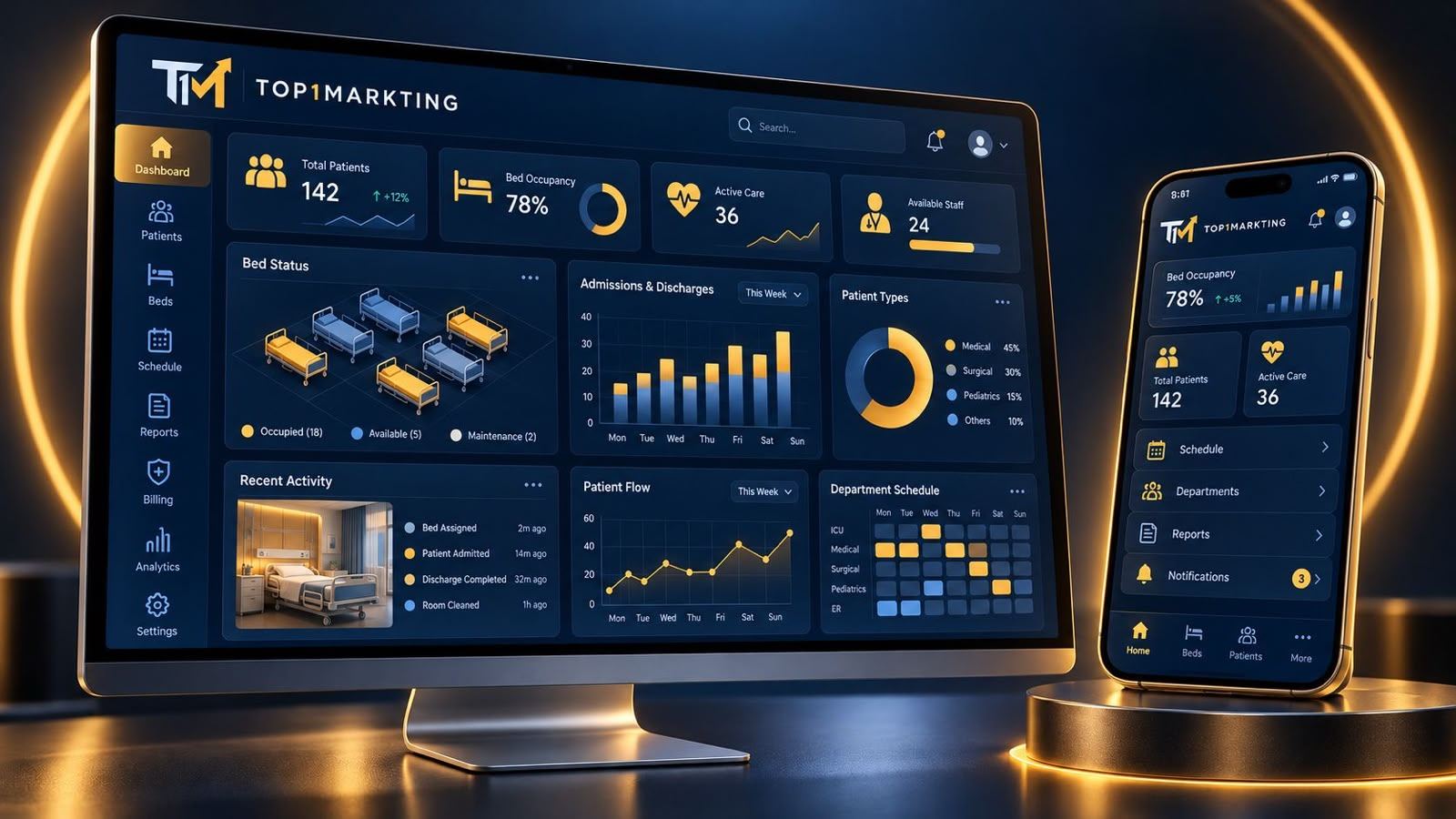
In addition to programming a hospital or medical center management system, a facility may need digital services that help present its services, receive patient requests, and introduce its specialties and physicians.
It is important to distinguish between the internal system that manages operations and data and the website that serves as the facility’s public-facing interface for visitors and patients.
The project may include designing a hospital or medical complex website, creating pages for departments, specialties, and physicians, and adding contact and appointment request forms.
It may also include Search Engine Optimization (SEO) and content optimization for visibility in AI-powered search environments through Generative Engine Optimization (GEO).
The website or online portal can also be connected to the medical system so that appointment requests or permitted data are transferred to the internal system through APIs, provided that the technical architecture and permissions allow it.
However, an informational website is not a replacement for a hospital management system, and connecting external services requires separate analysis and scope definition.
Top1Markting provides these services as complementary digital solutions for medical system projects. Facilities can select the services they need according to their goals, whether they require an informational website, improved service pages, or integration between an appointment form and an existing system.
Designing a Website for Hospitals and Medical Complexes in Jeddah
Hospital website design in Jeddah helps create an online interface that presents facility information to patients and visitors and explains its specialties, services, departments, and contact methods.
An informational website differs from a hospital management system. The website presents information and supports general interaction with visitors, while the internal system manages operations and data according to user permissions.
A website may include:
-
An overview of the hospital or medical complex.
-
Dedicated pages for departments and medical specialties.
-
Physician profile pages.
-
Information about services, appointments, and contact methods.
-
A form for appointment requests or service inquiries, according to the facility’s request-handling process.
The website should be responsive across mobile phones and other devices. Its page structure should also be clear and easy to navigate so visitors can quickly find the specialty or service they need.
The website can also be designed to support the addition of new departments and services in the future.
Professional website design services in Jeddah include developing websites suited to companies and organizations, with the ability to customize the site structure and content according to hospital or medical center requirements.
If you want to introduce patients to your facility’s services, specialties, and physicians, request a website that presents information clearly and makes contact details and appointment requests easy to access.
SEO for Hospital and Medical Center Websites in Jeddah
Hospital and medical center websites need well-organized pages and content so visitors and search engines can understand the services and specialties offered by the facility.
SEO for hospitals in Jeddah includes reviewing technical performance, content, and page structure while considering how people search for medical services and information about departments and physicians.
The SEO process begins with a technical website audit, reviewing crawlability, indexability, page speed, and user experience.
The website structure, internal links, service pages, and specialty pages are then analyzed. Page titles, descriptions, content, and the clarity of the information provided on each page are also reviewed.
An important part of the process is creating well-structured pages for medical services and specialties, explaining the nature of each service and relevant facility information.
Content duplication and similar pages that provide no meaningful value should be avoided.
Relevant Structured Data can also be considered when its requirements apply, and page visibility in search results can be monitored using measurement and analytics tools.
The SEO strategy varies according to the website’s current condition, competition, and the keywords targeted by the facility. A specific ranking or immediate appearance in Google results cannot be guaranteed.
However, structured SEO work can help address technical issues, improve content organization, and clarify the relationship between website pages and the services they describe.
You can explore SEO services for websites and companies in Jeddah if you want to review your medical website and improve service and specialty pages through an appropriate SEO strategy.
If your facility already has a website, request an initial review of its technical performance and service pages to identify improvement opportunities and priorities.
GEO Services for Hospitals and Medical Centers and Visibility in AI-Powered Answers
As AI-powered search and answer tools continue to develop, it is increasingly important for hospital and medical center information to be organized and clear.
The relationship between the facility’s name, location, specialties, and services should be easy to understand.
GEO for medical centers in Jeddah focuses on improving the organization of digital content and information so that search engines and generative answer systems can interpret it more clearly.
GEO differs from traditional SEO through its additional focus on entity clarity and the relationships between information, alongside content quality and structure.
Possible activities include reviewing the facility’s profile, standardizing essential information, organizing specialty and service pages, improving content structure, and using appropriate structured data when applicable.
Related terms include:
-
Generative Engine Optimization.
-
Entity Clarity.
-
Structured Content.
-
Knowledge Representation.
These concepts help create more connected and understandable content, allowing digital systems to interpret the facility’s name, services, and areas of operation through its published information.
Implementing GEO does not guarantee that a hospital will appear in ChatGPT answers or any other AI tool. It also cannot guarantee a specific ranking or number of appearances.
Results depend on multiple factors related to sources, content, and each platform’s mechanisms. However, information clarity and organization can be improved to support better understanding and potential use of the published content.
If you want to develop your facility’s presence in modern search environments, request an assessment of your website content and the clarity of its published hospital, specialty, and service information.
Connecting the Informational Website to the Appointment System and Medical Portal
A website can be transformed from an informational interface into a channel for receiving appointment and inquiry requests by connecting the hospital website to its appointment system or internal medical portal.
This connection allows requests submitted through the website to reach the system used by reception staff or clinic management instead of being handled as separate messages disconnected from internal workflows.
For example, a Booking Form can allow visitors to select a specialty or required service, enter their contact information, and suggest a preferred time.
The request can then be sent to the internal system through API Integration, provided that the system offers suitable interfaces and its permissions allow the connection.
After the request is received, it can be reviewed and converted into an appointment according to the facility’s procedures.
The website can also be connected to a Patient Portal, allowing users to access selected services through their accounts according to the available permissions and developed functions.
This may include tracking appointment requests or viewing selected information, provided that the system’s external access rules clearly define which data and services can be made available.
When designing the integration, the data flow must be defined from the moment a request is submitted until it reaches the responsible employee.
The integration should also handle transmission failures, duplicate requests, and data validation. Sensitive medical information must not be made available through the website unless appropriate security measures and clear permissions have been implemented.
Electronic portal development services can also be used when a facility needs a medical portal with user accounts and services or wants to connect website interfaces to relevant internal system functions.
If you want to receive appointment requests through your hospital website and connect them to the internal system, request a definition of the appointment request flow from the website to the reception system, along with the technical interfaces required.
Frequently Asked Questions About Hospital and Medical Center Management System Programming in Jeddah
What Is a Hospital Management System (HMS) in Jeddah?
A Hospital Management System (HMS) is software designed to manage medical and administrative operations within a hospital.
It can be developed to include patient registration, appointments, medical records, department management, billing, reports, and user permissions, according to the healthcare facility’s requirements in Jeddah and the project scope.
What Is the Difference Between HMS, HIS, EMR, and EHR When Developing Medical Systems in Jeddah?
These systems differ according to the functions they focus on:
-
HMS: Focuses on managing administrative and operational processes within a hospital.
-
HIS: A Hospital Information System that connects different functions and data across a healthcare facility.
-
EMR: An Electronic Medical Record system that focuses on documenting a patient’s medical information within a facility.
-
EHR: An Electronic Health Record system that may support the exchange of health information between multiple organizations, depending on available integration capabilities and permissions.
Choosing the appropriate system for a facility in Jeddah depends on its operating model, required modules, and data management approach.
Can a Custom Hospital Management System Be Programmed in Jeddah?
Yes. A hospital’s procedures and the requirements of its different departments can be analyzed before developing a custom system with the required modules, interfaces, and databases.
This avoids forcing ready-made functions onto a facility when they may not match its operating procedures.
Development begins by defining the requirements and project scope before selecting the appropriate technical architecture.
Can a Management System Be Developed Specifically for Medical Centers and Clinics in Jeddah?
Yes. A system can be developed to manage medical centers and clinics in Jeddah, with a scope appropriate to the facility’s size and operating model.
It can focus on patient records, appointments, physicians, specialties, invoices, and reports, with additional functions available when needed, such as branch, laboratory, or pharmacy management.
Does a Hospital Management System in Jeddah Support Both Arabic and English?
Bilingual interfaces, forms, and reports can be developed with support for Arabic right-to-left (RTL) display and English left-to-right (LTR) display.
The translation scope, data presentation, and medical terminology are determined according to the hospital or medical center’s requirements.
Can a Hospital System Be Connected to Laboratory and Radiology Systems in Jeddah?
Integration between the medical system and the facility’s laboratory software, radiology systems, and devices can be assessed according to the integration capabilities, protocols, and interfaces available.
Each system or device must be examined separately to identify the appropriate integration method. It should not be assumed that all devices support integration in the same way.
Can a Hospital Management System Be Connected to Insurance Companies in Jeddah?
Functions can be developed to manage insurance information, approvals, claims, and insurance invoices within the system.
Actual integration with insurance companies or insurance platforms requires reviewing the available integration interfaces and the technical and regulatory requirements of each organization before defining the implementation scope.
Can Multiple Medical Branches Be Managed Through One Dashboard in Jeddah?
Yes. The system can be designed to manage multiple medical branches through a centralized dashboard.
It can provide separate permissions for each branch or unified branch management, depending on the facility’s organizational structure and operating model.
Reports can also be configured to help management monitor data and operations across different locations.
How Much Does It Cost to Program a Hospital Management System in Jeddah?
The cost of programming a hospital management system in Jeddah depends on the facility’s size, number of departments and users, required modules, external integrations, data migration, hosting, and technical support.
The cost is therefore determined after analyzing the hospital or medical center’s requirements and preparing a clearly defined project scope, rather than relying on one standard price for all facilities.
Can a Hospital Management System in Jeddah Be Developed in Phases?
Yes. The project can be divided into phases, beginning with high-priority functions such as patient management, appointments, medical records, and billing.
Advanced modules and integrations can then be added according to the facility’s requirements and budget.
This approach helps organize development and expand the system gradually.
Can Patient Data Be Transferred from an Old System to a New Hospital System in Jeddah?
Patient data migration from the current system can be assessed after reviewing the database, file formats, data quality, and ability to extract the information.
The assessment identifies the data to be transferred, reviews its structure, and tests migration integrity before the records are approved for use in the new system.
Does a Hospital Management System in Jeddah Include Patient Data Protection?
Technical measures can be implemented to protect patient data, including role-based access permissions, operation and modification logs (Audit Logs), backups, and controlled access to information.
The appropriate protection controls and regulatory requirements are determined according to the facility’s nature and the regulations applicable in the Kingdom of Saudi Arabia.
Start Developing Your Hospital and Medical Center Management System in Jeddah with Top1Markting
If you are looking for a company to program a hospital management system in Jeddah, the first step is to identify your hospital or medical complex’s requirements and the modules you need to manage.
These may include patient management, appointments, medical records, departments, billing, insurance, and reports.
A successful system does not depend on the number of features it contains. It depends on how well its functions match actual workflows, how easy it is to use, and whether it can be developed further in the future.
Top1Markting provides analysis, design, and programming services for custom administrative and medical systems, including management systems for hospitals, medical centers, and multi-specialty clinics.
Services can include dashboards, databases, Arabic-English interfaces, and integration with external systems according to available technical requirements.
Whether you manage a multi-department hospital, a specialized medical center, or a group of clinics in Jeddah, you can discuss your project, define the required functions, and determine implementation stages to receive a technical proposal and quotation suited to the project scope.
Contact Top1Markting at 0549881368 to discuss your project and begin analyzing the requirements for programming a hospital or medical center management system that meets your facility’s needs.