E-commerce Store Development in Dubai | Custom Store Programming | Top1Markting
Custom e-commerce store development in Dubai, built from scratch, with a custom admin dashboard, database development, payment and shipping integration, API integration, Arabic and English support, and SEO-ready store development. +971507662114
MAMohamed Al-Khatib
|
5 min read
E-commerce Store Development in Dubai | Custom Store Programming | +971507662114
When you need to create an e-commerce store in Dubai, ready-made solutions may not be suitable for every business, especially when the project requires custom functionality, a dedicated admin dashboard, or integrations with payment, shipping, inventory, and customer management systems. That is why e-commerce store development focuses on building the store according to the nature and requirements of the business instead of limiting the project to the capabilities of a ready-made template or platform.
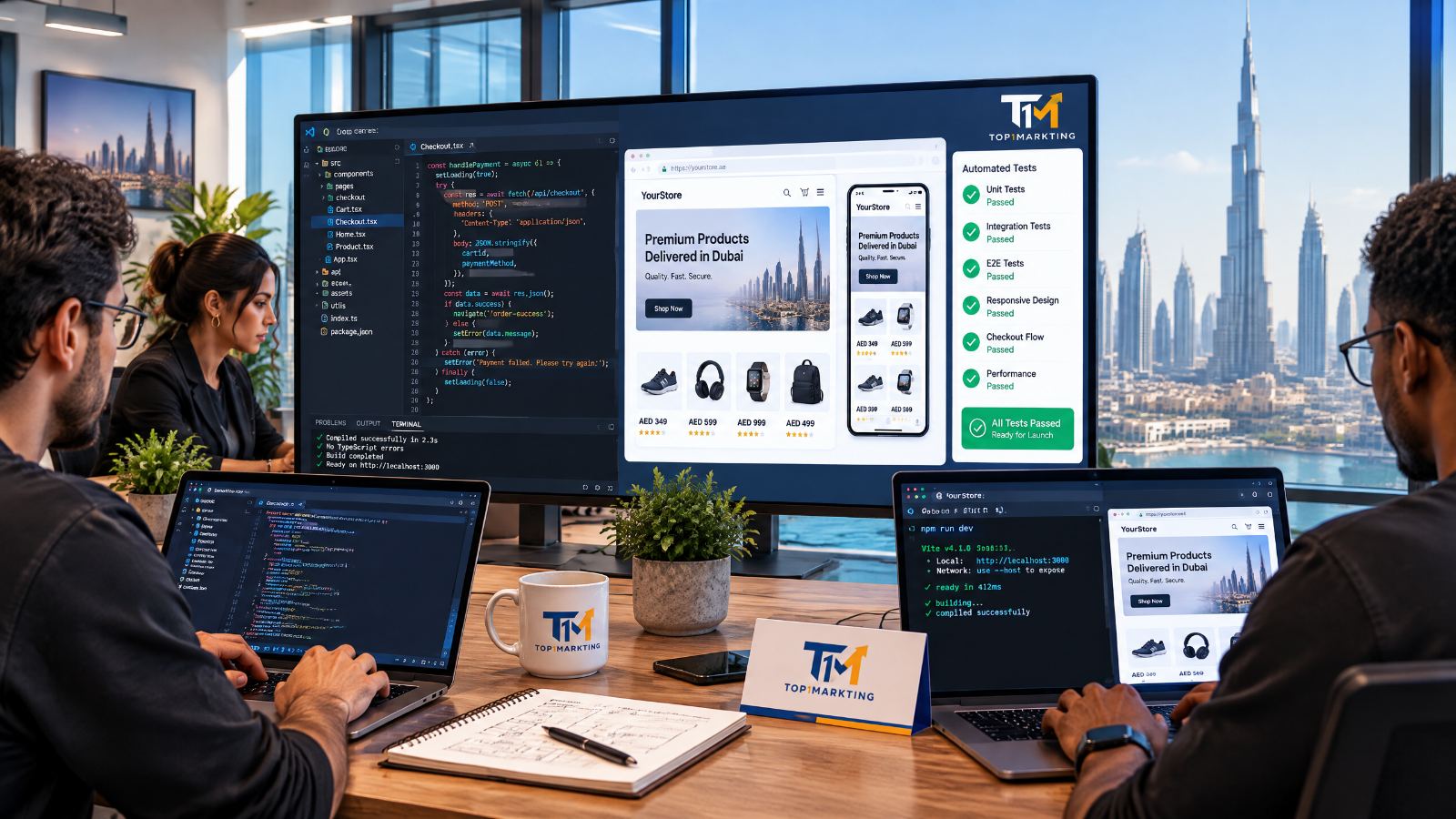
Top1Markting provides e-commerce store development services in Dubai through custom store programming, including interface design, Backend and Frontend development, database development, admin dashboards, product, order, and customer management, with the ability to integrate payment gateways, shipping services, WhatsApp, APIs, and analytics tools.
The store is developed to be mobile-responsive, scalable, user-friendly, and optimized for search engines, with the ability to add the functions and systems required by the project, whether it is a new store or an existing business looking to move to a more flexible e-commerce platform.
+971507662114
Why Do Some E-commerce Stores in Dubai Need Custom Programming?
Not all e-commerce stores operate in the same way when it comes to selling, managing products, processing orders, or handling customers. A project may start with a ready-made solution and later develop new requirements that the existing platform cannot provide in the required way. In such cases, custom programming allows the store to be developed according to the business workflow instead of forcing the business to adapt to a ready-made system.
When a Ready-made Store Is Not Enough
Ready-made platforms may be suitable for stores with simple sales processes, but some businesses require different functions or workflows. When the capabilities of the platform become a limitation, a custom system can be developed to provide the required functionality.
Different Sales Models for Different Businesses
A store selling ready-made products operates differently from a store based on pre-orders, customized products, subscriptions, or quantity-based pricing. Some businesses therefore need custom programming logic that matches their sales model and order management process.
Functions Not Available in Ready-made Solutions
A store may require features such as custom pricing, membership systems, conditional offers, multi-location inventory, or automated order processes. In such cases, the required functionality can be developed directly within the system instead of relying on extensions that may not fully meet the project's requirements.
The Need for a Custom Admin Dashboard
Store management teams may require an admin dashboard that differs from traditional dashboards, allowing them to view data, orders, customers, inventory, and reports according to their actual workflow.
Connecting the Store with Company Systems
The store may need to communicate with other systems within the company, such as CRM, ERP, inventory, accounting, shipping, or payment systems. Custom programming makes it possible to build the required integrations through APIs according to the system architecture.
Scaling as the Store Grows
As the number of products, customers, orders, branches, or company operations increases, new requirements may appear in administration, reporting, permissions, and integrations. The store can therefore be built from the beginning in a way that allows new functions to be added as the project grows.
When Is Custom Development Suitable for a Dubai Project?
Custom development can be suitable when the store has a unique workflow, requires custom functionality, multiple integrations, a dedicated admin dashboard, greater scalability, or when ready-made solutions can no longer meet the project's current or future requirements.
How Does a Store Idea Become an E-commerce System?
Before writing the code, the store concept needs to be converted into clear requirements that can be implemented programmatically. At Top1Markting, the development process starts by understanding how the business operates and identifying the components it needs, then building the technical structure according to those requirements.
Understanding the Business Model
The first step is to identify how the store generates sales, how products are presented, how orders are processed, how customers are handled, and what differentiates the business from others.
Defining Products and Services
The types of products or services and the data required for each product are identified, including images, descriptions, prices, options, inventory, categories, and attributes.
Defining the Customer Journey
The user journey is mapped from entering the store to searching for a product, selecting it, adding it to the cart, completing payment, and receiving the order, while identifying the stages that require custom functionality.
Defining Users and Permissions
Different types of users can be defined, such as store managers, order staff, inventory employees, and customer service teams, with specific permissions assigned to each user.
Defining Payment Methods
The required payment methods are identified and integrated with suitable payment gateways, while considering payment status and automatic order updates after successful or failed transactions.
Defining Shipping and Delivery
Delivery areas, shipping companies, shipping fees, and order tracking methods are defined according to the business model and the areas served by the store.
Defining Required Reports
Store owners can determine the reports they need, such as sales, orders, customers, products, inventory, and order sources, allowing the admin dashboard to be designed around the data actually required.
Defining Technical Requirements
After understanding the business model, the project requirements are converted into technical specifications covering interfaces, database, Backend, Frontend, permissions, integrations, and APIs.
Building the Structure Before Development
Before developing the functions, the overall system structure is established, including the relationships between pages, users, products, orders, database components, and integrations, so that the development process is based on a clear and scalable architecture.
Building an E-commerce Store from Scratch in Dubai
When a project requires a custom-developed store, the core system components are developed according to the defined requirements instead of relying on a ready-made template. Top1Markting develops the store to combine the customer-facing interface with the backend systems that manage store operations.
Interface Design
The store starts with clear and user-friendly interfaces covering the homepage, categories, products, cart, checkout, account pages, and information pages, while considering the mobile user experience.
Frontend
The Frontend represents the part customers interact with. It is developed to display products, options, carts, and orders in an organized and responsive way across different screen sizes.
Backend
The Backend handles core operations such as user registration, orders, products, payments, permissions, database interactions, and external integrations.
Database
The database is designed according to the store's requirements and the data it needs to manage, including products, customers, orders, payments, inventory, categories, and permissions.
Admin Dashboard
The admin dashboard allows store elements to be managed from one place, including products, orders, customers, inventory, content, users, and reports according to the permissions assigned to each user.
User Management System
A customer registration, login, and account management system can be developed, along with different internal user permissions based on roles.
Product Management
Product management can include adding and editing products, categories, prices, images, options, inventory, and the required product data.
Order Management
An order management system can be developed to manage different order stages, starting from order creation through payment, preparation, shipping, and delivery, with customizable statuses according to the store's workflow.
Customer Management
Customer information and order history can be managed and connected to other systems when the project requires CRM or custom customer management solutions.
API Development
APIs can be developed to connect the store with external services and systems, including payment gateways, shipping companies, CRM, ERP, analytics tools, and other services required by the project.
Store Function Testing
Before launch, the core functions, pages, registration forms, cart, payment, orders, permissions, and integrations are tested, along with the store across different devices to ensure the components work as required.
If the project requires a web system that goes beyond a traditional e-commerce store, its requirements can be connected with Custom Web Development in Dubai to develop a custom platform that combines the store, systems, and additional functions within a single technical architecture.
Developing an E-commerce Store for the Dubai Market
When developing an e-commerce store targeting customers in Dubai, programming is not limited to displaying products and completing orders. The system can be built around the nature of the audience, delivery areas, branches, payment methods, and customer service requirements. Top1Markting develops custom e-commerce stores according to the project's requirements and target market.
Arabic and English Customer Support
The store can support Arabic and English content, products, orders, and customer service, with the user experience customized for each language according to the target audience.
RTL and LTR Design
The Arabic version supports RTL, while the English interface uses LTR, with the interfaces designed to maintain usability in both directions.
Targeting Customers in Dubai
The store can be prepared to serve customers in Dubai through local market content and pages, with the ability to connect advertising campaigns and geographic data with order sources to identify areas generating stronger results.
Supporting Different Areas in Dubai
A system can be developed to define delivery areas within Dubai and assign different fees, conditions, or delivery times to each area when required, rather than using one standard setting for all customers.
Multiple Branches and Points of Sale
If a business has multiple branches, the system can be developed to manage branches and connect orders, inventory, and delivery to the appropriate branch according to the required workflow.
Delivery Options in Dubai
Multiple delivery options can be added, with the ability to define delivery fees, service areas, minimum order values, or delivery conditions according to the store's requirements.
Online Payment Methods
The store can be integrated with suitable online payment gateways, with payment statuses processed and order statuses updated according to the payment result.
Connecting the Store with Customer Service and WhatsApp
Direct customer service options can be added, including WhatsApp integration when required, to facilitate inquiries, order follow-up, and customer communication.
Preparing the Store for Expansion Across the UAE
The store can be built in a way that allows additional areas, branches, and delivery options to be added as the business expands to other Emirates, without rebuilding the entire system at each stage of growth.
Custom Product and Category Programming
Product management varies from one store to another, so the product and category system can be designed according to the nature of the business instead of relying on a standardized structure. Custom programming at Top1Markting allows functions to be developed around the store's products, sales model, and management process.
Product System
A complete product system can be developed to add and manage product data, including names, descriptions, images, prices, inventory, categories, and attributes.
Products with Multiple Options
Products with multiple options can be supported, such as size, color, type, or other attributes, with the ability to connect each option to pricing or inventory when required.
Sizes and Colors
A system can be created to manage sizes and colors and associate them with products, allowing customers to select available options before adding a product to the cart.
Digital Products
The store can be developed to sell digital products, with an appropriate mechanism for delivering or providing access to the product after payment.
Made-to-Order Products
Custom-order products can be supported, allowing customers to provide specific information, options, or specifications before submitting an order.
Products with Variable Inventory
Inventory can be connected to products, options, and branches when required, allowing quantities to be updated according to orders and store operations.
Main and Subcategories
A main and subcategory structure can be created to organize products and help customers reach the required section easily.
Filters and Search
Search and filters can be developed according to product attributes, such as price, category, color, size, brand, and other characteristics relevant to the business.
Related Products
Related or recommended products can be displayed based on the product being viewed, helping customers discover additional products within the store.
Offers and Coupons
An offers and coupon system can be developed according to conditions defined by the business, such as percentage discounts, fixed amounts, campaign durations, or specific products and categories.
E-commerce Admin Dashboard Designed Around Project Requirements
The admin dashboard is the part of the store used by the management team on a daily basis. Therefore, it should not simply be an interface for adding products, but can be developed around the business workflow and the tasks performed by the team.
Product Management
Adding, editing, deleting, and organizing products, prices, images, categories, options, and inventory.
Order Management
Monitoring orders, changing statuses, reviewing customer, payment, and delivery details, and customizing order stages according to the business model.
Customer Management
Managing customer data, tracking orders and interaction history, and connecting customer data to external systems when required.
Inventory Management
Monitoring available quantities and connecting inventory with products, branches, and different options according to the business workflow.
Price Management
Managing product prices, offers, and special pricing according to the permissions and settings required by the project.
Coupon Management
Creating and managing discount codes, defining usage conditions, values, validity periods, and applicable products.
Content Management
Managing page content, banners, sections, articles, and other store elements through the admin dashboard.
Branch Management
For multi-branch businesses, each branch can be managed with its location, inventory, orders, and customer activity according to the required system.
User and Permission Management
Multiple accounts can be created for store employees with specific permissions, ensuring that each employee only has access to the data and functions required for their role.
Reports and Analytics
Reports can be developed to display important data such as sales, orders, customers, products, and inventory, with customized reporting based on management requirements.
Store Settings
The dashboard can manage general store settings, including business information, payment methods, shipping, languages, taxes, notifications, and other project-specific settings.
When store requirements extend beyond product and order management into a complete operational platform, a custom dashboard and business solutions can be developed through Software Systems Development Company, connecting e-commerce operations with the company's internal processes within one system.
Connecting an E-commerce Store with Payment and Shipping in Dubai
E-commerce development does not stop at designing pages and displaying products. It can include a complete process that handles the order from product selection through payment, delivery, and order-status updates. Top1Markting develops stores that can integrate suitable payment methods, calculate shipping, manage orders, send notifications, and communicate with external systems and services.
Payment Gateways
The store can be integrated with online payment gateways suitable for the business and target market, with a clear and secure checkout process and automatic order-status updates based on the payment result.
Cash on Delivery When Suitable
Cash on delivery can be added when appropriate for the products and business model, with rules defining when this option is available and connecting it with order and delivery management.
Shipping Cost Calculation
A shipping calculation system can be programmed based on factors such as customer location, order value, product weight, number of items, or delivery type, allowing the shipping cost to be displayed before order confirmation.
Delivery Companies
The store can be integrated with delivery services and companies used by the business, allowing order information to be transmitted and shipping updates to be received according to the external system and available API.
Delivery Areas in Dubai
Delivery areas in Dubai can be divided into zones with different fees or conditions when required, such as minimum order values, delivery fees, or estimated delivery times.
Order Statuses
Clear order statuses can be developed, such as new, under review, confirmed, being prepared, out for delivery, delivered, or cancelled, with the ability to customize statuses according to the business model.
Order Notifications
Automatic notifications can be sent when an order is created or its status changes, through email, WhatsApp, or other notification services that can be integrated into the system.
Invoices
An invoicing system can be prepared to generate and manage order and invoice data through the dashboard, with the ability to customize it according to the project's accounting workflow.
Connecting the Store with External Systems
The store may need to communicate with an inventory system, CRM, ERP, accounting software, or shipping platform. Custom programming allows these integrations to be developed according to project requirements rather than being limited to predefined features.
APIs and Software Integrations
APIs allow the store to connect with external systems and services and exchange data between them, whether for sending orders, updating inventory, synchronizing customers, or tracking payment and shipping operations.
Multi-Branch E-commerce Store Development in Dubai
When a business operates multiple branches in Dubai, the e-commerce store needs to handle branches, inventory, orders, delivery, and permissions through a unified structure. These functions can be developed within the store to provide centralized management while maintaining branch-specific data and processes.
Creating Multiple Branches
Multiple branches can be added to the system, with each branch having its own location, contact details, working hours, and services.
Independent Inventory for Each Branch
Products can be connected to each branch's inventory independently, allowing management to monitor quantities at each location and track inventory movement.
Branch Order Management
Orders can be directed to the appropriate branch based on location, inventory, or business rules defined by the project, with tracking from receipt through preparation and delivery.
Delivery Areas
Each branch can be assigned specific delivery areas, delivery fees, order conditions, or routing rules to organize deliveries throughout Dubai.
Branch Employees
Separate accounts can be created for branch employees, with each user connected to the responsible branch and assigned the functions they are allowed to perform.
User Permissions
Custom programming allows different permissions to be assigned to managers, branch employees, order staff, inventory employees, and other users, so each user can access only the data and functions required.
Branch Reports
Separate reports can be developed for each branch to display orders, sales, inventory, customers, and other data, along with consolidated reports for central management.
Dedicated Branch Page When Required
A dedicated page can be created for each branch, including location, services, contact information, and opening hours, with the ability to optimize branch pages for search engines as part of a local SEO strategy.
Centralized Branch Management
Instead of managing each branch through a separate system, a centralized dashboard can allow management to monitor branches, orders, inventory, users, and reports from one place while maintaining appropriate permissions and data separation.
Arabic and English E-commerce Store for Dubai
E-commerce stores in Dubai may need to provide a shopping experience in both Arabic and English, particularly when serving different customer groups. Therefore, multilingual functionality should be part of the store architecture from the programming stage rather than simply translating text after development is completed.
Arabic Content
The Arabic interface and content can be prepared for right-to-left reading, with products and categories organized clearly for Arabic-speaking users.
English Content
A complete English version of the store can be provided, including interfaces, products, categories, and essential information, while maintaining an organized user experience.
RTL and LTR
Both RTL for Arabic and LTR for English can be supported across interfaces and elements, including menus, forms, product pages, and checkout.
Bilingual Product Titles
Separate fields can be created for product names, descriptions, and information in Arabic and English so that the appropriate data is displayed according to the customer's selected language.
Category Pages
Categories and internal pages can be organized separately for each language, with proper URL structures, content, and headings to avoid treating multilingual versions as duplicate pages.
Language-Specific User Experience
Navigation, interface elements, and content can be customized according to the selected language while maintaining a smooth transition between both versions.
SEO for Multilingual Versions
Multilingual e-commerce SEO should address page structure, titles, descriptions, URLs, internal linking, and language signals so search engines can understand the different versions of each page.
Language URL Structure
A clear language URL structure can be built so that each language version has an understandable and manageable architecture, with the technical elements required for multilingual content.
Developing a Shopping Experience for Dubai E-commerce Customers
Store success depends not only on the number of products or visual design, but also on how easily customers move from product discovery to order completion, delivery tracking, and repeat purchases. The shopping journey can therefore be developed around the nature of the products, customer behavior, and business goals.
Product Search
The store search can be developed to help customers find products quickly, with filters, categories, and options appropriate to the products.
Product Page
The product page can include essential information such as images, description, price, options, availability, shipping information, and return policy, with the elements organized to support the customer's purchasing decision.
Adding Products to the Cart
Adding products to the cart should be clear and fast, with quantities, prices, selected options, and cart contents updated before checkout.
Checkout
The Checkout page can be developed to reduce unnecessary steps and collect only the information required to complete the order, with customizable fields based on the business and delivery method.
Delivery Selection
Customers can select their preferred delivery method when multiple options are available, with the related fees and conditions displayed clearly.
Payment Selection
Available payment options are displayed according to the store settings, including online payment or cash on delivery when available and appropriate.
Order Confirmation
After payment or order confirmation, the order is created in the system and its details are displayed to the customer while the required information is recorded in the admin dashboard.
Order Tracking
A page or system can be developed to allow customers to follow order status, such as being prepared, out for delivery, or delivered, according to the statuses used by the store.
Repeat Purchases
Features can be provided to help customers reorder previous products, such as order history and the ability to add previously purchased products to the cart.
Post-Purchase Customer Service
The store can be connected to customer service through WhatsApp, email, or other communication channels, with the ability to associate customer inquiries with order numbers for easier follow-up.
This makes e-commerce development part of the complete sales process, starting with product presentation and continuing through payment, shipping, customer service, and repeat purchases.
Developing Search and Filters Inside the Store
As the number of products and categories increases, search and filtering become more important for helping customers find the right products quickly. A custom search system can therefore be developed around product characteristics, with filters and sorting options that improve the browsing experience.
Instant Search
Search can be developed to display results while the customer types, including relevant products, categories, or suggestions.
Search by Product Name
Customers can find products by name, with support for different word forms and common ways of writing product names.
Search by Category
Search results can be connected to main and subcategories, allowing customers to narrow results and reach a specific product group.
Search by Brand
For stores with multiple brands, search or filtering by brand can make it easier to find specific products.
Price Filtering
A price range can allow customers to define minimum and maximum prices and display products within the selected budget.
Specification Filtering
Filters can be developed according to product characteristics, such as color, size, material, capacity, weight, or other specifications relevant to the business.
Product Sorting
Results can be sorted by price, newest products, best sellers, ratings, or another criterion suitable for the store.
Search Optimization for Large Stores
Stores with large product catalogs require a more efficient search structure to handle data volume and deliver fast results. Database indexing, query processing, and data architecture can be organized to maintain store performance and accessibility.
Developing an E-commerce Store Connected to Company Systems
An e-commerce store may be part of a larger business ecosystem. Development therefore does not have to be limited to managing products and orders within the store. The system can be built to exchange data with the company's other systems. Custom programming allows these integrations to be designed around the actual business architecture instead of treating the store as an isolated platform.
CRM
The store can be connected to a customer relationship management system to transfer customer and order data and link purchases to customer records, helping sales and customer service teams access information from the company's main system.
ERP
Integration with an ERP system can exchange information related to products, inventory, orders, customers, and invoices according to the systems and permissions used by the organization.
Inventory System
Product quantities can be synchronized between the store and the inventory system so availability is updated when sales or internal changes occur.
Accounting System
Orders, invoices, and payment data can be connected with the company's accounting system, with the data and synchronization method defined according to project requirements.
Point-of-Sale System
When a company operates physical branches or stores, the e-commerce store can be integrated with the point-of-sale system to connect product, sales, and inventory data.
WhatsApp
The store can be connected to WhatsApp services to send order notifications, receive customer inquiries, or transfer selected information to the customer service team, depending on the available technical tools.
Email
An automated email system can be developed to send messages when an order is created, its status changes, a customer registers, or other defined actions occur.
SMS
The store can be connected to an SMS service to send notifications such as order confirmation, shipping updates, or other alerts defined by the business.
API
APIs allow data exchange between the store and external systems, whether for sending orders, receiving product information, updating inventory, or synchronizing customers, with authentication and data exchange mechanisms defined according to the system requirements.
Webhooks
Webhooks can be used to automatically notify external systems when specific events occur inside the store, such as creating a new order, changing order status, or completing payment.
When project requirements go beyond a traditional e-commerce store, these integrations can be developed as part of a complete software ecosystem through Software Systems Development Company, connecting the store with internal systems and external services while organizing data, permissions, and information exchange.
Store and Data Security
When developing an e-commerce store in Dubai, data and transaction security should be part of the system architecture from the beginning, especially when the store handles customer accounts, orders, payments, and internal business data. Custom development can therefore include security layers for the interface, dashboard, database, and APIs.
User Account Security
Customer and user accounts can be protected through appropriate login mechanisms, secure password management, and session controls that reduce the risk of unauthorized access.
Permissions
Separate permissions can be assigned to different user types so employees and managers cannot access functions or data outside their responsibilities.
Admin Dashboard Security
The admin dashboard requires additional protection because it contains product, order, customer, and configuration data. Appropriate access controls and verification methods can be implemented according to the system.
Customer Data Protection
Customer information should be handled through secure storage and transmission mechanisms, with access to sensitive information limited to authorized users and functions.
API Security
When the store is connected to external systems through APIs, endpoints should be protected using appropriate authentication and validation methods, with clear definitions of the data and operations each party can access.
Backups
A periodic backup system can be configured for store and database data to support recovery in the event of technical problems or unexpected data loss.
System Updates
Updating system components, software libraries, and integrations when required can help address vulnerabilities and technical issues while maintaining store stability.
Error Monitoring
Error monitoring and event logging can be developed to identify technical issues, analyze their causes, and address them before they significantly affect the store or customers.
Payment Security
Payment transactions can be handled through appropriate payment gateways, avoiding storage of sensitive payment information within the store when it is not required and relying on the security mechanisms provided by the selected payment gateway.
SEO Within E-commerce Store Development
Store SEO readiness begins with programming and page architecture, not content alone. When an e-commerce store is developed with custom programming, its technical structure can be prepared from the beginning to facilitate crawling and indexing and improve how product and category pages are presented to search engines.
URL Structure
Clear and organized URLs can be developed for products, categories, and other pages while avoiding random structures or URLs that are difficult to understand and manage.
Page Titles
Page titles can be managed through the admin dashboard, allowing suitable titles to be assigned to each product, category, and internal page.
Meta Title and Meta Description
Dedicated fields for Meta Title and Meta Description can be added to the admin dashboard, allowing SEO data to be managed for products, categories, and other pages.
Canonical
Canonical tags can be supported when required, particularly where multiple URLs may lead to similar content or where filters and product options generate variations.
Sitemap
The store can generate and update a Sitemap for important pages as products and categories are added or modified, helping search engines discover content.
Robots
The Robots file can be managed to define which pages or paths search engines should access or avoid crawling according to the site's SEO strategy.
Schema
Relevant structured data can be added for products, categories, and other information where appropriate, helping search engines understand the type of content on each page.
Product Pages
Product pages should be indexable and contain clear elements such as product name, description, price, images, and important information, with SEO data managed through the dashboard.
Category Pages
Category pages can be developed with clear structures, internal links, and manageable content rather than functioning simply as product collections without an appropriate SEO structure.
Store Speed
Programming methods, file loading, database queries, and server-side operations can affect store performance, so speed and unnecessary elements should be considered during development.
Mobile Experience
The store should work effectively across smartphones and other devices, with attention to loading speed, navigation, and purchasing from smaller screens.
When a comprehensive SEO strategy is required to improve the visibility of the store, content, and pages in search engines, the development work can be connected with SEO Company in Dubai, combining technical SEO, store architecture, and content within one strategy.
Store Design and Development: Where Does Programming Begin?
E-commerce design and programming are connected stages, but each has a different role. Design focuses on appearance, user experience, and element placement, while programming transforms those interfaces into an actual system capable of managing products, customers, orders, payments, shipping, and other functions.
Store Interface Design
The process begins by defining the interface structure and arranging elements such as navigation, products, categories, cart, account pages, and checkout according to the business.
User Experience
The customer journey is organized so users can move from the homepage to products, the cart, and checkout in a clear and structured way.
Frontend Development
Once the design is approved, the interfaces are converted into a functional Frontend that works across different screens and devices, with attention to interaction and responsiveness.
Building Store Functions
This is where programming plays its core role, developing products, carts, accounts, orders, payments, shipping, coupons, and other functions according to project requirements.
Database
A database is created to store products, customers, orders, inventory, settings, and other information, with relationships between data structured appropriately.
Admin Dashboard
A custom admin dashboard can be developed to manage products, orders, customers, inventory, content, and permissions from one place.
Testing
Before launch, the core functions are tested to ensure forms, orders, payments, search, filters, and integrations work properly across target devices and browsers.
Connecting Frontend and Backend
The Frontend communicates with the Backend through a software layer that sends and receives data and performs required operations, such as adding a product to the cart, creating an order, or updating shipping status.
Store design therefore does not exist separately from programming. It becomes complete when the interfaces are transformed into a functioning e-commerce system. Design and development can be combined through E-commerce Store Design Company to develop a complete store from interface design through functions, database, and admin dashboard.
Technologies That Can Be Used to Develop a Custom Store in Dubai
The technology used for e-commerce development should be selected based on the project's nature, product volume, user numbers, required integrations, and expected scalability rather than simply choosing a well-known technology. The technical architecture can therefore differ from one store to another, and Top1Markting selects suitable technologies based on the project's actual requirements.
PHP and Laravel
PHP and Laravel can be used to develop the Backend, manage store logic, database operations, accounts, orders, and software functions, particularly when the project requires a flexible and scalable development environment.
JavaScript
JavaScript can be used to develop interactive store elements such as search, filters, cart functions, forms, and real-time updates, and can be integrated with Frontend and Backend technologies according to the project architecture.
React
React can be used to build interactive and reusable interfaces, especially for stores with dynamic functions and user experiences that require elements to update without fully reloading the page.
Next.js
Next.js can be used for e-commerce projects that require modern interfaces, strong performance, and a web architecture suitable for applications with many pages and indexable content.
MySQL
MySQL can be used to manage data related to products, customers, orders, inventory, branches, and other store components, with the database designed according to the relationships between them.
REST API
REST APIs provide an organized channel for exchanging data between the store and external systems, including payment gateways, shipping services, CRM, ERP, mobile applications, and other services.
Backend and Frontend
The Frontend and Backend work together as one system. The interface interacts with customers, while the Backend handles business logic, database operations, permissions, and integrations.
Choosing Technology According to the Project
A small store may require a different architecture from a store with thousands of products, multiple branches, inventory management, and multiple integrations. Technologies and architecture should therefore be selected after analyzing requirements rather than relying on a fixed technology list.
E-commerce Store Development for Different Dubai Industries
E-commerce development varies according to products, sales models, order processing, and inventory management. Stores can therefore be developed around the requirements of each industry rather than using identical functionality and architecture for every business.
Fashion Stores
Size, color, material, and multiple product images can be supported, with inventory managed by size or color and appropriate product filters.
Perfume and Beauty Stores
Products can be organized by brand, type, usage, size, fragrance, options, offers, and related products.
Food Stores
Food products can be displayed with quantity, size, and add-on options, with orders connected to delivery areas, delivery schedules, and pickup times when required.
Electronics Stores
Technical specifications can be organized with filters based on brand, model, storage, and other features, with warranty, accessories, and related products managed according to business requirements.
Furniture and Home Décor Stores
Furniture and décor products may require options such as dimensions, colors, and materials, along with delivery or installation pricing based on location and order type.
Specialized Product Stores
Custom functionality can be developed for products that do not fit traditional categories, including made-to-order products or products requiring customers to provide specifications before ordering.
B2B E-commerce Stores
A B2B sales system can be developed with business accounts, multiple user permissions, special pricing, bulk orders, payment terms, and customized invoices according to the business model.
Multi-Branch Stores
Products, inventory, orders, delivery areas, permissions, and reports can be connected to individual branches while all branches are managed through a centralized dashboard.
Restaurants Requiring a Custom Ordering System
A custom ordering system can be developed for restaurants and cafés, including digital menus, add-ons, options, ordering times, delivery, pickup, payment, and customer service integrations.
What Happens After the Store Launch?
Launching an e-commerce store is not the end of development. It begins an operational stage in which actual data and customer behavior can be used to improve the system. Store performance can be monitored, issues can be identified, and new functions can be added as operations grow.
Performance Monitoring
Store speed, page stability, and core functions can be monitored to identify performance issues that may affect customer experience.
Error Detection
Technical errors and issues that appear during store usage can be monitored, analyzed, and addressed.
Order Analysis
Order data can help identify popular products and stages of the ordering process that may require improvement.
Customer Behavior Analysis
Customer navigation between pages, products, cart, and checkout can be analyzed to identify friction points and improve the shopping journey.
Product Updates
Stores continuously require new products, price changes, specification updates, inventory changes, and category updates, so data management should remain flexible.
Function Development
New requirements may appear after launch, such as loyalty programs, subscriptions, additional payment methods, or customer-specific functions.
Shopping Experience Optimization
Operational data and customer feedback can be used to simplify search, cart, checkout, payment, and delivery while reducing unnecessary steps.
Adding New Integrations
As the business grows, the store may need integration with CRM, ERP, new shipping providers, payment services, or other platforms.
Preparing the Store for Growth
The store architecture should be scalable so products, users, branches, functions, and integrations can be added without rebuilding the entire system at every stage.
When Should You Develop an Existing Store Instead of Building a New One?
Not every project needs to start from scratch. In some cases, the existing store can be upgraded, while its problems may be related to its software architecture or limitations. The existing store should therefore be evaluated first to determine whether gradual development is appropriate or whether rebuilding would better meet project requirements.
Existing Store Problems
Problems may appear in functionality, administration, integrations, or user experience. The first step is to identify the cause and determine whether it can be addressed within the existing architecture.
Slow Performance
If the store has become slow because of data volume, database queries, file loading, or architectural issues, the cause can be analyzed before deciding whether rebuilding is necessary.
Limited Admin Dashboard
The existing dashboard may not suit the way products, orders, or inventory are managed. It may be possible to improve or replace parts of it depending on the system's technical capabilities.
Payment and Shipping Problems
When the store does not support required payment or shipping services, the possibility of adding new integrations can be evaluated before replacing the entire system.
Difficult Product Management
If adding products, modifying prices, updating inventory, or managing categories requires complicated steps, improving the management system may become an important part of the development process.
Need for New Functions
The business may require functions that were not available when the store was first created, such as multi-branch management, special pricing, subscriptions, loyalty programs, or customized ordering.
Need for External Integrations
The store may need to connect with CRM, ERP, inventory, accounting, or point-of-sale systems. The available APIs and integration capabilities of the existing system should be evaluated.
Rebuilding or Gradual Development
There is no single solution for every store. Gradual development may be appropriate when the existing architecture is flexible, while rebuilding from scratch may be more suitable when deep technical limitations prevent implementation of essential requirements. The appropriate path can be determined after analyzing the current store, project requirements, development cost, and expected timeline.
How Do You Choose an E-commerce Development Company in Dubai?
Choosing an e-commerce development company in Dubai is not based only on the store's appearance or technologies used. It also depends on the company's ability to understand the business model and convert commercial requirements into a functional and scalable system. The technical architecture, integrations, and development capabilities should therefore be evaluated before starting the project.
Understanding the Business Model
The development company should understand how products are sold, who the customers are, and how orders, payments, and shipping are handled because these factors determine the required store functionality.
Ability to Develop from Scratch
If the project requires non-standard functions or a custom admin dashboard, it is important to verify the team's ability to develop the system from scratch rather than relying entirely on templates and ready-made solutions.
Backend and Frontend Development
The store requires a clear user interface and a Backend capable of managing products, orders, customers, and internal operations, with effective integration between both sides.
Database Development
The database should be designed around the store's structure and relationships, particularly when the project involves large numbers of products, branches, customers, or orders.
Custom Admin Dashboard
The administration interface should match the business workflow and allow the team to manage products, orders, inventory, customers, and permissions efficiently.
API Integration
The development company should be able to develop and integrate APIs when the store needs to communicate with payment gateways, shipping companies, internal systems, or external services.
Payment and Shipping Experience
Understanding payment gateways, shipping services, order statuses, and delivery processes is an important part of e-commerce development.
Arabic and English Support
If the store targets Arabic- and English-speaking customers, its architecture should support both languages and RTL/LTR layouts correctly.
SEO Readiness
The store architecture should support core SEO elements such as page titles, descriptions, URLs, Sitemap, Canonical, and structured data.
Scalability
A growing store may require new functions, so the architecture should allow branches, integrations, and new features to be added without rebuilding the entire system.
Technical Support
After launch, technical and operational requirements may appear. It is therefore important to understand the available support, maintenance, updates, and future development process before starting the project.
Why Can Building an E-commerce Store from Scratch Be Suitable for Some Dubai
Projects?
Developing a store from scratch can be suitable for projects that require a system closely aligned with their workflow, particularly when requirements go beyond the functions normally offered by ready-made e-commerce platforms. Custom programming is not necessarily suitable for every project, but it provides greater flexibility when specific requirements exist.
Control Over Functions
Functions can be developed according to the required workflow rather than adapting the business to the functions available in a ready-made platform.
Development Flexibility
The system can be expanded as project requirements change, whether the new functions involve products, orders, customers, branches, or integrations.
System Designed Around the Business
The store architecture can be built around the business model, whether it is a B2C store, B2B store, made-to-order business, or multi-branch operation.
Control Over Administration
The admin dashboard can be designed around daily team operations, displaying the data and functions required by each user.
Custom Integrations
When the project needs to connect with an internal system or external service without a suitable ready-made extension, the integration can be developed according to the available API or integration method.
Scalability
The architecture can be designed to accommodate growing numbers of products, customers, orders, branches, and services.
Non-Standard Functions
Some projects require special functionality such as quantity-based pricing, custom orders, different shipping rules, corporate accounts, or multiple permissions. These functions can be programmed according to project requirements.
Connecting the Store to Company Systems
The store can become part of the company's wider ecosystem by connecting it with inventory, accounting, CRM, ERP, point-of-sale systems, and other internal tools.
Cost of E-commerce Store Development in Dubai
There is no fixed cost that applies to every e-commerce development project in Dubai because each project differs in size, functions, management structure, and required integrations. Development cost is therefore determined after reviewing the actual requirements and project scope.
Store Size
The size of the system, number of pages, functions, and expected data volume affect the required development scope.
Number of Products
A store with a limited product catalog has different requirements from a store containing thousands of products, options, and variable inventory.
Type of Functions
The more custom functionality required, such as specification-based ordering, dynamic pricing, memberships, or subscriptions, the greater the analysis, development, and testing requirements.
Admin Dashboard
Cost varies according to the level of dashboard customization and the number of operations that need to be managed.
Number of Languages
Developing an Arabic and English store may require a multilingual architecture for products, categories, content, URLs, and SEO.
Payment Gateways
Requirements vary according to the number of payment gateways, payment methods, and integration mechanisms.
Shipping and Delivery
Requirements may include shipping cost calculation, delivery areas, order tracking, and integrations with delivery companies.
Software Integrations
Connecting the store with external services or internal systems requires analysis of APIs, data exchange, and synchronization methods.
CRM and ERP
If the project requires CRM or ERP integration, the scope depends on the data and processes that need to be synchronized.
Connected Applications and Systems
The store may need to communicate with a mobile application, point-of-sale system, inventory platform, accounting system, or another service. Each integration has its own technical requirements.
Support and Development
Maintenance, updates, and ongoing development may be included in the project scope or agreed upon separately according to the business's needs.
For this reason, e-commerce development does not have a fixed price. The cost depends on the actual requirements, number of functions, integrations, system architecture, and development scope.
From a Store Idea to an E-commerce Platform in Dubai
Turning a business idea into an e-commerce store does not begin with writing code immediately. It goes through several stages that help define requirements and build the system in an organized and scalable way.
Studying the Idea
The business, products, customers, sales model, and objectives of the digital platform are analyzed.
Requirements Analysis
Required functions are identified, including products, cart, payments, shipping, accounts, branches, inventory, and integrations.
Building the Architecture
The system structure, database, relationships between components, and Frontend and Backend architecture are defined.
Interface Design
Store and dashboard pages and the shopping experience are designed around the business and the devices used by customers.
System Development
The interfaces and requirements are transformed into a functioning system covering features, database operations, user management, orders, and products.
Connecting Services
Payment gateways, shipping services, WhatsApp, email, and external systems are integrated according to project requirements.
Store Testing
Registration, products, cart, payment, orders, filters, integrations, and compatibility across devices are tested.
Launch
After testing and preparing the appropriate environment, the store is launched and its core operations are monitored.
Continuous Development
After launch, new functions, integrations, and improvements can be added according to business growth, actual data, and customer requirements.
E-commerce Store Development in Dubai with Top1Markting
Top1Markting provides e-commerce store development services in Dubai for businesses that need custom programming and a scalable architecture, starting from analyzing the project idea and requirements through system development, service integrations, and launch preparation.
Project Requirements Analysis
The process starts by understanding the business model, products, customers, orders, branches, and required integrations, then converting these requirements into a clear system concept.
Custom E-commerce Store Development
The store is developed according to project requirements rather than relying on a fixed template, with interfaces, functions, and database architecture built around the business.
Custom Admin Dashboard
A dashboard can be developed to manage products, orders, customers, inventory, branches, users, permissions, and settings according to project requirements.
Database Development
The database is designed around the store structure and relationships between products, customers, orders, inventory, and other system components.
Payment and Shipping Integration
Payment gateways, shipping, and delivery services can be integrated, with order statuses, notifications, and invoices developed according to the business workflow.
API Development and Integrations
APIs can be developed and integrated with external systems and services, including CRM, ERP, inventory, accounting, point-of-sale systems, and other platforms.
Arabic and English Support
The store can be developed in Arabic and English with RTL and LTR support, while organizing content, products, categories, and URLs for each language version.
SEO-Ready Store Development
SEO elements can be incorporated into the store architecture, including URLs, titles, Meta Tags, Canonical, Sitemap, Robots, Schema, page speed, and mobile experience.
Store Development as the Business Grows
After launch, new functions, integrations, branches, payment methods, shipping options, and user-experience improvements can be added according to the project's needs and operational growth.
If your store idea requires a custom system rather than simply a product display interface, Top1Markting can transform your business requirements into a custom e-commerce platform that combines design, development, admin dashboard, database, and integrations within one system.
+971507662114
Turn Your Store Idea into a Custom E-commerce Platform in Dubai
A custom e-commerce store does not start with a ready-made template that is later adapted to the business. It starts with the business requirements, sales model, customers, and internal operations. The appropriate store architecture is then defined, followed by interface design, Frontend and Backend development, database and admin dashboard development, and payment, shipping, and external system integrations according to project requirements.
With Top1Markting, you can develop a custom-programmed e-commerce store in Dubai with functions tailored to your business and an architecture that can grow with your products, orders, customers, and branches, while supporting Arabic and English and preparing the technical foundation for SEO and future integrations.
If your store idea requires custom functionality, a dedicated admin dashboard, or integration with company systems, your requirements can be transformed into a complete e-commerce platform rather than simply a product display website.