

E-commerce Store Development in Dubai | Store Development and Improvement Based on Project Requirements

E-commerce store development in Dubai requires more than simply changing the store’s visual appearance. As a business grows, there may be a need to improve functionality, performance, user experience, payment and shipping systems, admin dashboard, and various integrations. The store may also need technical improvements to support SEO, future expansion, and the addition of new services or sections.
If you have an existing e-commerce store that needs improvement or redevelopment of certain parts, or if you want to develop a new store based on specific requirements, the development process can be tailored to your business model and the way you manage orders, customers, and products. Development may include the frontend, programming, databases, admin dashboard, integrations, and services connected to the store.
Top1Markting provides e-commerce store development services in Dubai based on the requirements of each project, with the ability to develop custom functionality and connect the store with the systems and services required by the business, while focusing on performance, customer experience, and scalability.
When Does an E-commerce Store in Dubai Need Real Development?
When the Store Becomes Slow
As the number of products, orders, and data increases, the store may begin loading pages more slowly, or some operations may take longer to complete. In this case, the code, database, queries, and file-loading methods can be reviewed to achieve better performance.
When Product Management Becomes Difficult
Managing products can become more complicated as the number of products, categories, options, and inventory items increases. The product management system within the admin dashboard can therefore be improved, including search, filtering, pricing, inventory, and product-related data.
When Orders Increase
A growing number of orders requires a store that can handle daily operations efficiently, from creating an order to payment, status updates, and customer data management. This may require developing certain parts of the system, database, and order-processing workflow.
When the Admin Dashboard Becomes Limited
If the existing admin dashboard does not provide the tools required by the store owner, it can be developed to match the actual workflow, including user permissions, reports, order management, customer management, inventory, and more flexible organization of sections and functions.
When the Business Needs New Functions
As a business grows, it may require functionality that is not available in the existing store, such as a custom offers system, subscriptions, coupons, loyalty programs, custom orders, or features designed around specific products. In such cases, software development can be used to add the required functionality instead of replacing the entire store.
When Payment Options No Longer Suit Customers
Payment preferences vary depending on the business model, customers, and target market. The store may therefore need additional payment gateways, improved checkout steps, or better handling of payment statuses and incomplete orders.
When the Store Needs to Connect to Other Systems
An e-commerce store may need to connect with shipping, inventory, accounting, customer management, or external services. These integrations can be implemented through API and other appropriate development methods, allowing data to move between systems in an organized way.
When the Business Wants to Expand Across Dubai and the UAE
As the number of products, orders, customers, or delivery areas increases, new store management requirements may appear. The technical architecture should therefore be scalable, whether through improving the existing system or adding functions that support expansion across Dubai and other Emirates.
Developing an Existing Store or Building a New Store in Dubai?
Not every e-commerce store needs to be rebuilt from scratch. In some projects, improving the existing system may be sufficient, while other projects may require rebuilding major components because of programming issues, database limitations, or difficulties adding new functionality.
When Is Improving the Existing Store Enough?
If the store’s core architecture is sound and scalable, performance improvements, new functionality, integrations, and admin dashboard development can be implemented without rebuilding the entire system. The decision depends on the current programming structure and the scale of the required changes.
When Does the System Need to Be Rebuilt?
Rebuilding may be more suitable when the existing code is inflexible, difficult to modify, or unable to support new functionality, especially when problems affect multiple parts of the system. In this case, the first step is to identify which components can be retained and which require new development.
Evaluating the Existing Database
Database evaluation helps determine whether it is suitable for the current and future size of the store. Product, customer, order, and inventory data are reviewed, including the relationships between them, while identifying issues that may affect performance or scalability.
Evaluating the Admin Dashboard
The admin dashboard is reviewed to determine how easily products, orders, customers, inventory, content, and permissions can be managed. If the existing functions do not match the project’s workflow, the dashboard can be reorganized or new functions can be developed.
Evaluating the User Experience
The customer journey starts when the visitor reaches a product and does not end until the order is completed. Navigation, product search, categories, product pages, shopping cart, checkout, and communication channels can therefore be reviewed to identify areas that need improvement.
Performance and Speed Testing
The store’s loading speed and response time are analyzed, including the code, database, images, files, queries, and integrations that may affect performance. Appropriate improvements can then be identified based on the results.
Reviewing Existing Integrations
If the store is connected to payment gateways, shipping companies, inventory systems, accounting systems, or CRM platforms, these integrations should be reviewed to understand how data moves between the systems and whether they can be improved or expanded.
Creating a Development Plan Before Making the Decision
After reviewing the store, the required functionality, technical issues, integrations, and development scope are identified. This helps determine whether partial development is sufficient or whether larger sections of the system need to be rebuilt.
When store requirements involve custom functionality or development from scratch, you can explore E-commerce Store Programming to understand how a custom-programmed store can be developed according to project requirements rather than relying on ready-made functions that may not suit the business.
What Does E-commerce Store Development in Dubai Include?
E-commerce development is not limited to changing the design. It can include the programming and administrative components used to operate the store and manage products, orders, and customers. The development scope varies according to the store’s current condition and the functions required by the project.
Store Frontend Development
Frontend development can improve how products, categories, offers, and content are displayed while making the interface more suitable for the business and easier to use on computers and mobile devices.
Backend Development
The backend is responsible for processing store operations such as products, orders, customers, payments, and permissions. It can be developed according to the system requirements and business workflow.
Admin Dashboard Development
The admin dashboard can be developed to provide more flexible tools for managing products, orders, customers, content, and inventory, with the ability to add custom sections and functions required by the team.
Database Development
Database development helps organize product, customer, order, and inventory data according to the size of the store, while considering performance and future scalability.
Product System Development
Product management can be improved to handle categories, options, prices, images, inventory, and different product attributes according to the type of products sold by the store.
Order Management Development
This can include improving the order lifecycle from creation to status updates, preparation, shipping, and delivery, with the ability to add statuses and actions based on the project’s workflow.
Customer Management Development
The customer system can be developed to organize customer information, orders, and interaction history, with additional tools for account management, communication, and customer support.
Inventory Development
For stores with large numbers of products, the inventory system can be developed to track quantities and availability while connecting inventory with orders and products more efficiently.
Reporting Development
Custom reports can be added to help the store owner monitor sales, orders, products, customers, and inventory and extract the information required for store management.
Permission Management
Different user permissions can be created within the admin dashboard so each employee or department has access only to the tools they need, while controlling access to data and functions.
Improving the Customer Experience Inside the Store
Successful store development is not only about programming. It also involves how customers interact with the store from product discovery to completing a purchase. The focus is therefore on reducing complexity and making information and products easier to access.
Making Products Easier to Find
Categories, menus, and navigation can be organized to help customers reach the products they need with as few steps as possible.
Improving Internal Search
The internal search engine can be developed to provide results that are more relevant to what customers are looking for, including different product names and related keywords.
Developing Filters
Filters help narrow search results by price, category, attributes, brand, or other criteria appropriate for the products.
Improving Product Pages
Product pages should present important information clearly, including images, descriptions, prices, options, availability, and shipping information, while making the purchase process easier.
Simplifying the Shopping Cart
The shopping cart can be developed to make product and quantity adjustments easier, while clearly displaying products, quantities, prices, shipping, and the total amount before checkout.
Improving Checkout
The clearer and more direct the checkout process is, the easier it becomes for customers to complete their purchases. Checkout forms, data fields, payment options, and shipping options can therefore be developed according to the store’s requirements.
Reducing Checkout Steps
The customer journey can be reviewed to remove unnecessary steps or combine certain actions, allowing customers to move from product selection to order completion more smoothly.
Improving the Mobile Experience
Since many customers browse and purchase through mobile devices, the store’s pages, buttons, menus, forms, and shopping cart should be optimized for smaller screens.
Improving the Journey from Product to Payment
The entire purchase journey can be reviewed, from accessing the product to completing payment, to identify points that may create hesitation or usability problems and improve them accordingly.
Developing an E-commerce Store for Dubai Customers
Developing a store for customers in Dubai is not simply about adding the word “Dubai” to store pages. It involves creating a shopping experience and services suited to the target market, customer behavior, payment methods, delivery processes, and branch management requirements.
Arabic and English Store
The store can be developed in Arabic and English while maintaining clear content, product information, and user experience in both versions, serving different customer segments across Dubai and the UAE.
RTL and LTR Support
When supporting Arabic and English, the store needs to support right-to-left RTL for Arabic and left-to-right LTR for English, with appropriate interface and element alignment for each language.
Targeting Customers Across Dubai Areas
Products, content, and services can be organized according to customers across different Dubai areas, especially when delivery options, service hours, or offers vary by location.
Area-Based Delivery Options
The store may require different shipping and delivery options based on the customer’s area, with the ability to define fees, delivery times, or service conditions according to the project’s policies.
Supporting Dubai Branches
If the business has multiple branches, the store can be developed to display branch information and connect products, inventory, or orders to the appropriate branch based on project requirements.
Payment Methods Suitable for the Market
Electronic payment options can be integrated according to the store’s business model and target customers, while focusing on an easy checkout experience and accurate payment status synchronization with orders.
WhatsApp Integration for Customer Support
The store can be integrated with WhatsApp to make customer communication easier, whether for product inquiries, order tracking, or customer support, depending on the business’s support workflow.
Supporting Expansion Across the UAE
If the business plans to expand beyond Dubai, the store architecture should ideally support additional locations, delivery options, branches, and operational models without requiring a complete system rebuild.
Store Development Based on the Business Model
There is no single approach suitable for every store. A fashion store is different from a food store, electronics store, or service-based store. Store functions, admin dashboards, integrations, and the shopping experience should therefore be developed according to the products, sales model, and project requirements.
E-commerce Admin Dashboard Development
Developing an e-commerce admin dashboard in Dubai aims to make store management more flexible, especially as products, orders, customers, and branches increase. The dashboard can be built or improved according to the actual business workflow rather than relying on unnecessary standard features.
Product Management
The dashboard can allow products to be added and updated, including prices, images, descriptions, status, and other product information, while supporting organized management of large product catalogs.
Category Management
Categories and sections can be created, organized, and managed from a centralized dashboard, with the ability to connect products to relevant categories and restructure the store when required.
Order Management
Order management includes tracking an order from creation through payment, preparation, shipping, and delivery, with the ability to change the order status and record related actions.
Customer Management
Customer accounts, orders, and interaction history can be organized to help the store team access the information needed when assisting customers.
Inventory Management
The admin dashboard can monitor product quantities and availability while connecting inventory with orders and branches according to the store’s workflow.
Price Management
Product prices can be controlled and updated from one dashboard, with support for different pricing rules or commercial requirements when needed.
Discount Management
A custom discount system can manage coupons and offers, including usage conditions, offer periods, and eligible products or categories.
Branch Management
When a business has multiple Dubai branches, branches can be added and their data can be managed while connecting them with products, inventory, orders, and delivery areas according to project requirements.
Users and Permissions
Multiple employee accounts can be created with different permissions, allowing store managers, order staff, inventory staff, and branch employees to access only the tools relevant to their roles.
Reports
Custom reports can be created for sales, orders, products, customers, inventory, and branches, helping management monitor store operations.
Analytics
Store metrics and statistics can be displayed within the admin dashboard, including order volume, sales, best-selling products, customers, and inventory activity.
Product and Inventory System Development
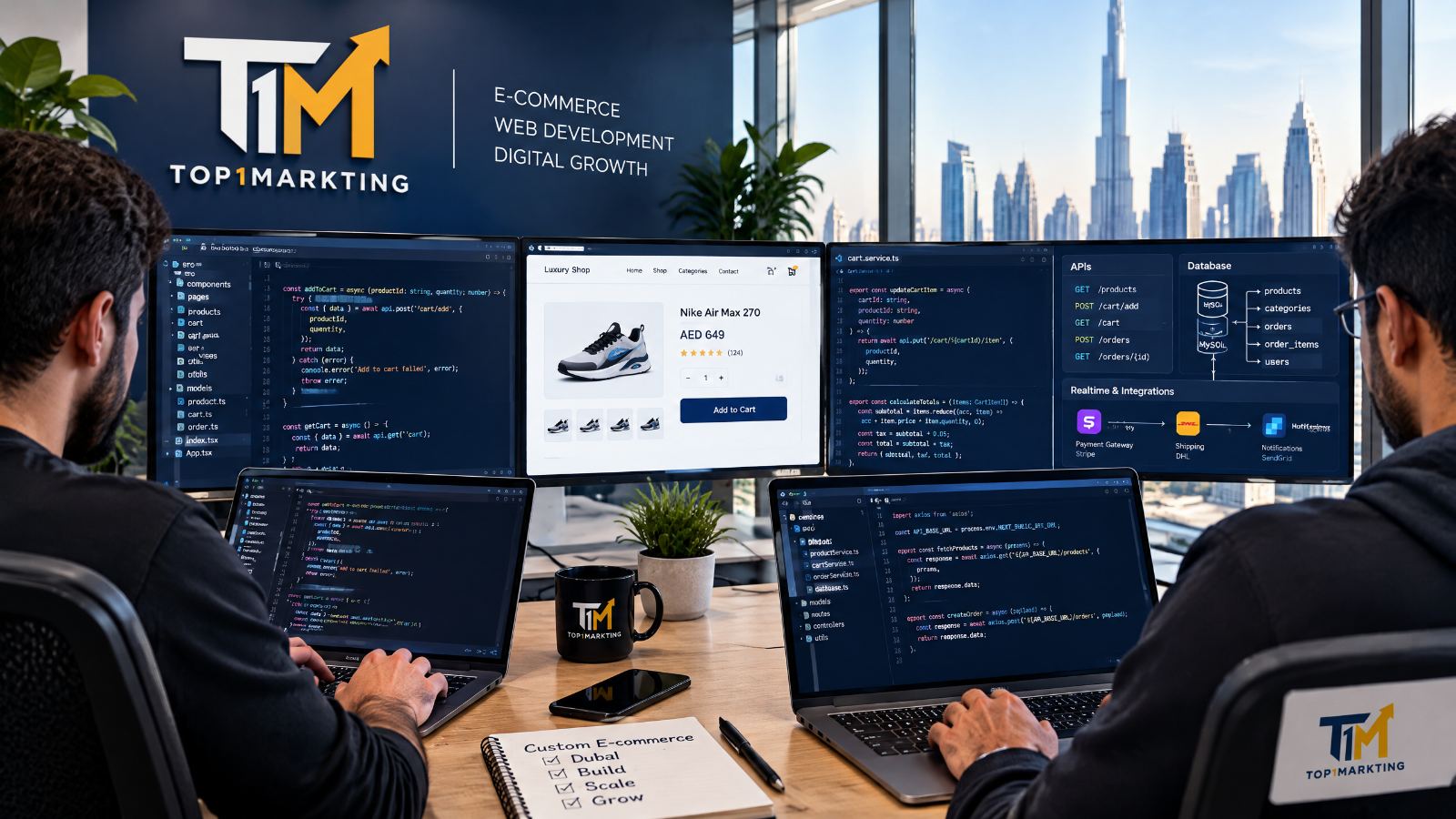
An e-commerce store in Dubai needs a product and inventory system that matches its product types and operational volume. As options, branches, and orders increase, organized inventory management becomes increasingly important.
Products with Multiple Options
Products can be developed with multiple options such as sizes, colors, or different attributes, with each option managed according to its own data and inventory when required.
Sizes and Colors
A system can be added to manage sizes and colors and connect them to products, allowing customers to select the required specifications during checkout.
Products Based on Specifications
Some products require multiple specifications. The system can be developed to add, organize, and display these specifications clearly to customers.
Inventory Management
The inventory system can track available, reserved, and sold quantities and connect inventory changes with store operations.
Low-Stock Alerts
Alerts can be added when a product reaches a specific quantity level, helping the store team identify products that need to be restocked.
Branch Inventory
For businesses with multiple Dubai branches, inventory can be separated by branch, allowing available quantities to be displayed according to location and improving product and order management.
Out-of-Stock Products
Products can be assigned an out-of-stock status, with the option to hide them or keep them visible while displaying their availability status according to the store’s strategy.
Bulk Product Updates
For stores with large product catalogs, tools can be developed to update prices, statuses, categories, or other product data for multiple products at once.
Connecting Inventory to Orders
Inventory can be connected to orders so quantities are updated based on store operations, while accounting for cancellations, returns, and order modifications according to the system.
Payment and Shipping Development
Payment and shipping development is an essential part of improving an e-commerce store in Dubai because the purchase journey does not end when a customer selects a product. It also includes payment, delivery selection, and order tracking until the product reaches the customer.
Improving Payment Steps
The checkout process can be simplified by reducing unnecessary fields and actions while making the process clear and compatible with mobile and desktop experiences.
Payment Gateway Integration
The store can be connected to the required payment gateways according to the project’s business model, allowing transaction data and payment status to be synchronized with orders.
Shipping Options
Multiple shipping options can be added based on delivery areas, delivery speed, and store policies, with the ability to manage these options from the admin dashboard.
Delivery Company Integration
The store can be connected to delivery services and companies through suitable software integrations so required order data can be transferred to the shipping system.
Shipping Cost Calculation
A custom system can calculate delivery costs based on location, order value, weight, or shipping method according to the business rules.
Delivery Areas
Delivery areas across Dubai and the UAE can be defined and connected to different fees, delivery options, or delivery times when required.
Order Status Tracking
Order stages can be displayed to customers and staff, from order confirmation through preparation, shipping, and delivery, with status updates managed from the dashboard.
Customer Notifications
Notifications can be developed for different order stages, including order confirmation, payment, shipping, and delivery, using the communication channels selected by the store.
Invoices
Invoice generation can be developed and connected to orders and customers, with invoices prepared according to the project’s accounting workflow and data requirements.
Developing an E-commerce Store to Support Dubai Branches
When a business operates multiple branches in Dubai, the store needs a system that connects branches with products, inventory, orders, employees, and permissions while allowing operations to be managed centrally.
Managing Multiple Branches
Multiple branches can be added to the system, with information such as location, contact details, and available services managed for each branch.
Branch Inventory
Each branch can have separate inventory, allowing available quantities to be monitored and changes resulting from sales, transfers, or returns to be tracked.
Branch Orders
Orders can be connected to the appropriate branch based on the customer’s location, product availability, or the project’s operational model.
Delivery Areas
Delivery areas can be connected to specific branches so orders are processed according to the customer’s location and responsible branch.
Branch Employees
Employee accounts can be created and connected to specific branches, with each user assigned the functions they are allowed to perform.
User Permissions
Different permissions can be assigned to branch managers, sales employees, inventory staff, and order staff while preventing access to information that users do not need.
Branch Reports
Separate reports can be created for each branch to track orders, sales, and inventory, while also allowing management to view consolidated data across all branches.
Individual Branch Pages When Needed
If the business needs each branch to appear independently online, dedicated branch pages can be developed with location details, services, opening hours, and contact information.
Managing Branches from One Dashboard
Branches, orders, inventory, customers, and permissions can be managed through a centralized dashboard while allowing access to each branch’s data according to assigned permissions.
Connecting the Store to External Systems and Services
An e-commerce store in Dubai may need to integrate with other systems for sales, customer management, accounting, inventory, and communication. These integrations can be implemented according to the store’s technical architecture and the services being used.
CRM
The store can be connected to a customer relationship management system to transfer customer and order data and support customer service and relationship management.
ERP
When an ERP system is used, the store can be connected to the data and processes that need to be exchanged between the two systems.
Accounting System
Orders, sales, and invoices can be connected to the company’s accounting software according to the required integration.
Inventory System
Inventory data can be synchronized between the store and an external inventory system to reduce discrepancies between different platforms.
Point of Sale
If the business combines online sales with physical branches, the store can be integrated with the point-of-sale system according to the technical architecture being used.
The store can be connected to WhatsApp to facilitate customer communication and send or receive certain information and notifications according to the available integration method.
Email integrations can be developed to send automated messages related to registration, orders, payments, shipping, and other store operations.
SMS
SMS services can be integrated to send customer notifications such as order confirmation or status updates.
API
APIs allow the store to exchange data with external services and systems. Custom APIs can also be developed when the project requires data exchange between multiple systems.
Webhooks
Webhooks can be used to automatically notify systems when specific events occur, such as creating an order, changing a payment status, or updating a shipping status.
When a project requires integration with custom systems or development of specialized software solutions beyond standard integrations, Software Systems Development can be used to develop and connect solutions according to the business workflow in Dubai.
Developing the Store for SEO
When developing an e-commerce store in Dubai, it is important for the technical architecture and pages to be SEO-friendly from the beginning. Good development helps organize product and category pages, improve how search engines access content, and prepare the store for growth in products, keywords, and target locations.
Improving Page Structure
Store pages can be organized into a clear structure connecting categories, products, and important pages, making the architecture easier for both users and search engines to understand.
Improving URLs
Clear and organized URLs can be created for product, category, and section pages while maintaining a structured URL architecture, especially when developing an existing store.
Meta Titles
The store can include a title management system so each product, category, and important page has a relevant title based on the content and target keywords.
Meta Descriptions
Meta descriptions can be managed for store pages, allowing customized descriptions for products and categories rather than relying on unsuitable automatically generated text.
Canonical
Canonical URLs can be configured for pages that may have multiple URLs or versions, helping search engines identify the primary page.
Sitemap
An XML Sitemap can be generated according to the store structure, including relevant product, category, and other pages that should be accessible to search engines.
Robots
The Robots.txt file can be configured to control which pages or paths search engines can access based on the store’s technical architecture and SEO requirements.
Schema
Relevant Schema structured data can be added for the store, products, and other content types to help search engines understand the information presented on each page.
Product Pages
Product pages can be developed to support SEO, including organized titles, descriptions, images, specifications, prices, availability, structured data, and relevant internal links.
Category Pages
Category pages can be optimized to become useful and targetable landing pages in search results, with organized products, content, headings, and internal links.
Internal Linking
Internal links can be developed between products, categories, and important pages to improve navigation and connect related products and topics throughout the store.
Store Speed Optimization
Store speed is part of technical development and customer experience. Code, images, database queries, and other elements that affect page-loading speed can therefore be reviewed.
When the project requires a comprehensive SEO strategy for the store, SEO Company in Dubai can help analyze the store architecture, keywords, pages, and technical issues and develop an optimization strategy suited to the project.
Developing a Fast and Mobile-Friendly Store
Store speed and mobile compatibility are important elements of e-commerce development in Dubai, especially given the variety of devices and screen sizes customers use. Performance and responsiveness should therefore be treated as part of store development rather than as a separate step after completion.
Page Loading Speed
Pages that take longer to load can be analyzed and the underlying causes reviewed, whether they relate to code, database queries, images, files, or external services.
Images and Files
Image and file loading can be optimized by reducing file sizes, organizing loading behavior, and using suitable formats while maintaining product image quality.
JavaScript
JavaScript code and elements used across the store can be reviewed to reduce unnecessary operations that may affect loading speed or user interaction.
Interface Responsiveness
The interface should respond quickly and clearly to buttons, forms, menus, and other interactions while minimizing delays that may affect the customer experience.
Mobile Experience
The store can be developed to work effectively on mobile devices, considering text size, buttons, menus, images, order forms, and checkout interfaces.
Core Web Vitals
Core Web Vitals can be reviewed and improved in areas related to loading speed, interactivity, and visual stability, particularly on important pages such as products and categories.
Product Page Optimization
Product pages can be improved in terms of loading speed, element organization, images, information, and calls to action, helping customers browse products and make purchase decisions more easily.
Reducing Unnecessary Elements
Plugins, scripts, and page elements can be reviewed and unnecessary components removed or deferred to reduce page load and improve overall store performance.
Developing an Arabic and English Store
Many e-commerce stores in Dubai need to support Arabic and English within the same shopping experience, especially when serving customers from different backgrounds and language preferences. Developing a multilingual store therefore involves more than translating text; it requires a complete system for managing content, products, pages, and purchases while maintaining usability in both languages.
Managing Content in Both Languages
The content management system can be developed to add and edit Arabic and English content from the admin dashboard while keeping each language organized. This makes it easier to manage store pages, offers, and informational content without compromising either language version.
Products in Arabic and English
Products can include names, descriptions, specifications, and additional information in both Arabic and English while keeping both versions connected to the same product. This is important for Dubai stores serving different customer segments.
Categories in Both Languages
Multilingual functionality also includes product categories, menus, and filters so customers can navigate store sections in their preferred language. Categories can also be organized differently when required by the product structure and customer search behavior.
Checkout Pages
The language experience should extend to important pages such as the shopping cart, checkout, and order confirmation so customers do not have to interact with a different language while completing a purchase. Order messages, data fields, and notifications can also be adapted to the selected language.
Multilingual URLs
Store URLs can be organized appropriately for Arabic and English versions while maintaining a technically sound page structure and connecting multilingual versions. This helps both users and search engines understand the relationship between Arabic and English content.
SEO for Each Language
A bilingual store should include independent SEO settings for each language, including page titles, descriptions, target keywords, internal links, and structured data when required. In the UAE market, this helps provide suitable pages for Arabic and English search behavior.
Arabic and English User Experience
Providing two languages is not enough; the interface should be appropriate for each language, especially because Arabic and English use different reading directions. RTL and LTR support, menus, buttons, forms, and product pages should therefore be developed for a clear desktop and mobile experience.
Developing E-commerce Stores Based on Business Type in Dubai
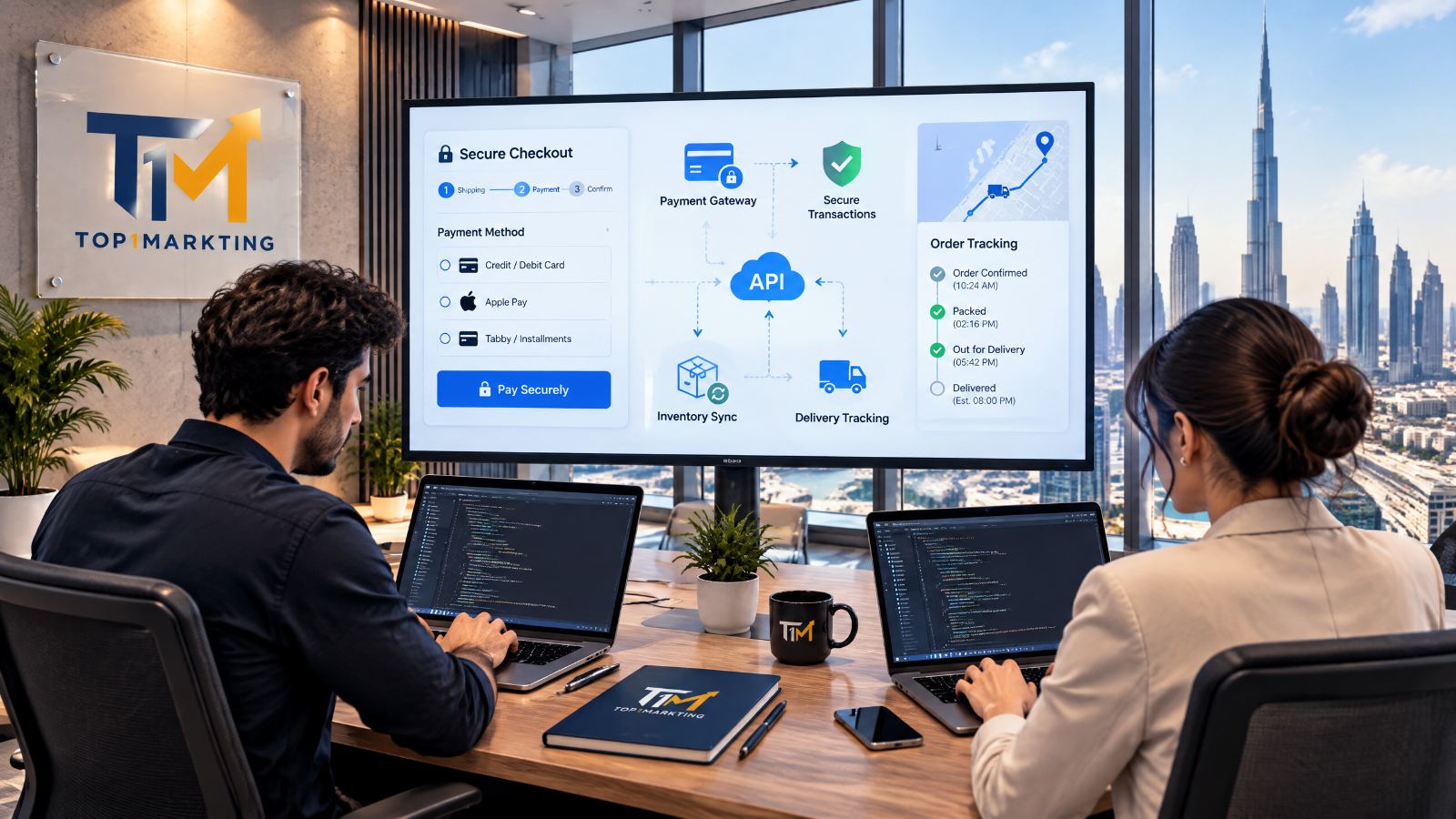
There is no single e-commerce architecture suitable for every business. A fashion store has different requirements from a food store, electronics store, or B2B business. Store development in Dubai should therefore consider the business model, product volume, sales process, customers, inventory, shipping, payment, and expected expansion.
Fashion Stores
Fashion stores often require size, color, and product-variant management, with inventory tracked for each variant. Filters, search, and product pages can be developed to make it easier to find the required size, color, or product type while connecting these options to orders and inventory.
Perfume Stores
Perfume stores can be developed to display product details such as type, size, ingredients, and descriptions while organizing categories, brands, and available options. Additional functionality can be added to help customers discover suitable products and improve delivery and ordering within Dubai.
Beauty Stores
Beauty and cosmetics stores often need products organized by type, brand, and use, with multiple attributes and specifications. Search, filters, and product recommendations can be developed to improve product discovery and the customer journey.
Food Stores
Food stores may require inventory, delivery zones, service areas, and product availability functionality. Some businesses may also need ordering times or scheduled delivery. The store can be developed according to the product type and delivery model across Dubai.
Electronics Stores
Electronics stores often need to display many technical specifications, so product structures, filters, and search should be capable of handling numerous attributes. Product comparison, specifications, models, and inventory can also be developed to help customers make purchase decisions.
Furniture and Interior Stores
Furniture and interior stores may need to display images, dimensions, materials, colors, and product options, as well as delivery or installation information. Product pages can be developed to organize these details clearly, particularly for large or customizable products.
Specialized Product Stores
Specialized stores may require functionality that is not available in standard e-commerce systems, such as specific technical attributes, unique ordering processes, or product customization. The store can therefore be developed around the product and sales model rather than forcing the business into a fixed system.
B2B Stores
B2B e-commerce stores differ from consumer stores and may require business accounts, special pricing, minimum order quantities, quote requests, and multiple user permissions. These functions can be developed within one admin dashboard and connected to inventory, invoices, and internal systems when needed.
Multi-Branch Stores
For businesses operating multiple branches in Dubai, the store can be developed to manage branch inventory, orders, delivery areas, employees, permissions, and reports through a centralized system.
Developing Custom Functions Inside the Store
Some Dubai businesses require functionality beyond traditional e-commerce features, especially when their business model or sales process is different. In these cases, custom functions can be developed and connected to the store database, admin dashboard, orders, and customers.
Membership System
A membership system can be developed with different customer levels, each connected to specific prices, permissions, or benefits. This can be useful for stores serving registered or repeat customers.
Loyalty System
A loyalty system can reward customers based on purchases and interactions. The rules can be managed through the admin dashboard and connected to customer accounts and orders.
Points System
A points system can define how customers earn and use points, whether through purchases, campaigns, or specific actions within the store. Points expiration and minimum redemption requirements can also be configured according to the project’s policies.
Subscriptions
Subscription functionality can be developed for businesses offering products or services on a recurring basis, including subscription plans, durations, renewals, notifications, and payment status. The system can be designed around the actual subscription model rather than using a one-size-fits-all solution.
Orders Based on Specifications
If a product requires customer-selected specifications before ordering, a custom order form can be developed to allow customers to choose the required options and send them with the order to the management team.
Customized Products
Products can be developed to allow customers to add custom information or options before completing a purchase, such as text, dimensions, colors, or specifications. This information can then be stored within the order for fulfillment.
Customer-Specific Offers
Rules can be developed to offer different promotions based on customer type, purchase history, order value, or membership level. This provides greater flexibility than general discounts shown to all customers.
Advanced Coupons
A coupon system can support multiple conditions such as minimum order value, specific products or categories, selected customers, validity periods, or limited usage. These rules can be managed from the admin dashboard.
Custom Order System
Some businesses require an ordering process that differs from traditional e-commerce, such as quote requests, products requiring custom specifications, or orders that need review before payment. The order workflow can be developed around the business process.
Functions Developed Around the Business Model
The purpose of custom development is to build functions that support the store’s actual workflow rather than relying only on standard features. The business model in Dubai can therefore be analyzed to determine the required functionality and connect it with products, customers, orders, inventory, payments, and external systems.
Technologies Used in E-commerce Store Development
The appropriate technology depends on the project size, required functionality, number of users, integrations, and expansion plans. Different technologies can therefore be used for e-commerce development, with the architecture selected to balance performance, flexibility, and scalability.
PHP
PHP is widely used for web applications and e-commerce development and can be used to build different parts of the system and connect them with databases and APIs. Its use depends on the project architecture and technical requirements.
Laravel
Laravel is a PHP framework that can be used to build an organized and scalable backend, particularly for stores requiring custom dashboards, business rules, and multiple integrations.
JavaScript
JavaScript is used for interactive and dynamic store functions such as filters, search, forms, and page interactions. It can be used on the frontend or other parts of the system depending on the selected architecture.
React
React can be used to build interactive interfaces for stores that require advanced user experiences and reusable components. Its suitability depends on the project structure, frontend requirements, and performance considerations.
Next.js
Next.js can be used to develop modern web interfaces with JavaScript-based architecture and features suitable for performance-focused applications. It may be appropriate for stores requiring an advanced frontend and strong backend integration.
MySQL
MySQL can be used to manage product, customer, order, inventory, and other store data. The database structure is designed according to the system architecture and relationships between data while considering performance and scalability.
REST API
REST APIs allow the store to connect with external services and systems such as payment gateways, shipping services, CRM, ERP, accounting systems, and more. Custom APIs can also be developed when the project requires data exchange between multiple systems.
Backend and Frontend
The frontend is the part of the store customers interact with, while the backend handles business logic, data, orders, permissions, and internal operations. In custom e-commerce stores, both components are developed to work together with the database and internal systems.
How Is the Right Technology Selected?
Technology should not be selected simply because it is popular. It should be chosen based on the store’s requirements, size, functionality, number of products and users, integrations, and expansion plans. One Dubai project may need a simple but scalable architecture, while another may require a more complex system supporting branches, inventory, CRM, ERP, multilingual content, and custom orders.
The development process therefore begins by analyzing current and future requirements, followed by selecting the appropriate frontend, backend, database, and integration architecture. This allows the store to evolve gradually without technology becoming a limitation to business growth.
How Is an E-commerce Store Development Project Implemented in Dubai?
E-commerce development in Dubai begins by understanding the current state of the project, identifying problems and improvement areas, and then implementing development in clear stages. The goal is not to change the store simply for the sake of change, but to address weaknesses, improve customer experience and management, enhance performance, and create a foundation for future growth across Dubai and the UAE.
Analyzing the Existing Store
The process starts with a technical and business review of the existing store, including the interface, user experience, page speed, products, orders, admin dashboard, database, payment, shipping, and integrations. This analysis helps determine what can be improved and what may need to be rebuilt.
Identifying Problems
After analyzing the store, problems affecting customers or operational efficiency are identified, such as slow pages, difficult checkout, inventory issues, or limited dashboard functionality. Each problem can then be linked to its impact on the store.
Prioritizing Improvements
Not all changes have the same priority. Improvements can be prioritized according to their impact on sales, operations, and customer experience. For example, payment or performance issues may be more urgent than adding a new feature, depending on the project.
Defining New Functions
Once the problems are identified, the required functions can be listed, whether related to products, inventory, branches, customers, payments, or external integrations. Each function should be defined before development begins.
Creating the Development Plan
Requirements are converted into a clear development plan covering stages, required changes, and affected systems. The plan also determines whether development will be performed on the existing store or whether certain components need to be rebuilt.
Developing the Interface and System
The frontend and backend are developed according to the defined requirements, with improvements to browsing, products, cart, checkout, and internal functionality. The interface can be optimized for Dubai customers across desktop and mobile devices, with Arabic and English support when needed.
Implementing Integrations
If the store needs payment gateways, shipping companies, CRM, ERP, accounting, or inventory integrations, the connections are implemented and data exchange is tested. This reduces manual work and connects different operations into one system.
Testing
Before launch, new functions, pages, orders, payments, shipping, accounts, permissions, and integrations are tested, along with mobile devices and different browsers. The objective is to identify issues before updated functionality reaches customers.
Launch
Once testing is complete and the system is ready, the improved version is launched according to a plan designed to minimize disruption to existing orders and customers. For larger projects, the launch may be performed gradually.
Monitoring Performance After Development
Development does not end when the updated store is launched. Performance, orders, page speed, customer behavior, and technical issues should be monitored after deployment. This helps identify further opportunities for improvement as the Dubai business grows.
Signs That Your E-commerce Store Needs Development

An e-commerce store may appear to work normally while still having problems that affect sales, management, or customer experience. The need for development can therefore be identified through operational and technical indicators, particularly as products, orders, and customers increase.
Lower Order Completion Rate
If many customers reach product and cart pages but fewer complete purchases, there may be an issue with the checkout journey, payment process, store speed, or information clarity. Analyzing this stage can help determine whether the store needs development.
High Cart Abandonment
High cart abandonment may be related to complicated checkout steps, unexpected costs, or limited payment and shipping options. The cart and checkout process can therefore be reviewed and developed to reduce barriers to purchase.
User Complaints
Repeated complaints about product search, registration, payment, or order tracking may indicate weaknesses in the user experience. Collecting and analyzing customer feedback can help identify functions that need improvement.
Difficult Order Management
As order volume increases, manual processing can become difficult and the existing dashboard may no longer suit the business. The order workflow can then be developed with additional statuses, permissions, and management tools.
Repetitive Manual Work
Manually entering data, updating inventory, or moving orders between different systems takes time and increases the possibility of errors. Integrations can help automate these processes and connect the systems used by the business.
Inventory Problems
Out-of-stock products, incorrect quantities, or difficulty tracking branch inventory can affect orders and customer service. The inventory system can be developed and connected with products, orders, and branches for better accuracy.
Payment Problems
Payment failures, limited payment options, or unclear checkout steps can directly affect order completion. Payment gateways, checkout flow, and technical integrations can therefore be reviewed.
Slow Website
Slow product, category, cart, or checkout pages can negatively affect the customer experience, especially on mobile devices. The store may need improvements to images, code, database queries, and technical architecture.
Difficulty Adding New Functions
If every new feature requires complicated changes or causes issues in other areas, the existing store architecture may be limiting development. Rebuilding or improving parts of the system can make future development more flexible.
Lack of Sufficient Reports
If the dashboard does not provide clear information about orders, sales, customers, inventory, or branches, operational decision-making becomes more difficult. Reports and analytics can be developed to provide the data required by the business.
How Do You Know If Store Development Was Successful?
Store development should not be measured only by adding new functions or changing the design. It should be evaluated based on improvements in performance, customer experience, management, and system stability. Clear metrics should therefore be compared before and after development.
Improved Store Speed
One of the key indicators is faster page loading and improved responsiveness, particularly for product, category, cart, and checkout pages. Technical performance metrics can be monitored after launch.
Improved User Experience
If customers can find products, use search and filters, and complete orders more easily, the user experience has improved. Customer behavior, feedback, and usage metrics can help measure this effect.
Higher Order Completion
The order completion rate can be compared before and after development to determine whether improvements to the cart, checkout, and shopping experience had a measurable effect. This metric should be evaluated alongside other business and marketing factors.
Fewer Technical Problems
Improved stability and fewer errors involving pages, orders, payments, or integrations are important indicators of development quality. System logs and post-launch monitoring can help identify additional issues.
Easier Store Management
Development is successful when product, order, customer, inventory, branch, and permission management becomes clearer and less dependent on manual steps.
Faster Order Processing
When the order workflow is connected with payment, shipping, and inventory, the time required to process orders can be reduced. Comparing processing times before and after development can help measure operational improvements.
Better Inventory Management
The improved system should provide more accurate data on product quantities, branches, and inventory status. Reduced inventory errors and faster data updates can indicate successful development.
Better Data and Reporting
Development is also successful when sales, orders, customers, products, and inventory data become easier to access and understand from the admin dashboard.
Easier Addition of New Functions
A key benefit of development is creating a scalable system where new functions and integrations can be added without rebuilding the entire store every time. This becomes increasingly important as a Dubai business expands into new branches, products, services, or UAE markets.
Cost of E-commerce Store Development in Dubai
There is no fixed price for e-commerce store development in Dubai because the cost depends on the existing store, required changes, number of new functions, integrations, languages, branches, and development requirements. The cost can therefore be determined after analyzing the store and understanding the project’s actual requirements.
Current Store Condition
Development costs vary depending on whether the store is new, existing and in need of improvements, or based on a system that requires major redevelopment. The existing architecture, interface, database, and admin dashboard should be reviewed before defining the scope.
Development Scope
One store may need limited changes to a few functions, while another may require major system development. The broader the development scope and the more components that need modification, the more resources are required.
Number of New Functions
Adding a simple feature is different from developing a complete membership, branch, or custom-order system. Each function should therefore be defined and its relationship with other store components understood before estimating the project.
Admin Dashboard
If the existing dashboard is limited, the project may require new sections for products, orders, customers, inventory, branches, reports, and permissions. The cost depends on the required customization.
Integrations
Connecting the store with payment gateways, shipping companies, CRM, ERP, accounting, or inventory systems requires development and testing for each system. Cost varies according to the number of integrations and API requirements.
Number of Branches
A single-branch store differs from a business managing multiple Dubai branches. Supporting branches may require separate inventory, orders, delivery areas, employees, permissions, and reports.
Languages
Arabic and English support involves more than translating text. It may require content, product, category, URL, and SEO structures for both languages, along with RTL and LTR interface support.
Payment and Shipping
Payment and shipping development depends on the gateways and delivery companies required by the business, as well as shipping calculations, delivery areas, order tracking, invoices, and notifications.
Custom Development
When a store needs functionality unavailable in ready-made solutions, the project may require custom programming from scratch or custom development within the existing system. The scope depends on the required functions and business rules.
Support and Future Development
The project may include technical support, updates, and future development, particularly for stores that continue to grow. After launch, the store may require additional functionality, integrations, or improvements.
How to Choose an E-commerce Development Company in Dubai
Choosing an e-commerce development company depends on its ability to understand the project from both commercial and technical perspectives, not simply its ability to design an interface. The business owner should make sure the development team can analyze the existing system, build the required solutions, and connect them to the business processes used in Dubai.
Ability to Analyze the Existing Store
Development should begin with reviewing the store’s performance, interface, database, admin dashboard, and integrations. A proper analysis helps determine what needs to be developed and what can be retained.
Understanding E-commerce
Store development requires an understanding of the complete sales cycle, from product presentation and search to cart, payment, shipping, customer service, and order management. The development team should therefore understand e-commerce operations, not only programming.
From-Scratch Programming
When a project requires custom functions, the development company should be capable of developing system components from scratch rather than depending entirely on templates or limited solutions.
Frontend and Backend Development
The team should be able to develop both the customer-facing interface and the backend responsible for system logic, data, orders, permissions, and internal operations.
Admin Dashboard Development
The admin dashboard is a core component of an e-commerce store, so the development company should be able to build it according to the business workflow, including products, orders, inventory, customers, branches, reports, and permissions.
API Integration
Modern e-commerce stores often need to connect with multiple external services. The development team should therefore have experience with REST APIs and other data exchange technologies.
Payment and Shipping Integration
The company should be able to connect payment gateways and shipping services and test the complete order, payment, shipping, status, and notification workflow.
Technical SEO Understanding
Store development should not create unnecessary SEO problems. The development team should understand URLs, Canonical, Sitemap, Robots, Schema, page speed, structured data, and other technical SEO elements.
Ability to Develop Custom Functions
A business may need memberships, subscriptions, custom orders, branch systems, special pricing, B2B functionality, or other custom features. The development company should be capable of translating business requirements into custom software functions.
Clear Development Plan
Before development begins, the project stages, requirements, functions, integrations, testing process, and launch method should be clearly defined. This makes the project scope easier to understand and monitor.
Store Development Is More Than Changing Its Appearance
E-commerce store development in Dubai is not limited to changing colors, images, or page layouts. The main problem may be within the internal system, admin dashboard, performance, integrations, or order-management workflow. Real development therefore begins by identifying what the business actually needs.
Development Can Be in the System
The store architecture, database, backend, order logic, product system, and inventory can be developed when the existing system is no longer suitable for the business size or new requirements.
Development Can Be in Management
The team may need a more organized admin dashboard for products, orders, customers, inventory, branches, reports, and permissions. In this case, development focuses on improving internal operations rather than the visual appearance alone.
Development Can Be in Customer Experience
Search, filters, product pages, cart, checkout, and navigation can be developed to make the customer journey easier and reduce obstacles to completing orders.
Development Can Be in Performance
If the store is slow or experiences problems as product and order volumes increase, development may involve improving the database, queries, code, images, and technical architecture.
Development Can Be in Integrations
The store can be developed to connect with payment systems, shipping services, CRM, ERP, accounting, inventory, WhatsApp, and other services used by the business.
Development Can Be in SEO
Development can include improving page architecture, URLs, Canonical, Sitemap, Schema, internal linking, and performance to create a stronger technical foundation for search engines.
Development Can Be in Branch Management
When a business has multiple Dubai branches, the system can be developed to manage inventory, orders, delivery areas, employees, permissions, and reports for each branch through a centralized dashboard.
Development Can Prepare the Store for Expansion
Development may be intended to prepare the store for more customers, products, and orders, additional branches, or expansion from Dubai to other UAE markets. The architecture should therefore consider future requirements rather than only solving the current problem.
Frequently Asked Questions About E-commerce Store Development in Dubai
What Is the Difference Between Store Design and Store Development?
Store design focuses on the interface, appearance, and user experience, while development includes programming, functionality, databases, admin dashboards, integrations, and performance. Both can be combined in one project when the store requires comprehensive redevelopment.
Can an Existing E-commerce Store Be Developed?
Yes. An existing store can be developed after reviewing its architecture, technologies, database, functions, and integrations. The analysis helps determine which components can be improved and which may need to be rebuilt.
Can a Pre-Programmed Store Be Developed?
In many cases, yes. However, development depends on the technology used, access to the source code and database, and the structure of the system. The existing system should therefore be evaluated first.
Can New Functions Be Added to an E-commerce Store?
Yes. New functions can be added according to the business model, including memberships, subscriptions, custom orders, advanced discounts, branches, loyalty systems, and integrations, provided the current architecture supports development or can be modified accordingly.
Can a Custom Admin Dashboard Be Developed?
Yes. A custom dashboard can be developed to manage products, orders, customers, inventory, branches, permissions, and reports according to the project’s workflow.
Can the Store Be Connected to a CRM?
Yes. The store can be connected to a CRM system through APIs or other suitable integration methods to exchange customer and order data according to the project requirements.
Can the Store Be Connected to an ERP?
An e-commerce store can be connected to an ERP system when the business needs to synchronize products, inventory, orders, customers, invoices, or other data. The integration method depends on the ERP system and available API.
Can a Multi-Branch Store Be Developed?
Yes. The store can be developed to manage multiple branches, including branch inventory, orders, employees, permissions, delivery areas, and reports through a centralized system.
Can the Store Support Arabic and English?
Yes. The store can support Arabic and English across content, products, categories, cart, checkout, and other pages, with RTL and LTR support and SEO optimization for each language.
Can Store Speed Be Improved?
Yes. The causes of slow performance can be analyzed, including images, code, database queries, and page-loading methods, followed by appropriate development and performance testing.
Does Store Development Affect SEO?
Development can affect SEO if page structures, URLs, or content are changed without proper technical handling. Redirects, Canonical URLs, Sitemap, Robots, structured data, and internal linking should therefore be considered during development.
How Much Does E-commerce Store Development Cost in Dubai?
There is no fixed price for e-commerce store development in Dubai. The cost depends on the current condition of the store, development scope, number of functions, integrations, branches, languages, payment and shipping systems, and level of custom programming required. The cost can therefore be determined after analyzing the project requirements.
How Long Does E-commerce Store Development Take?
Development time varies from one project to another depending on the store size, number of functions, integrations, and condition of the existing system. Some existing stores may only need limited modifications, while others may require longer development phases to rebuild major components and test them.
Can the Store Be Developed in Stages?
Yes. Development can be divided into stages according to priorities. The first phase may address the issues with the greatest impact on sales and customer experience, followed by additional functions and integrations according to a clear development plan. This approach can be useful for stores that operate continuously and need to minimize disruption to daily operations.
Is Your Store Ready for the Next Stage?
An e-commerce store in Dubai does not stop evolving after launch. As products, orders, customers, and operations increase, new requirements may appear in management, payment, shipping, inventory, reporting, integrations, and customer experience. The right development approach may therefore involve adding a specific function, improving part of the existing system, rebuilding certain components, or developing the entire store according to the project’s requirements and growth plan.
If the existing store has performance, management, or shopping experience issues, the first step is not necessarily to change everything. It is to identify the bottleneck and build the right development solution around it. The issue may be related to a specific page’s speed, order management, the admin dashboard, payment and shipping, or the store architecture. In some cases, developing a specific component may be more appropriate than rebuilding the entire system.
If the store has become limited as the business grows, broader development may be required, including custom programming, integrations, branch management, inventory, multilingual functionality, or improvements to the technical architecture and SEO. The appropriate decision should begin with analyzing the current store and understanding the project’s current and future requirements.
With Top1Markting, you can review your store’s current condition, identify the required development areas, and create a development plan based on your business model and requirements in Dubai and across the UAE.
+971 50 766 2114