

CRM Development Company in the UAE | Custom CRM and Sales Management Solutions for Businesses
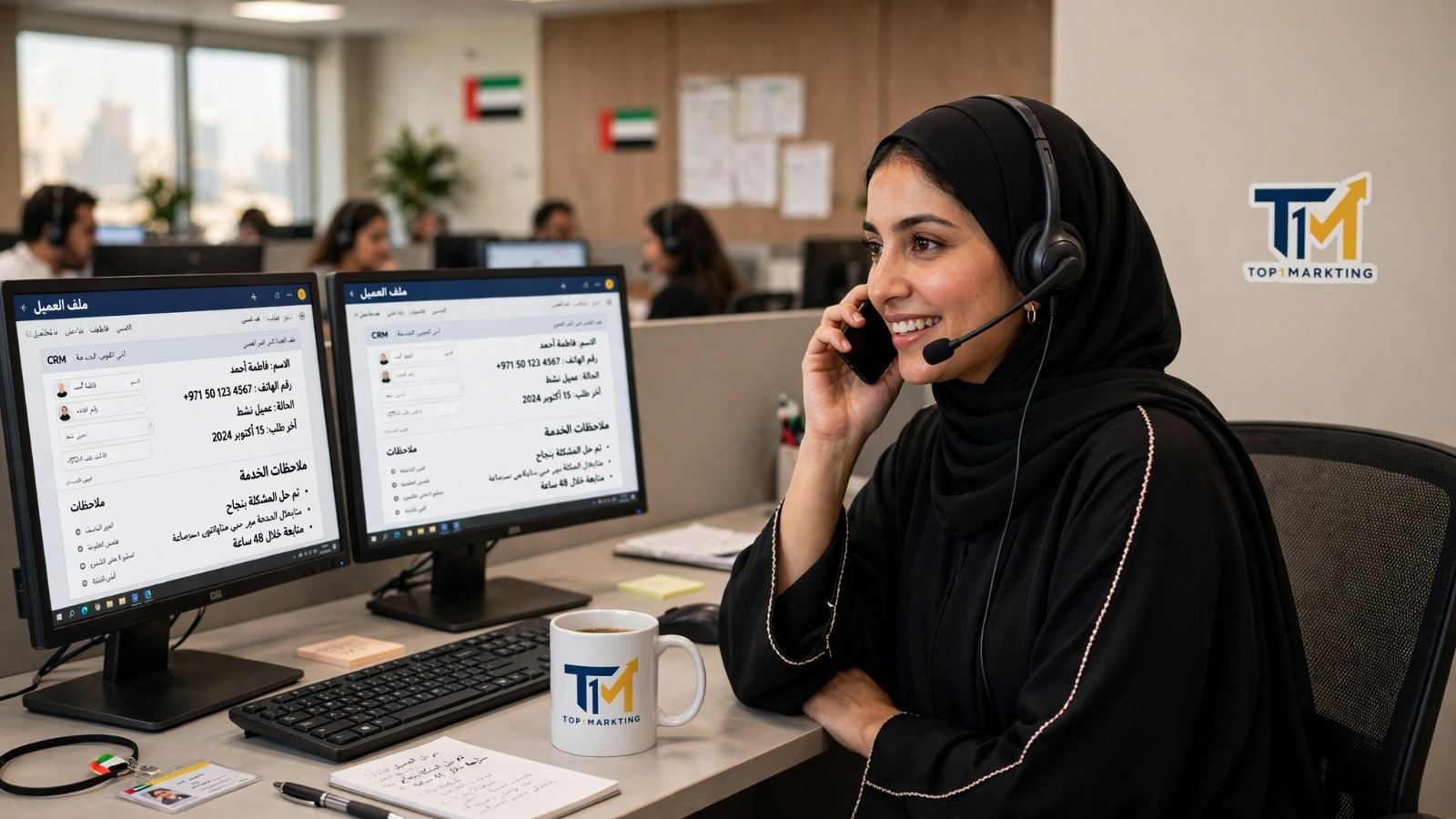
+971507662114 – If your company needs to organize customer data, track sales opportunities, manage sales teams, and handle orders through a unified system, partnering with Top1Markting allows you to develop a custom CRM system tailored to your business activities and internal workflows.
We provide CRM system development services in the UAE, designing and developing customized customer relationship management and sales solutions. Our services cover every stage, from recording and classifying customer information and assigning leads to employees, to tracking calls, meetings, visits, quotations, and prices, as well as managing sales pipelines, orders, reports, and dashboards.
We develop customer and sales management software according to the needs of trading companies, service providers, real estate businesses, shipping and distribution companies, and organizations that rely on sales teams. The system can include user permissions, employee performance monitoring, activity and task tracking, and customer and sales opportunity status management. Additional features can include lead management, follow-up notifications, interaction histories, management reports, and integration with other systems when suitable APIs and the required permissions are available.
Whether you are looking for a CRM development company in Dubai, Abu Dhabi, Sharjah, Ajman, Ras Al Khaimah, Fujairah, Umm Al Quwain, or Al Ain, a customized system can help organize your sales operations more effectively instead of relying on scattered spreadsheets, separate files, or ready-made software that does not match your company's procedures.
CRM development starts with understanding your existing business processes and identifying management and employee requirements. This is followed by database and interface design, development of the required functions, and system testing before launch. The objective is to deliver CRM Software UAE tailored to your business requirements and designed to support future growth.
Best CRM Development Company for Customer and Sales Management in Dubai and Abu Dhabi
Choosing the best CRM development company in the UAE is not simply about obtaining software for storing customer names. It is about finding a software development company capable of understanding how your organization operates and transforming its daily procedures into an integrated management system.
Companies with sales teams need customer relationship management, organized customer databases, lead tracking, sales pipeline management, deal and employee management, and performance reports accessible from one platform.
Successful CRM development begins with analyzing the company's requirements before writing code. This includes understanding how inquiries are received, how leads are assigned to employees, how calls and meetings are recorded, how quotations and orders are followed up, and what permissions each user requires.
The next step involves designing the interfaces, database, and administrative functions according to these requirements, rather than providing ready-made software that forces employees to follow procedures that may not suit the organization.
Top1Markting provides CRM development and customer and sales management solutions for businesses in Dubai, Abu Dhabi, and other UAE emirates. The system can be customized with specific interfaces, reports, permissions, and sales stages according to the nature of each business.
The project may include a corporate sales management system, lead management, employee performance tracking, and integration with other tools or systems when the necessary integration methods and permissions are available.
Difference Between Buying Ready-Made CRM Software and Developing a Custom CRM System
Ready-made CRM software may be suitable for companies whose procedures match its available features. However, custom CRM development becomes a practical option when an organization requires functions, workflows, or reports that existing software cannot provide in the required way.
With a custom CRM system, you can define sales pipeline stages, lead distribution methods, required customer information, user permissions, and the structure of dashboards and reports.
The system can also be designed to match the procedures of real estate companies, shipping businesses, distribution companies, and commercial service providers instead of relying on general features that do not reflect their actual operations.
How to Choose the Right CRM Development Company for Your Business in the UAE
Before hiring a specialized CRM company, make sure it can analyze project requirements, design an organized database, develop clear interfaces, program the required functions, and test the system before launch.
It is also important to agree on the project scope, permissions, required reports, and future scalability, while clarifying any external integrations and their implementation requirements.
You can explore Business Systems Development in Dubai, Custom Web Application Development in Abu Dhabi, and Custom Website Development in Dubai when your business needs a web platform connected to its CRM system.
What Are the Benefits of a Custom CRM System for Companies in Business Bay, Dubai?
The benefits of a CRM system become clear when customer information, tasks, and deals are transformed into organized data that employees and managers can access and monitor.
Instead of distributing customer information across Excel files, messages, and separate applications, a CRM system provides a centralized database that helps organize communication, assign responsibilities, and monitor sales opportunities.
A custom CRM system in Dubai can be developed according to your company's requirements, combining customer data management, communication history, lead tracking, lead distribution, task management, follow-up notifications, user permissions, and dashboards.
The final features depend on the nature of the business, the number of users, and the company's sales management procedures.
Some of the main capabilities of customer and sales management software include:
-
Centralized Customer Database: Recording customer details, contact information, company information, and related business entities, with search and classification options.
-
Communication and Interaction History: Maintaining records of calls, meetings, notes, and correspondence entered by employees.
-
Sales Pipeline Tracking: Identifying each customer's status and sales stage, from the initial inquiry to the quotation or completed deal.
-
Lead Distribution: Assigning potential customers to sales representatives according to management-defined rules.
-
Task Management and Notifications: Scheduling follow-ups, meetings, and tasks associated with each customer or deal.
-
Sales and Performance Reports: Displaying open and closed deals, recorded sales values, lead conversion indicators, and sales team performance.
-
User Permissions: Defining what managers, supervisors, and sales employees can view or modify within the system.
-
Scalability: Adding new screens, functions, or reports as the company grows and its requirements change.
Does a CRM System Help Organize Leads in Dubai?
Yes. A CRM system can be developed to manage leads through the entire process, from the initial inquiry until they become sales opportunities or actual customers.
The process begins by adding customer information and recording the inquiry source, whether it comes from the company website, phone calls, marketing campaigns, or another channel. The lead can then be classified and assigned to the responsible employee.
The system can include different lead statuses, such as New Lead, Contacted, Quotation Required, Negotiation, or Deal Closed.
Employees can record the results of every interaction and schedule the next follow-up, while management can monitor the number of leads, their sources, and the status of each opportunity.
This makes lead registration software an effective tool for organizing inquiries and tracking sales opportunities rather than simply maintaining a list of names and phone numbers.
How Does CRM Provide Sales and Productivity Reports for Companies in Business Bay?
A CRM system helps collect sales data and recorded activities within the company and transform them into reports and dashboards that explain business performance.
A CRM Dashboard can be designed to display new leads, open and closed deals, recorded sales value, lead sources, opportunity conversion rates, and individual employee performance according to management-defined indicators.
Through Sales Reports, managers can compare results across different periods, employees, or inquiry sources. They can also identify deals requiring follow-up and opportunities that have remained inactive for a specific period.
Revenue reports, order reports, and completion rates can also be customized according to the nature of the business and the available system data.
The accuracy of these reports depends on employees regularly entering information and updating customer and deal statuses, as well as selecting appropriate performance indicators before development begins.
CRM Programmer in Abu Dhabi for Developing Customer Management Software According to Your Business Activities
When searching for a CRM programmer in Abu Dhabi, the most important factor is choosing a developer who can transform actual business procedures into clear software functions.
Companies differ in how they receive customers, distribute leads, follow up on quotations, and manage deals. Therefore, custom CRM design is not simply about changing interface colors or adding a company logo to ready-made software.
It requires analyzing requirements and designing the database, functions, and permissions to match the company's sales cycle.
CRM development begins by studying how the company interacts with customers and identifying sales stages and the information employees need to record.
The next steps include designing user interfaces, developing an interconnected database, and programming the required functions.
This also includes creating different permission levels for managers, supervisors, and sales representatives, with the possibility of expanding the system in the future when new branches, teams, or services are introduced.
The programmer should focus on the functions the company actually needs instead of adding unnecessary features that increase complexity and development costs.
Best CRM Programmer for Designing Customer Databases in Abu Dhabi
The database is one of the most important components of any CRM system because it contains the information employees rely on to communicate with customers, manage deals, and follow up on orders.
CRM database development therefore requires a clear structure for relationships between customers, companies, contact persons, employees, tasks, and deals.
The database can include basic customer information, phone numbers, email addresses, company details, inquiry sources, responsible employees, and interaction histories.
Each customer can also be linked to their business opportunities, quotations, and orders, allowing users to access related information without searching through separate files.
CRM Database design considerations include reducing duplicate records, organizing data updates, defining access permissions, and creating a structure that allows new fields and sections to be added when necessary.
The final database structure depends on the project's nature, the number of users, and the amount of data handled by the company.
Developing User-Friendly CRM Interfaces for Companies in Al Ain
The quality of a customer management system depends not only on programming and database performance but also on how easy its interfaces are to use in daily operations.
CRM interface design should allow employees to register new customers, access their information, review communication histories, and manage tasks and deals without complicated steps.
A dashboard can display the most important information for each user, such as assigned customers, follow-up schedules, overdue tasks, and active deals.
The manager's interface can be customized to display performance indicators, reports, and team activities, with menus and permissions adjusted according to each employee's role.
The development process also considers User Experience (UX) and User Interface (UI) design, with the possibility of making the system compatible with computers, smartphones, and tablets according to project requirements.
This helps companies in Al Ain and across the UAE use the system from devices suitable for their daily operations.
To explore web-based platforms and management systems, you can review our Custom Web Application Development Services in Abu Dhabi and Website Programming Services in Abu Dhabi.
Importance of Developing a Sales Management System and Deal Tracking Software for Companies in Deira and Bur Dubai
Companies that rely on sales teams need a clear system for tracking the customer's journey from the initial inquiry to quotation submission, negotiation, contracting, and completed sales.
Developing a sales management system in Dubai helps organize these stages within one platform instead of relying on manual follow-ups or distributing deal information across Excel files and personal correspondence.
Through Sales CRM UAE, sales opportunities can be registered and linked to the relevant customer and responsible sales employee, while tracking quotations, negotiation status, and final outcomes.
Management can also set sales targets, review team performance, and identify deals that require additional attention or follow-up.
A corporate sales management system can be developed according to the company's actual sales cycle and may include:
-
Sales Pipeline Organization: Defining the stages through which customers move from the initial inquiry to contracting, with customizable stages according to the business.
-
Business Opportunity and Deal Management: Creating a record for each sales opportunity and linking it to customer information, expected value, and the responsible employee.
-
Quotation Tracking: Recording quotations sent to customers and reviewing their status, approvals, and required modifications.
-
Employee Responsibilities: Identifying the employee responsible for each customer or deal and the tasks assigned to them.
-
Deal Outcome Recording: Documenting successful and unsuccessful deals, including reasons for rejection or lost opportunities when available.
-
Sales Target Tracking: Setting sales targets and comparing actual results with established goals.
-
Sales Reporting: Displaying open and closed deals, deal values, conversion rates, and sales team performance.
-
Management Decision Support: Providing organized information that helps management evaluate performance and identify bottlenecks and business opportunities.
Quotation Tracking and Commercial Deal Management System in Deira, Dubai
Companies that send multiple quotations may struggle to identify which offers have been reviewed or approved and which require modification or follow-up.
A quotation management system can therefore be developed within CRM, linking every quotation to its customer, deal, and responsible employee.
The quotation tracking system allows users to create records containing customer information, product or service details, offered prices, and quotation submission dates.
Each quotation can then be assigned a status such as New, Sent, Under Review, Requires Modification, Approved, or Rejected.
Employees can record notes and updates throughout negotiations and document reasons for unsuccessful deals when known.
Quotations and Deal Tracking can also be connected to the sales pipeline, allowing management to monitor the value of pending quotations and identify opportunities approaching completion.
Pricing approval procedures and authorization levels are configured according to the company's internal policies.
Sales Employee Target Management and Performance Reports in Bur Dubai
Sales employee management software helps management monitor team results using actual business data instead of relying on manual reports or irregular evaluations.
A CRM Sales Team module can be customized to record each employee's targets, the number of customers they follow up with, completed tasks, and deals closed within a specific period.
The employee performance dashboard can display indicators such as new leads, recorded follow-up calls, visits, submitted quotations, completed deals, and achievement rates compared with targets.
Employee and sales team performance can also be compared according to management-defined indicators and business requirements.
Daily, weekly, or monthly reports can help sales managers understand activity levels and results, identify employees who need support, and redistribute customers and tasks when necessary.
Productivity indicators should remain customizable so that employee performance is not evaluated solely by the number of completed deals without considering the sales cycle and opportunity value.
CRM System for Sales Representatives and Field Visits in Jebel Ali and Dubai South
Distribution, supply, trading, and service companies that rely on sales representatives need a way to organize external visits, record their results, and follow up on the orders generated by those visits.
A Field Sales CRM system can combine customer information, sales territories, visits, and orders within one platform, allowing management to monitor representative activities and review customer interactions.
The sales representative management system can include employee registration, user permissions, customer and territory assignment, visit scheduling, visit results, notes, and agreed orders.
Employees can also access the system through their smartphones to enter information during fieldwork instead of postponing data entry until the end of the day.
Field Sales CRM can include:
-
Registering sales representatives and their information.
-
Defining permissions for each user.
-
Assigning customers and sales territories to employees.
-
Creating visit schedules and customer follow-up appointments.
-
Recording visit results, notes, and new customer requirements.
-
Linking quotations and orders to customers and representatives.
-
Tracking tasks generated by each visit.
-
Preparing reports about visits, orders, and sales opportunities.
-
Supporting mobile access according to the project design.
-
Adding geolocation when there is a clear operational need, after explaining its purpose and obtaining user consent. Location tracking is not considered a mandatory feature of every CRM system.
Developing a Customer Visit Tracking System for Sales Representatives in Jebel Ali
A customer visit tracking system can be developed to document every field visit and connect it to the relevant customer and responsible employee.
Each visit record can include the visit date, customer name, sales representative, meeting outcome, notes, and next required tasks.
Visit statuses can include Completed, Postponed, Decision-Maker Unavailable, Quotation Required, or New Sales Opportunity.
Representatives can also record the products or services the customer is interested in and schedule the next follow-up appointment.
This helps organize field sales reports and identify customers who have been visited and opportunities requiring additional follow-up, without relying on each representative's personal memory or scattered reports.
Developing a Customer and Sales Representative Order Management System in Dubai South
Distribution and supply companies need to connect customer orders with sales representatives, sales teams, and management to prevent order details from getting lost between calls and messages.
CRM Order Management can be developed to allow employees to create new orders and link them to customers and responsible representatives while recording products, services, quantities, and required details.
The system can display order statuses according to company-defined stages, such as New Order, Under Review, Approved, Being Prepared, In Progress, or Completed.
It can also record modifications and notes, assign responsibility for each stage, and generate reports showing order quantities, statuses, and values over specific periods.
The order management system is designed according to the company's procedures, with the option of integrating it with inventory, accounting, or operational software when required and when suitable integration methods and permissions are available.
Best CRM Development Company for Real Estate Companies and Customer Management in Business Bay and Jumeirah, Dubai
Real estate companies and brokerage offices in Dubai handle large numbers of inquiries related to property purchases and rentals, requiring them to manage customers, agents, viewing appointments, and deals.
A custom Real Estate CRM in Dubai can provide a centralized system combining customer information, preferences, property units, and business opportunities instead of distributing information across multiple spreadsheets and conversations.
The real estate customer management system can be customized according to the procedures of the brokerage office or company.
It can register customers interested in purchasing or renting properties, match customers with suitable units according to their budgets and preferences, distribute inquiries among agents, and track interactions until the deal is completed.
Real Estate CRM UAE can include:
-
Real Estate Customer Registration: Saving customer information and contact details, including whether the customer is interested in buying, renting, or investing.
-
Customer Preferences Management: Recording budgets, locations, property types, sizes, numbers of bedrooms, and other requirements.
-
Property Matching: Organizing property listings and connecting them with interested customers according to available information.
-
Real Estate Agent Management: Distributing customers and inquiries among employees and assigning responsibility for each opportunity.
-
Property Viewing Management: Recording viewing appointments, inspection results, and customer feedback.
-
Deal Management: Tracking negotiations, offers, agreements, and final outcomes.
-
Agent Performance Reports: Displaying customers, opportunities, viewings, and deals recorded by each employee.
-
Real Estate Website Integration: Connecting the CRM to the company's website or online portal to display properties and receive inquiries, depending on platform capabilities and available integration methods.
CRM development can be connected to Real Estate Company Website Design in Dubai or Corporate Portal Development in Dubai when a company needs a platform that displays properties, receives customer requests, and connects them to its customer management system.
CRM Development for Shipping and Logistics Companies in Jebel Ali and Deira
Shipping, transportation, warehousing, and logistics companies handle various inquiries, quotations, and service orders from individuals and businesses.
These companies need organized customer information and a clear way to track their commercial interactions.
A CRM for shipping companies in the UAE can be developed according to sales and customer service procedures, combining inquiries, service requests, shipping quotations, and communication histories within one system.
A logistics customer management system can include a customer and company database, service request registration, shipping quotation management, order tracking, and employee responsibility assignment.
Reports can also be customized to display new customers, submitted quotations, pending orders, and completed business deals.
Logistics CRM UAE may include:
-
Customer and Company Database: Recording customer information, contact persons, and previous interaction histories.
-
Shipping Inquiry Management: Recording the requested service, shipment information, and details required by the company.
-
Quotation Management: Creating a record for each quotation and linking it to the customer, service, price, and status.
-
Logistics Service Order Tracking: Monitoring customer order statuses and the stages reached according to company procedures.
-
Employee Responsibility Organization: Assigning customers, inquiries, and orders to sales and customer service employees.
-
Customer and Order Reports: Displaying inquiry volumes, quotations, orders, and business opportunities over specific periods.
-
Operational System Integration: Connecting CRM to a shipping platform or operations management system when a suitable API and the required technical permissions are available.
It is important to distinguish between a CRM system, which organizes customer relationships and sales, and a shipping operations management system, which tracks the operational execution of shipments.
A company may need an independent CRM system or an integration with its existing operational platform, depending on the project scope.
A shipping company's digital presence can also be supported through Shipping Company Website Design in Dubai, alongside administrative system development through Business Systems Programming Services in Dubai.
CRM Solutions for Small and Medium-Sized Businesses in Sharjah and Ajman
Not every company needs a large CRM system containing dozens of functions.
Small and medium-sized businesses often need practical solutions that match the number of employees, customer database size, and nature of their sales operations.
CRM for businesses in Sharjah and Ajman can therefore be developed according to actual business requirements, providing essential customer management, task tracking, follow-ups, and reporting features without adding unnecessary functions.
Developing a CRM system for small businesses begins by identifying how customers are registered and assigned to employees, what information management needs to monitor, and which reports are required for decision-making.
The next step involves defining the number of users and permissions and designing an appropriate dashboard, while allowing new modules to be added as the company expands.
It is important to define the project scope before development because system costs depend on the number of functions, screens, integrations, and technical complexity, rather than simply describing the software as a basic or advanced CRM.
When Does a Small Business Need a CRM System?
A business needs a CRM system when managing customers, inquiries, and tasks becomes difficult using scattered files or personal messages, or when multiple employees participate in customer and sales management.
A CRM system can also be useful when a company has recurring customers, sales opportunities requiring regular follow-up, or managers who need to monitor customer interactions without asking every employee individually.
The company can start with a basic system that includes customer registration, communication history, follow-up appointments, task assignment, and simple reports.
As the business grows, it can add deal management, quotations, orders, and advanced reports according to its needs.
Customer Management Software for Startups in Sharjah
Startups need to organize customer information from the beginning of their operations, but this does not mean investing in a system larger than their actual requirements.
Startup CRM can be developed with essential features that help register customers, track communications and tasks, and manage business opportunities through a simple interface.
The system may include a database of potential customers, inquiry source identification, notes, follow-up scheduling, and employee responsibility assignment.
Basic reports can also show new customers, follow-up statuses, and opportunities converted into actual business relationships.
When developing CRM for startups, the system structure should support gradual expansion, allowing new functions such as quotation management, order management, and additional permissions to be introduced as the company's requirements change, without necessarily rebuilding the entire system when the technical architecture supports scalability.
Multi-User CRM Development for Businesses in Ajman
When multiple employees or teams work within an organization, account management and user permissions become essential parts of system design.
A multi-user CRM can be developed so that each employee has an independent account with access to specific data and functions according to their job responsibilities.
Different permission levels can be configured, including System Administrator, Sales Manager, Supervisor, Sales Representative, and Customer Service Employee.
Managers can access reports and information required for their responsibilities, while employees can be restricted to customers and tasks assigned to them according to company policies.
An activity log can also be added to record user operations, such as creating customers, editing information, or updating deal statuses.
This helps organize operations and review system changes.
Multi-User CRM development must consider data protection and appropriate access permissions, particularly when handling commercial customer information.
Integrated CRM System for Managing Customers, Inventory, and Invoices in Al Ain and Abu Dhabi
Some companies need more than a customer management application. They may want to connect sales, orders, products, inventory, and invoices within one integrated management platform.
In this case, an Integrated CRM can be developed to combine the required functions into an interconnected system, linking customer records to orders, products, services, and invoice histories.
A comprehensive CRM system can be designed according to the company's business activities, whether it operates in sales, distribution, or service delivery.
The system may include customer registration, product and service management, sales and order tracking, invoice records, and administrative reports.
Inventory management or accounting integration can be added when required and included in the project scope.
It is important to identify the required modules before programming because unnecessary functions and complex integrations can increase development costs and delivery time without providing real operational value.
Connecting CRM to Inventory and Product Management Systems in Abu Dhabi
CRM can be connected to an inventory management system when a company needs to monitor products, available quantities, and their relationship with customer orders.
This integration allows products to be registered within the system and linked to quotations and orders, enabling sales teams to review product information and availability based on the inventory system's data.
CRM Inventory Integration may include:
-
Creating product and service records and linking them to customers and orders.
-
Recording required quantities within each order.
-
Displaying product availability according to inventory information.
-
Updating quantities when orders are approved or sales are completed, if supported by the system's workflow.
-
Synchronizing product and order data between systems when suitable integration methods are available.
-
Preparing reports showing product and order activity related to sales.
The integration method depends on the existing inventory system's architecture, database, and available API interfaces.
The current system must therefore be reviewed before determining the integration method to avoid data conflicts or duplication.
Developing a CRM System for Invoice and Customer Order Management in Al Ain
Companies can develop a CRM invoicing module to organize financial and commercial records associated with customers and orders.
Each invoice can be created as a separate record and linked to the relevant customer and order or deal, with information such as invoice number, date, value, and status recorded according to the company's procedures.
A customer order management section can also be developed to display order details, requested products or services, responsible employees, and execution status.
Payment statuses such as Outstanding, Paid, or Partially Paid can be recorded when these details are included in the system's scope and agreed workflow.
These functions help provide interconnected records and administrative reports covering orders, invoices, and sales.
The system can also be connected to the company's accounting software when suitable integration interfaces are available.
It is important to determine whether the company only needs invoice record management or more advanced accounting functions because each scope has different requirements.
CRM Programmer for Developing Mobile Customer and Sales Management Applications in Al Barsha and Mirdif, Dubai
Companies whose employees work outside the office or frequently visit customers need access to CRM data through smartphones and tablets.
A customer and sales management system can be developed to work through a mobile browser, or a separate CRM application can be programmed when the project requires dedicated mobile features.
Mobile CRM helps employees review customer information, deals, and tasks, record communication and visit results, and update sales opportunity statuses while working.
Notifications for follow-up appointments and new tasks can also be added, with data synchronized between users according to the system's configuration and permissions.
A customer management application may include:
-
Secure employee login with defined permissions.
-
Displaying customer information, communication history, and deals.
-
Recording call, meeting, and visit notes.
-
Reviewing tasks and follow-up schedules and updating their statuses.
-
Receiving notifications when a new task is assigned or a follow-up appointment approaches.
-
Synchronizing updates with the main system according to the approved connection method.
-
Protecting accounts and data through appropriate authentication and permission controls.
Difference Between a Responsive CRM Interface and a Standalone Mobile Application
Not every CRM project requires a separate mobile application.
If the required functions are limited to displaying information, registering customers, and managing tasks from smartphones, a Responsive CRM interface may be sufficient.
This allows the system to operate through a mobile browser with screens, buttons, and layouts adapted to mobile devices.
A standalone CRM App may be more suitable when the project requires operating system features, a customized mobile experience, or additional capabilities that a browser-based interface cannot adequately provide.
The choice depends on usage requirements, employee numbers, required functions, and the available budget.
You can benefit from Custom Web Application Development Services in Abu Dhabi and Custom Website Development in Dubai when developing a web-based CRM platform or connecting it to your company website.
Best Software Engineer for CRM Development and Internal System Integration in Mohammed Bin Zayed City, Abu Dhabi
When a company uses multiple applications to manage customers, sales, accounting, and orders, it may need a CRM software engineer to assess the possibility of connecting these systems and exchanging data between them.
The purpose of integration is to reduce repeated data entry, facilitate information transfer between departments, and provide a more organized view of business operations.
System integration begins by examining existing applications and identifying the information the company needs to exchange.
The next step involves reviewing databases, APIs, authentication methods, and available permissions.
After that, the appropriate data transfer or synchronization method is defined, implemented, and tested before actual operation.
CRM integration services may include:
-
Reviewing the existing systems and applications used by the company.
-
Identifying the information that needs to be exchanged between systems.
-
Assessing integration possibilities with accounting software, online stores, or order management platforms.
-
Using APIs when available and suitable for integration.
-
Defining data synchronization methods and schedules.
-
Reducing repeated data entry between departments.
-
Testing integration and verifying data transfer accuracy.
-
Considering access permissions and customer information protection.
Integration with every external application cannot be assumed to be automatically possible.
Implementation depends on the availability of APIs or approved access methods, as well as the system provider's approval and the company's permissions.
Connecting CRM to the Company Website and Service Request Forms in Mohammed Bin Zayed City
A CRM system can be connected to the company website so that customer inquiries submitted through contact forms and service request forms are transferred directly into the CRM database instead of being entered manually.
When a website visitor submits a form containing their name, phone number, and requested service, the system can create a new lead record and register the inquiry source and submitted page according to the information collected by the form.
Website CRM Integration can include receiving form submissions, classifying leads by service type, distributing inquiries among employees, and notifying the responsible person.
Customer statuses and follow-up tasks can also be assigned after the inquiry is received.
This feature connects the website to sales operations, preventing customer requests from remaining separate from the company's administrative system.
Implementation depends on the website architecture and the availability of APIs or suitable integration methods between the forms and the CRM database.
CRM Integration with Accounting Software and Corporate Systems in Abu Dhabi
CRM integration with accounting software or ERP systems can be considered when an organization needs to exchange customer, order, invoice, or sales information between multiple applications.
The process begins by identifying the information required by each system, determining which application will be the primary source of information, and defining how data will be updated and synchronized.
Accounting Integration may involve transferring customer information, sales records, or invoices to the accounting system.
ERP Integration may allow broader information exchange between CRM and other business modules, depending on the capabilities of the existing system.
Before implementation, available APIs, access permissions, and authentication methods must be reviewed.
The integration process should also define how errors and duplicate records will be handled, followed by synchronization testing and operational documentation.
The objective is to establish a practical connection between existing applications without assuming that all systems support integration in the same way.
CRM Development Company Prices in Dubai and Sharjah and Factors That Determine Costs
CRM development prices in the UAE vary according to the nature of the required system, project size, and functions needed by the company.
Therefore, there is no single price that applies to every business.
The cost of CRM development depends on whether the company needs a basic customer management application for registering customer information and tracking sales opportunities, or an integrated system containing sales, employee, order, inventory, invoice, and reporting modules.
CRM software prices also differ when comparing ready-made software with a customized solution developed by a software company.
Ready-made software may have a lower initial cost, but it may not provide all the procedures and permissions required by the business.
Custom CRM development, on the other hand, allows the system to be built according to the company's actual workflow.
The most important factors affecting CRM Development Cost UAE include:
-
Project Size and Required Modules: Adding modules for customer management, sales, tasks, orders, inventory, and invoices affects development time and implementation costs.
-
Number of Users and Permissions: System requirements differ between a small group of employees and a platform used by sales teams, management, and accounting departments with different permissions.
-
Database Requirements: Data volume, database organization, and relationships between customers, orders, employees, and products affect database design and development.
-
Interfaces and Design: The number of screens and dashboards and the level of user experience customization affect programming costs.
-
Mobile Application: Developing a standalone CRM application has a different scope and cost from building a responsive web interface for smartphones and computers.
-
System Integrations: Connecting CRM to accounting, inventory, websites, or external platforms may require API development and additional testing, depending on the capabilities of the systems being connected.
-
Reports and Automation: Detailed reports, notifications, automatic lead distribution, and sales pipeline automation require defining business rules and required functions.
-
Support, Maintenance, and Updates: The agreement should clarify what is included in error correction, updates, and technical support, and whether future development has separate costs.
Average CRM Development Prices for Small Businesses in Sharjah
Small businesses in Sharjah generally need a CRM system that helps organize customer information, track communication and sales opportunities, and record tasks without paying for a system larger than their requirements.
They can therefore start with a basic CRM system containing essential functions and add new features as the business expands.
CRM prices for small businesses depend on the number of users, required functions, number of interfaces, and data management methods.
A system that allows customer registration, classification, and sales opportunity tracking has a different implementation scope from software that includes sales team management, detailed reports, notifications, and multiple permission levels.
When defining the project budget, it is important to distinguish between a basic system and a comprehensive multi-module platform.
A small service company may only need customer management, tasks, and quotations, while a distribution company may also require order tracking, sales representative management, products, and inventory.
Studying these requirements helps identify an economical development scope that matches the business without adding functions that are not currently necessary.
We do not provide estimated prices that are not based on actual specifications.
The cost of customer management software is determined after identifying the number of users, functions, and required interfaces, followed by preparing a clear project proposal and CRM quotation that matches the implementation scope.
Cost of Developing Custom CRM and Connecting It to Inventory and Accounting in Dubai
Development requirements generally increase when a company in Dubai needs a custom CRM system that goes beyond customer registration and sales tracking to include inventory, accounting, orders, and invoices.
In this case, the project is not limited to creating additional screens.
It also requires defining how data moves between systems, the responsibilities associated with each operation, and the permissions that allow employees to access or modify information.
The cost of connecting CRM to accounting and inventory depends on several factors:
-
The number of external systems that need to be connected and their integration readiness.
-
The availability of APIs and authorized access to system data.
-
The number of software modules operating together, such as customers, sales, products, inventory, and invoices.
-
The amount of data that needs to be transferred or synchronized and the relationships between records.
-
Data update rules, such as order registration, inventory updates, and invoice information transfer.
-
Integration testing to verify data accuracy and prevent duplicate records or information loss.
-
Technical support and maintenance requirements after launch.
System integration prices vary according to the complexity of each process.
Connecting a simple website inquiry form is different from synchronizing customer, order, inventory, and invoice data across multiple platforms.
An integrated system may also require unified reports for monitoring sales, inventory, and collections, adding further design, programming, and testing requirements.
CRM development is therefore priced according to a comprehensive analysis of the project scope rather than simply the system name.
Reviewing existing applications and required functions helps estimate implementation costs and define development stages, while clarifying the integrations, testing, and support included in the agreement.
Cheapest CRM Development Company in Ajman and Umm Al Quwain: Value and Project Scope
When searching for the cheapest CRM development company in the UAE, the quotation price should not be the only selection criterion.
Project costs are related to the functions the company receives, their implementation quality, and how well they match business operations.
One developer may offer a low price for software with limited features, while another quotation may include customer management, sales, permissions, reports, and required integrations within a broader implementation scope.
Comparing programming company prices in Ajman and Umm Al Quwain should therefore begin with reviewing the actual project scope rather than comparing numbers alone.
It is important to ensure that each quotation explains the functions to be developed, the number of interfaces, data management methods, delivery stages, and possible costs of additional development.
Before choosing an affordable CRM company, review the following:
-
Feature Comparison: Make sure each quotation identifies the system modules, such as customer management, sales opportunities, tasks, orders, and reports.
-
Project Scope Review: Verify the number of screens, users, permissions, and features included in the development price.
-
Data Ownership: Ask how company data is stored and whether it can be exported and recovered according to the agreement.
-
Additional Development: Understand how new features and modifications will be priced after the system becomes operational.
-
Support and Maintenance: Review the included error correction, updates, and technical support, including their duration and conditions.
-
Implementation Quality: Do not rely on price alone. Review the clarity of analysis, design, testing, and system delivery procedures.
Choosing economical CRM development means achieving the best balance between budget, functionality, and implementation quality, not necessarily selecting the lowest quotation.
Top1Markting can review your company's requirements in Ajman or Umm Al Quwain, identify essential modules and additional features, and propose an implementation scope that matches your business needs and project budget.
The quotation will clarify the included services before development begins.
Benefits of Choosing a Specialized CRM Development Company for Businesses in Ras Al Khaimah and Fujairah

Choosing a specialized CRM development company requires verifying its ability to understand business operations and transform them into a clear, usable, and scalable system.
A successful customer management project does not depend on coding alone.
It begins with analyzing company requirements, defining how customer information is recorded, tracking leads, assigning tasks, managing deals, and preparing reports.
Companies in Ras Al Khaimah and Fujairah should evaluate technical and organizational factors before contracting a software development company.
Important qualities to look for include:
-
Business Requirements Analysis: Understanding company operations, customer interaction stages, and the tasks performed by sales and management teams.
-
Feature Definition Before Development: Preparing a clear specification of system modules, interfaces, permissions, and required reports instead of beginning development without a defined scope.
-
Scalability: Designing the system to support additional users, modules, and functions as the business expands.
-
Function and Permission Testing: Ensuring that each user can perform authorized tasks and access information according to their assigned permission level.
-
System Documentation: Explaining how to use the main modules, manage accounts and data, and perform essential operations.
-
Delivery and Support Plan: Defining implementation stages, testing, delivery, and the conditions for technical support and error correction after launch.
-
Information Security: Considering customer data protection, access permissions, and backups according to project requirements.
It is also important to review the agreement before signing, including project scope, data ownership, delivery conditions, support, and any applicable warranty.
Any claims regarding certifications or quality guarantees should be based on documented and clear conditions rather than general marketing statements.
How to Choose a Specialized CRM Software Engineer in Ras Al Khaimah
When searching for a CRM software engineer or administrative systems programmer in Ras Al Khaimah, evaluate their ability to implement the project technically rather than relying only on the names of programming languages or development tools they use.
A CRM system requires a suitable software architecture, organized database, and interconnected functions that can support daily business operations.
You can evaluate the developer through the following criteria:
-
Software Architecture: The ability to establish a clear system structure that allows new modules to be introduced without unnecessarily affecting existing functions.
-
Backend Development: Understanding how to build processes that manage customers, sales, tasks, and permissions.
-
Database Management: Designing properly connected tables and organizing customer, employee, order, and interaction data.
-
CRM System Development: Transforming company procedures into practical functions, such as lead distribution, deal tracking, and report generation.
-
System Integration: Understanding how APIs work and how to connect the system to other platforms when supported.
-
Testing and Documentation: Preparing tests for essential functions and documenting system operations and implemented features.
It is useful to ask the software engineer to explain the proposed project structure, database organization, permissions, and how the system will handle additional users or modules in the future.
The project scope should also be clear before implementation so that different development quotations can be compared on similar technical and commercial terms.
What Quality Assurance Measures Should Be Included in a Customer Management System in Fujairah?
The quality of a customer management system in Fujairah can be evaluated through a clear testing plan and predefined acceptance criteria before delivery.
Instead of simply confirming that the system opens and runs, actual employee usage scenarios should be tested, including data accuracy and reporting results.
Quality Assurance includes several stages:
-
User Scenario Testing: Testing customer registration, information updates, employee assignment, sales pipeline tracking, and note recording.
-
Permission Review: Ensuring employees cannot access unauthorized information or functions and that management permissions work as configured.
-
Data Accuracy Verification: Reviewing record storage, updates, and relationships between customers, orders, and employees without duplication or conflicts.
-
Report Testing: Ensuring sales, task, and customer reports display accurate results according to recorded information and selected filters.
-
Integration Testing: When the system is connected to accounting, inventory, or a website, data transfer must be tested according to agreed scenarios.
-
Error Correction: Recording problems discovered during testing, identifying correction procedures, and retesting affected functions.
Quality assurance after delivery should also be defined in the agreement by specifying the support period, the types of errors covered, how maintenance requests are submitted, and whether new modifications or additional features are included or priced separately.
This approach allows CRM quality to be evaluated through reviewable results, actual testing, and clear support conditions instead of general promises that do not define each party's responsibilities.
Stages of CRM Development for Companies in Dubai: From Analysis to Launch
CRM development involves several stages, beginning with understanding how the company operates and ending with system launch and delivery according to the agreed functions.
Understanding the development process before contracting helps define responsibilities, clarify project scope, and reduce unplanned modifications during implementation.
CRM implementation in the UAE varies according to company size, business activity, number of users, and the systems requiring integration.
However, the development process generally includes the following stages:
-
Business Requirements Analysis: Reviewing customer interaction processes, sales opportunity registration, employee tasks, and existing order and reporting procedures.
-
System Feature Definition: Agreeing on the required modules, such as customer databases, sales management, tasks, orders, permissions, and dashboards.
-
Project Documentation: Documenting project scope, features, interfaces, and required integrations, while identifying what is included and what requires an additional agreement.
-
Database and Interface Design: Creating the data structure and relationships between customers, employees, and orders, while designing user screens and management dashboards.
-
Function Development: Building the agreed modules and connecting interfaces to the database and internal system processes.
-
System Testing: Reviewing functions, permissions, reports, and user scenarios, and testing integrations when included.
-
Existing Data Migration: If the company uses an old application or customer spreadsheets, assessing data migration and organization before importing it into the new system.
-
User Training: Explaining how to use the system, manage customers, record activities, and perform tasks according to user permissions.
-
Launch and Delivery: Deploying and delivering the system according to the project scope and predefined acceptance criteria.
-
Support and Development: Monitoring feedback, correcting problems, providing updates, and adding features according to agreed support and development conditions.
These steps make the software development process clear from the beginning and give business owners an understanding of project stages and expected deliverables before development starts.
It is advisable to approve the project scope and requirements document before implementation so that the final delivery can be reviewed and tested against clear criteria.
How Long Does It Take to Develop a Custom CRM System for Companies in Dubai?
CRM development time depends on system size and the functions required by the company.
There is no single timeline that applies to every project.
A basic customer management application with registration and sales opportunity tracking differs from an integrated system that includes sales, inventory, accounting, a mobile application, and external integrations.
The main factors affecting the project timeline include:
-
Number of Functions and Modules: More modules require additional analysis, design, development, and testing.
-
System Complexity: Processes involving multiple approvals or automatic lead distribution rules require additional development and testing time.
-
External Integrations: Connecting CRM to accounting, inventory, or a website depends on the readiness of other systems and the availability of APIs and required permissions.
-
Data Volume: Migrating existing data, cleaning it, and reviewing relationships between records may add further steps to the project.
-
Design and Requirements Approval: The company's response time when reviewing and approving interfaces and specifications affects project progress.
-
Testing Stages: The system needs sufficient time to test functions, permissions, and reports and ensure that they match business requirements.
A realistic project schedule is prepared after requirements analysis and implementation scope definition.
The delivery date may change if the company introduces new features, requests major modifications, or delays approval of certain stages.
Development Timeline is therefore determined after understanding the project details rather than promising a fixed delivery period before analyzing requirements.
Can CRM Be Developed in Stages for Companies in Dubai?
Yes. CRM development can be implemented gradually, allowing the company to start with essential functions and introduce additional modules according to business priorities and budget.
This approach is suitable for businesses that want to organize customer information and sales operations first while maintaining the ability to expand the system in the future instead of implementing every feature from the beginning.
A CRM project can be divided into practical stages:
-
Stage One – Customer Database: Creating customer profiles, recording contact information, classifying customers, and documenting interaction histories.
-
Stage Two – Sales Management: Adding sales stages, business opportunities, quotations, tasks, and sales team performance tracking.
-
Stage Three – Reports and Dashboards: Developing customer, deal, achievement, and performance indicator reports.
-
Stage Four – Integrations: Connecting the system to accounting, inventory, or the company website according to business requirements and external system capabilities.
-
Stage Five – Additional Features and Applications: Adding mobile applications, notifications, automation, or new administrative modules when required.
The success of this approach depends on designing the system architecture from the beginning to support expansion, ensuring that adding a new module does not unnecessarily require rebuilding essential components.
Modular CRM allows system functions to be divided into interconnected modules, while Scalable Software supports additional features and users as the company grows.
Every additional development stage remains subject to its own requirements and costs according to the agreed scope.
Tips for Choosing the Best CRM Software for Companies in Sharjah and Ajman
Choosing the best CRM software for a business does not depend on the software's popularity or the number of available features.
It depends on how well the system matches the company's workflow and daily business requirements.
A small business in Sharjah may need a customer database and task tracking, while an organization in Ajman may require a more detailed system for managing sales teams, orders, permissions, and reports.
Before purchasing ready-made software or contracting a custom development company, identify the problem you want to solve and compare available solutions using clear criteria:
-
Identify Business Requirements: Is the objective to organize customer data, track sales, or manage employees, orders, and reports?
-
Number of Users: Determine how many employees will use the system and which departments need access.
-
Essential Features: Select the functions required by the business instead of paying for unnecessary modules.
-
Ease of Use: Review interface clarity and the ease of registering information, searching for customers, and managing tasks.
-
Reports: Ensure that the system can generate reports that help management monitor customers, deals, and employee performance.
-
Integration: Check whether the system can connect to the company website, accounting software, inventory systems, or existing business applications.
-
Data Management: Ask about backups, data export and recovery, and access rights.
-
Total Cost: Compare subscription or licensing fees, development, integration, maintenance, and update costs rather than considering only the initial price.
-
Future Expansion: Ensure the solution supports additional users and functions as the business grows.
These criteria help businesses compare CRM software in the UAE and determine whether ready-made software is sufficient or whether they need a custom system that matches their internal procedures.
Is It Better to Buy Ready-Made CRM or Develop a Custom System in Sharjah?
The choice between ready-made CRM and custom CRM depends on business activities, budget, and required features.
Ready-made software may be suitable for companies that need standard functions and can adapt their workflows to the software.
Custom development is a suitable option when business operations require procedures, permissions, or integrations that existing solutions cannot provide in the required way.
| Comparison Criteria | Ready-Made CRM | Custom CRM |
|---|---|---|
| Starting Speed | Usually faster after registration and setup | Requires analysis, design, and programming |
| Customization | Limited to available features and settings | Functions can be designed according to company requirements |
| Cost | May depend on a subscription or license | Depends on development scope and integrations |
| Updates | Provided by the software vendor according to its plan | Determined by the development and maintenance agreement |
| Integration | Depends on supported integrations | Custom integrations can be developed when capabilities and permissions are available |
| Data Ownership | Subject to vendor terms and data export policies | Defined according to project terms and data ownership agreements |
| Flexibility | Restricted to platform capabilities | Allows functions to be built around business workflows |
Before making a decision, also review subscription fees when adding users, data storage limits, record export capabilities, cancellation policies, and customization costs.
Ready-made software is not always cheaper in the long term if extensive additional features are required.
Likewise, custom software is not necessarily the best choice when business requirements are simple and can be handled by an existing solution.
If your company needs a system that matches internal procedures or connects to existing software in a specific way, developing a custom CRM may be more suitable.
However, when the required features are standard and need little customization, ready-made software may be sufficient and faster to launch.
What Essential Features Should a CRM System Have for Businesses in Ajman?
CRM features vary according to business activity, but several essential functions help companies in Ajman organize customer information, track sales operations, and improve coordination between employees and management.
Important customer and sales management software features include:
-
Customer Records: Registering customer names, contact details, classifications, and interaction information in a centralized database.
-
Communication History: Documenting previous calls, meetings, messages, and notes so employees can follow up based on an accurate history.
-
Task Management: Creating employee tasks, assigning responsibilities, and defining follow-up dates and task statuses.
-
Sales Pipeline: Tracking customer progress from the initial inquiry to quotation, negotiation, deal completion, or closure.
-
Reports: Displaying customer, opportunity, deal, conversion, and sales team performance indicators.
-
Permissions: Defining what each employee or manager can view, modify, or approve within the system.
-
Notifications: Reminding employees about follow-up appointments, overdue tasks, and important updates according to system settings.
Some businesses may also require additional features such as quotation management, order management, inventory, invoices, or sales representative tracking.
These functions should be defined according to actual business procedures to avoid creating a complicated system containing screens that employees rarely use.
CRM Development Company Quotations and Custom Pricing Requests in Dubai and Abu Dhabi
If your company is looking to implement a customer and sales management system, the first step in obtaining CRM development quotations in the UAE is to explain your project requirements clearly enough to estimate the development scope and required functions.
Requesting a CRM software quotation is not based on the software name alone.
It depends on the number of users, modules, interfaces, integrations, and the business procedures you want to organize.
The project assessment begins by understanding the company's business activities and identifying the functions required by its employees, such as customer management, business opportunities, tasks, orders, reports, and permissions.
It is then determined whether the project requires a standalone mobile application, integration with accounting or inventory, a connection to the company website, or migration of data from an existing system.
To prepare a clear initial project proposal, it is useful to provide the following information:
-
Business Activity: The company's industry and the operations it wants to organize through CRM.
-
Number of Users: The number of employees and departments that will use the system, including different permission levels.
-
Required Functions: Customer management, sales, tasks, orders, reports, and other required modules.
-
Integrations: The names of the applications and systems that need to be connected, including information about API availability and access permissions.
-
Mobile Application: Whether a responsive web interface is sufficient or a standalone mobile application is required.
-
Existing System: The company website URL or a description of its current workflow and the software or files used to manage customers.
-
Existing Data: Whether customer records need to be transferred or organized before the new system launches.
-
Support and Development: Requirements for maintenance, updates, and future enhancements after delivery.
After reviewing this information, an initial project scope can be prepared, explaining the functions, interfaces, integrations, and implementation stages.
A CRM Development Quotation UAE can then be prepared according to the actual requirements.
This approach helps businesses understand implementation costs and compare quotations without relying on general prices that do not reflect the project's actual size.
How to Get a CRM Development Quotation for Companies in Dubai
To obtain a CRM development quotation for your company in Dubai, start by preparing a brief description of your business and how you currently manage customers and sales.
You do not need to have a complete technical document, but providing clear information makes it easier to identify required functions and estimate development costs.
You can prepare the following details when requesting a quotation:
-
Business Type: Do you operate a service company, real estate business, distribution company, shipping business, or another business that relies on a sales team?
-
Number of Users: How many employees will use the system? Are there different permissions for management, sales, and customer service?
-
Required Features: Do you need a customer database only, or sales opportunity management, tasks, orders, and reports as well?
-
Integrations: Do you want CRM connected to your website, accounting software, inventory system, or another external platform?
-
Application and Interfaces: Is a responsive mobile interface sufficient, or does the project require a standalone application?
-
Existing Data: Do you have old files or databases that need to be transferred?
-
Support: What are your requirements for maintenance, error correction, and updates after launch?
You can send a project description or available documents for an initial requirements review.
The project scope and required functions can then be identified, followed by an estimated development cost and proposed timeline, with any additional requirements that may affect pricing clearly explained.
Special Offers for Customer and Sales Management System Development in Abu Dhabi
If you are looking for CRM development offers in Abu Dhabi, you can inquire about the possibility of implementing a system that matches your company's budget and business operations.
Whether you need a basic customer management application or an integrated platform for sales, employees, orders, and reports, the proposed solution depends on your actual development requirements.
Packages and offers are based on the implementation scope rather than the number of pages or the software name alone.
There is a difference between a project limited to customer registration and task tracking and one that includes multiple modules, accounting and inventory integrations, and a mobile application.
The required functions, number of users, permissions, interfaces, and integrations are therefore reviewed before pricing is determined.
You can contact Top1Markting at +971507662114 to inquire about current offers and explain your project requirements in Abu Dhabi or any other UAE emirate.
Providing a clear description of your business and required features helps us assess the project, define a suitable implementation scope, and prepare a customized quotation explaining the included functions, development stages, cost, and support conditions according to the agreement.
Why Choose Top1Markting for CRM Development and Sales Management Systems in the UAE?
Top1Markting provides website development and custom software solutions for businesses, including CRM development for managing customers and sales according to business activities and team requirements.
Every project begins with understanding how the company manages customers, deals, and employees, followed by identifying the functions the system needs before moving to design and development.
CRM development is not based on installing the same software for every company.
Each business has different procedures for registering customers, assigning tasks, tracking sales, and preparing reports.
The system's components are therefore defined according to project requirements, whether the company needs a basic customer management application or an administrative platform containing multiple modules.
The solutions that can be considered and developed include:
-
Customer Management: Creating a centralized database, classifying customers, and maintaining communication and follow-up histories.
-
Sales Management: Tracking sales opportunities, deals, quotations, negotiation stages, and final results.
-
Employee and Task Management: Assigning customers to employees, defining responsibilities, and monitoring tasks and performance.
-
Dashboard and Reporting: Displaying performance indicators, customer statuses, deals, and activities according to user permissions.
-
Custom Features: Adding modules, fields, forms, and procedures that match the company's workflow.
-
System Integration: Assessing the possibility of connecting CRM to the company website, accounting software, inventory, or other applications when suitable integration interfaces and permissions are available.
The development process includes requirements analysis, implementation scope definition, database and interface design, function development, and system testing before delivery.
The system can also be developed in stages, allowing the company to start with essential functions and add reports, integrations, and applications when necessary.
You can explore Business Systems Development Services in Dubai, Custom Website Development in Dubai, Custom Web Application Development in Abu Dhabi, and Corporate Portal Development in Dubai.
If your company operates in Dubai, Abu Dhabi, Sharjah, or any other UAE emirate and needs a CRM system that matches its procedures, contact Top1Markting to discuss your business activities and required functions and receive a clear project scope before determining implementation costs.
CRM Development Company Contact Number in the UAE – Get in Touch and Request the Service
If you are searching for a CRM development company contact number in the UAE to discuss your customer and sales management project, you can contact Top1Markting directly to explain your company's requirements and inquire about developing a new system or upgrading an existing one.
Top1Markting – CRM System Development for Businesses in the UAE
+971507662114
To contact us and request the service, explain your business activity and how you currently manage customers and sales, including the number of employees who will use the system and the features you need, such as:
-
Registering customers and organizing contact information and follow-up histories.
-
Managing sales opportunities, deals, and quotations.
-
Assigning customers and tasks to sales employees.
-
Preparing reports, dashboards, and user permissions.
-
Connecting CRM to the company website, accounting software, or inventory systems.
-
Developing a mobile application or responsive interface when required.
You can also explain whether you are starting a new CRM project or looking to upgrade an existing system.
Based on the available information, the project requirements will be reviewed, the implementation scope and required functions will be identified, and a customized quotation will be prepared according to project size and development requirements.
Frequently Asked Questions About CRM Development and Customer and Sales Management in the UAE
Top Customer Questions About Choosing the Best CRM Development Company in Dubai and Abu Dhabi
What is the best CRM development company for customer and sales management in the UAE?
Choosing the best CRM development company depends on its ability to understand business requirements and transform them into practical system functions.
Review the clarity of its requirements analysis, its ability to customize databases, interfaces, and permissions, its experience with integrations and testing, and its delivery and technical support conditions.
It is important to receive a clear project scope before signing an agreement instead of relying on general promises or the number of advertised features alone.
How much does CRM development cost for companies in Dubai?
CRM development costs vary according to the number of users, required functions and modules, design and database customization, system integrations, and the need for a mobile application or advanced reports.
Data migration, support, and maintenance requirements can also affect the total cost.
The price is therefore determined after analyzing the company's requirements and preparing a clear project scope. An accurate figure cannot be provided without understanding these details.
Can a custom CRM system be developed according to a company's business activity in Abu Dhabi?
Yes. A custom CRM system can be developed according to the company's business activity and internal procedures.
The process begins by analyzing the workflow and identifying how customers are registered, sales are tracked, and tasks are assigned.
The database, interfaces, permissions, and functions are then designed according to business requirements.
The system can be customized for real estate companies, service providers, shipping businesses, distribution companies, and other industries according to the agreed requirements.
What is the difference between a CRM system and sales management software in Sharjah?
A CRM system is broader than deal tracking alone.
It focuses on managing the customer relationship by storing customer information, communication histories, orders, tasks, and interaction stages.
Sales management software focuses more specifically on sales opportunities, quotations, deals, and sales team performance.
Both functions can be combined into one system to track customers from their first inquiry until deal completion and analyze sales results.
Can CRM be connected to a company website and accounting software in Dubai?
CRM can be connected to a company website, accounting software, and inventory systems when the external applications support integration and provide suitable APIs or other connection methods and the required access permissions.
Integration may include receiving customer information from website forms or synchronizing orders, invoices, and accounting information.
The integration method and data transfer process are tested before launch because integration capabilities vary between systems.
Can CRM be used to track sales representatives and field visits in the UAE?
Yes. CRM can be developed to track sales representatives by assigning customers and tasks, recording visits and communication results, and monitoring orders registered by each representative.
A mobile-friendly interface can also help employees update visit information and manage field tasks.
If the business requires location tracking, its operational purpose must be clearly defined, and user consent and appropriate privacy protections must be considered.
Can a CRM system be developed in stages for small businesses in Ajman?
Yes. A business can start with a basic system containing a customer database, communication history, and sales tracking.
Advanced reports, permissions, integrations, and mobile applications can then be added in later stages.
Gradual development helps distribute the project budget according to business priorities, provided that the system architecture is designed from the beginning to support additional modules without rebuilding essential components whenever the business expands.
How long does it take to develop a custom CRM system in the UAE?
CRM development time depends on project size, the number of functions, database complexity, required integrations, the amount of data to be migrated, and the number of testing stages.
The company's response time when approving requirements and designs also affects the project schedule.
The development timeline and delivery stages are therefore determined after analyzing the project and documenting its scope. A fixed delivery date should not be promised before understanding the system requirements.
Can customer data be transferred from Excel to a new CRM system in Dubai?
Yes. Customer data can be migrated from Excel files to a new CRM system when the files are readable and compatible with the required data structure.
The process begins by reviewing columns and fields, cleaning records, standardizing data formats, and preparing the information for import.
A sample should then be tested to verify accuracy.
Duplicate records, missing information, and relationships between customers and orders should be reviewed before approving the final migration.
How can I request a CRM development quotation in the UAE?
To request a quotation, send a brief description of your business and how you currently manage customers and sales.
Specify the number of users and required functions, such as customer records, deal tracking, tasks, and reports.
Also mention any integrations needed with your website, accounting software, or inventory system, and whether you already have an existing application or customer data that needs to be migrated.
You can contact Top1Markting at +971507662114 to discuss your project requirements, review the implementation scope, and receive a quotation tailored to your company's needs.