
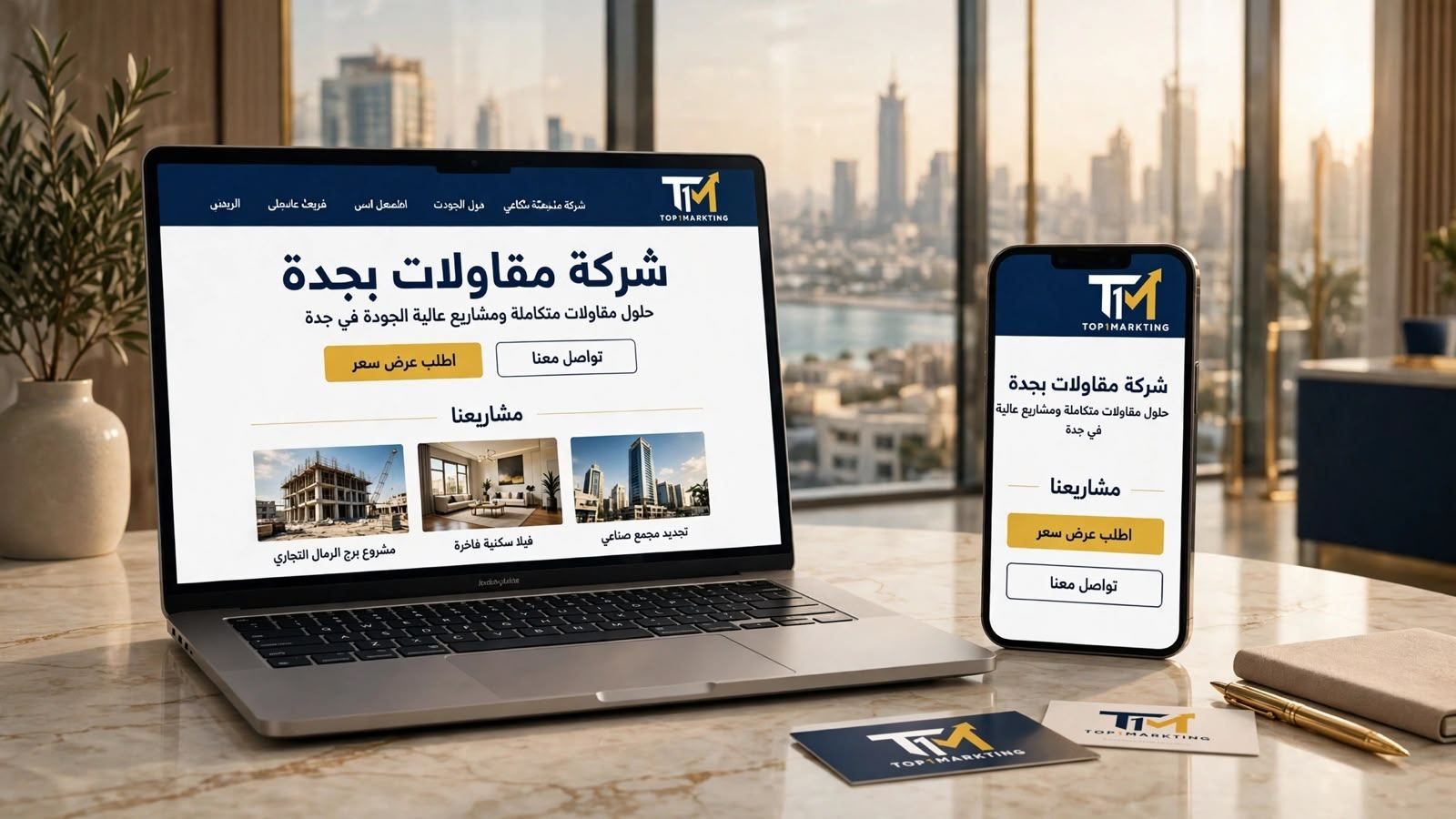
Website Design and Development Company for Contracting Companies in Jeddah
Contracting companies need digital solutions that help them showcase their services and projects while organizing their administrative and operational processes. If you are looking for a website design and development company for contracting businesses in Jeddah, Top1Markting provides website development and custom software solutions tailored to the construction and engineering industry, ranging from corporate websites to comprehensive systems for managing contracting operations.
A professional website can be designed to showcase the company profile, specialties, services, previous projects, portfolio, contact information, and customer inquiries in a clear and organized way. In addition, a customized management system can be developed to help manage contracting projects, monitor execution stages, organize tasks, employees, customers, and suppliers through an administrative dashboard tailored to the company's workflow.
The needs of contracting companies vary depending on their size and business activities. Some companies need a website to showcase their work and receive project inquiries, while others require more advanced software solutions to organize operations, monitor field teams, manage data, and generate reports. Therefore, the development scope can be customized according to the company's business model and project volume, with the option to connect the website to internal systems and expand its functionality when needed.
Whether you want a professional website for a construction company or a customized system for managing contracting projects, contact Top1Markting at 0549881368 to discuss your company's requirements and request a suitable quotation for your website or software development project in Jeddah.
Website Design for Contracting Companies in Jeddah to Showcase Projects, Services, and Previous Work

A website represents an important digital presence for contracting companies. It allows potential clients and business partners to learn about the company's specialties, services, completed projects, and contact options. Therefore, website design for contracting companies in Jeddah requires an understanding of the construction industry, engineering work, and how to present completed projects professionally rather than simply creating general pages containing the company name and contact details.
Top1Markting provides website design and development services for contracting companies and construction businesses, starting with corporate websites that introduce the company and its services and extending to additional features such as project portfolios, quotation request forms, and content management dashboards. Each website can be customized according to the company's activities, whether it specializes in general contracting, construction, finishing, electrical and mechanical works, or other engineering disciplines.
Developing a contracting company website includes organizing service pages, business specialties, and previous projects while focusing on user experience, easy navigation, and compatibility with mobile phones and different devices. Additional features can also be integrated to help company employees update projects, images, and information and receive customer inquiries directly through the website.
The required pages vary depending on the company's size and services. However, a corporate website may include a homepage, About Us, Services, Projects, Portfolio, News or Blog, Contact Us, and a Request a Quote form. You can explore Website Design Services in Jeddah and Corporate Website Design in Jeddah to determine the most suitable structure for your company's website.
Homepage Design for Contracting Company Websites and Digital Brand Identity
The homepage is the starting point through which visitors discover a contracting company and understand its business activities. Therefore, it should communicate the company's identity and specialties in an organized way, helping potential clients navigate to services, projects, and contact information without difficulty.
Homepage design for a contracting company depends on arranging information according to its importance to customers and organizations looking for a contractor to execute a project or collaborate on construction work.
A customized interface can be designed to include the company name, a brief introduction, its main specialties and services, selected completed projects, and clear buttons for contacting the company or requesting a quotation. A well-organized Navigation Menu can also make it easier for visitors to move between website sections, while the content is arranged to highlight the company's main business activities without overcrowding the page.
UI Design focuses on the visual elements and presentation of information, while UX Design aims to improve the visitor experience and navigation between pages. Responsive Layout is also considered to ensure that the website displays properly on smartphones, tablets, and desktop computers.
The homepage may include the following elements:
-
Company Overview: An introduction to the company's activities, experience, and business specialties.
-
Services and Specialties: A presentation of contracting, construction, finishing, and other services offered by the company.
-
Featured Projects: Selected examples of completed projects with links to detailed project pages.
-
Contact Elements: Contact buttons, inquiry forms, and quotation request options.
-
Call to Action (CTA): Directing visitors toward relevant actions, such as viewing projects or submitting a project inquiry.
The interface can also include selected photographs of the company's actual projects, taking image quality, page loading speed, and text clarity into consideration. The objective is to create a professional digital presence that reflects the identity of the construction company and the nature of its projects.
If you want a homepage that represents your company's identity and specialties, you can discuss your design requirements with Top1Markting and select the most suitable structure for your contracting website.
Development of Contracting Project Portfolios, Previous Work, and Construction Images
Contracting companies need an organized way to showcase their completed projects so potential clients can understand the company's practical experience and the types of work it has delivered.
For this reason, a contracting project portfolio can be developed within the website, with a dedicated page for each project containing its information, photographs, and a brief description of the completed work.
Developing a Project Portfolio involves creating a flexible structure that allows projects to be added, categorized, and updated through a Content Management System (CMS), without requiring code modifications every time the company wants to publish a new project.
The portfolio can be organized according to project type, engineering specialty, or the nature of the work, depending on the information the company wants to present to visitors.
A project page may include:
-
Project name and category.
-
Project location or city.
-
A brief description of the project scope.
-
Selected photographs from the construction stages or final results.
-
Additional project information, depending on what the company is authorized to publish.
Dynamic Pages can be used to create separate project pages based on a reusable template that can be updated easily, while a Project Gallery helps display photographs in an organized format.
Image Optimization can also be implemented to reduce image file sizes and improve the loading speed of portfolio pages while maintaining suitable display quality.
Before development, it is important to determine whether the company needs project categories, multiple photographs for each project, and the ability for its administrative team to update portfolio information independently. These decisions help determine the required portfolio features and management dashboard.
Top1Markting can develop a project portfolio that showcases completed work in an organized structure that is easy to manage and update. You can also explore Website Design Services in Jeddah and discuss the features required to present your company's portfolio.
Development of Quotation Request Forms and Contact Forms for Contracting Companies
A contracting company website should not be limited to displaying services and completed projects. It can also become a channel for receiving customer inquiries and new project requests.
Developing a Request for Quotation (RFQ) form helps collect initial project information and makes it easier for customers to submit inquiries instead of relying exclusively on traditional communication channels.
A customized RFQ Form can be developed according to the company's contracting services, allowing customers to enter their contact details, required work category, project location, and a brief description of their requirements.
If the service requires additional documentation, a File Upload feature can be added to allow customers to attach engineering drawings, documents, or project-related images, subject to permitted file types and size limits.
Backend functionality can also be developed to organize incoming inquiries and quotation requests, including:
-
Request Registration: Saving inquiry and quotation request information in a database.
-
Form Validation: Ensuring that essential information is entered correctly.
-
Email Notifications: Sending notifications when a new request is received.
-
Lead Management: Displaying inquiries within an administrative dashboard and tracking their status.
-
Request Categorization: Organizing inquiries according to service type, project category, or follow-up status.
The request submission process varies depending on the company's business model. A general contracting company may need a comprehensive project execution inquiry form, while a company specializing in finishing or technical works may require fields related specifically to its services.
Therefore, the form should be designed around the information required by the company's sales or management team to evaluate each request and contact the customer.
Experience in developing websites for business-to-business activities can also be useful when organizing corporate inquiries and supplier interactions, such as Supplier and Procurement Website Design in Jeddah.
If your company receives project inquiries from individuals or organizations, you can request a customized electronic form that matches your inquiry submission and review process, with the option to connect it to a management dashboard for organizing and tracking customer requests.
Request a Website for Your Contracting Company
Whether you need a corporate website to showcase your company's services and portfolio or a business website that includes a project gallery and quotation request forms, you can contact Top1Markting to discuss the required design and functionality.
Identify the pages you need, the type of content you want to publish, how projects will be updated, and how customer inquiries will be received to develop a suitable website structure for your contracting company in Jeddah.
Contracting Company Management Systems Development in Jeddah Based on Project Requirements
Contracting companies do not always need a website simply to showcase services and completed projects. As the number of projects increases and multiple construction sites, employees, and departments become involved, managing daily operations through separate files and manual spreadsheets becomes more difficult.
This is where the importance of developing Contracting Company Management Systems in Jeddah becomes clear. A customized software solution can bring operational data and processes together on a centralized platform, helping management monitor projects, resources, employees, and reports.
Top1Markting develops administrative systems and customized software solutions tailored to the operational requirements of contracting companies. The system can be built using independent but interconnected modules, such as project management, construction site management, task management, employee management, user permissions, and reporting.
Depending on the company's requirements, the solution can also include ERP functionality without adding unnecessary modules that the business does not use in its daily operations.
The development process begins with understanding the company's workflow, identifying the departments that will use the system, determining the information that needs to be recorded, and defining how tasks and data move between management, projects, and construction sites.
The next steps include defining Business Logic and operational rules, designing a suitable Database, developing user interfaces and dashboards, and connecting the system to the company website or other services through APIs when necessary.
A customized contracting management system may include:
-
Creating separate project records and linking them to relevant information and tasks.
-
Organizing employees, engineers, supervisors, and departments.
-
Monitoring execution stages and updating work statuses.
-
Recording reports, notes, and project-related documents.
-
Defining user permissions according to job responsibilities.
-
Displaying indicators and reports that help management monitor operations.
The system can also be customized to work across multiple devices, allowing authorized users to access the platform according to the approved login and permission structure. Its architecture and functionality are determined by the number of users, project requirements, and operational needs.
If you are looking for a company to develop a customized contracting management system, you can discuss your requirements with Top1Markting and request a software concept tailored to your company's size and operations, with the option to connect the internal system to your website through solutions such as Corporate Website Design in Jeddah.
Development of a Contracting Project Management System and Execution Stages
Managing contracting projects requires continuous monitoring of work stages, tasks, responsibilities, and delivery deadlines, especially when a company executes several projects simultaneously.
A Contracting Project Management System can serve as a centralized platform for recording project information, organizing execution stages, and helping management monitor work progress and tasks assigned to execution teams.
The system can begin by creating a separate record for each project containing its name, category, location, start date, target duration, and expected delivery date.
The project can then be divided into stages or Milestones according to the execution plan. Tasks can be assigned to each stage along with their responsible employees, allowing users to update task statuses, record notes, and monitor Progress Tracking through the management dashboard.
A contracting project management program may include the following features:
-
Project Creation: Registering project information and linking it to the responsible client or organization.
-
Execution Stage Planning: Organizing project activities into clearly defined stages.
-
Task Assignment: Assigning responsibilities and defining the required work.
-
Timeline Management: Recording start dates, end dates, and target delivery deadlines.
-
Progress Updates: Recording work status and completion percentages based on information entered by users.
-
Execution Reports: Generating reports showing completed stages, delayed tasks, and ongoing activities.
A Project Timeline or Gantt Chart can also be added when the project requires monitoring relationships between tasks and their scheduled dates.
Reports can be customized to display information about individual projects or multiple projects, depending on user permissions and management requirements.
Most importantly, the system should reflect the actual workflow of the contracting company. Some businesses need to monitor construction and building stages, while others focus on finishing, maintenance, or specialized engineering work.
Therefore, the required modules, data fields, and reports should be identified before development to ensure that the system is practical and relevant to the company's operations rather than simply functioning as a generic task list.
If your company manages several projects simultaneously, you can request a customized system that helps management monitor execution stages, tasks, and delivery schedules from one platform.
Development of Construction Site, Engineer, and Supervisor Management Systems
When a contracting company operates across multiple construction sites, monitoring field activities and exchanging information between engineers, supervisors, and management can become an operational challenge.
This can be addressed through a Construction Site Management System for Contracting Companies, where each site has its own record containing project information, assigned teams, reports, and related tasks.
The system connects management with execution sites through dedicated accounts for engineers and supervisors, allowing them to enter information, update work statuses, and submit daily reports according to their assigned permissions.
Management can then review the submitted information through a centralized dashboard instead of manually collecting details from multiple sources.
A construction site monitoring system may include:
-
Site Records: Registering each construction site and linking it to its associated project.
-
Engineer and Supervisor Management: Creating user accounts and assigning work locations and responsibilities.
-
Daily Reports: Recording completed work, observations, and challenges encountered during execution.
-
Task Assignment: Distributing tasks among engineers and supervisors and monitoring their completion.
-
Field Work Monitoring: Displaying the latest updates recorded for each site through the dashboard.
-
Document Management: Attaching photographs, documents, and reports related to project activities when needed.
A Mobile Dashboard can also be developed to make the system easier to use on smartphones while employees are working at construction sites.
Geolocation functionality can be considered when there is a clear operational requirement and in accordance with user consent and applicable privacy policies. Employee location tracking should not be assumed to be necessary in every management system.
Before development, it is important to identify the information management needs to monitor. Does each site require separate reports? What information can engineers update? Can supervisors access all projects or only the sites assigned to them?
These details help create a practical system that connects execution teams with management while maintaining organized business data.
If your company faces difficulties monitoring engineers, supervisors, and construction site updates, you can discuss developing a site management system with Top1Markting and define the required functionality according to the number of sites and your operational needs.
Development of an Administrative Dashboard for Contracting Company Employees and Permissions
Contracting management systems require a centralized administrative dashboard that helps management organize employee accounts, departments, business data, and the functions available to each user.
Not every employee should have access to all project information or the ability to modify every administrative record. Therefore, an Admin Dashboard can be developed with a permission management structure that matches the company's organizational hierarchy.
The dashboard begins with User Management, where accounts can be created for managers, employees, engineers, and supervisors, with each account linked to the appropriate department or job role.
Permissions can then be assigned using Role-Based Access Control (RBAC), ensuring that every user receives only the access level required to perform their responsibilities.
The administrative dashboard may include:
-
Employee Account Management: Adding users, editing information, activating accounts, and suspending accounts according to administrative permissions.
-
Department Organization: Linking employees to departments, teams, and projects.
-
Permission Management: Controlling the ability to view, add, edit, or delete information.
-
Login Management: Implementing Authentication to verify user identities and manage system access.
-
Activity Records: Using Audit Logs to record important operations, such as data modifications or changes to selected settings, depending on system functionality.
-
Administrative Dashboards and Reports: Displaying summaries of users, projects, tasks, and information available to each role.
For example, a project manager can be given permission to monitor assigned projects and tasks, while a site engineer can update execution reports related to their assigned location.
Management can receive broader permissions to review project data and reports, while employees can be restricted from accessing financial or administrative information outside their responsibilities.
Activity logs help identify which user performed specific modifications and when they occurred, supporting change reviews and system usage monitoring.
Permission levels should be defined during the initial analysis stage to ensure that the access structure matches the company's organizational hierarchy and internal policies.
Top1Markting can develop a customized administrative dashboard for contracting companies, including employee management, departments, user accounts, and permissions according to operational requirements.
Contact Top1Markting to discuss your company's needs and determine the most suitable dashboard and administrative functionality.
Request a Management System for Your Contracting Company
If you want to move from manual monitoring to a centralized administrative system, you can contact Top1Markting to discuss how your company manages projects, employees, and construction sites.
The required modules, permissions, reports, and integration methods are determined according to your company's needs, helping you obtain a customized software solution that can evolve as your contracting business grows.
Development of Accounting, Cost Management, and Payment Certificate Systems for Contracting Companies
Contracting companies need to monitor the financial aspects of each project in an organized way, starting with estimated budgets and expense registration and extending to payment certificates, financial claims, and outstanding payments.
Therefore, a customized Accounting and Cost Management System for Contracting Companies can include financial modules connected to individual projects, allowing accountants, project managers, and financial departments to review information and monitor costs and obligations through one platform.
Top1Markting develops customized software according to each company's operational workflow, with the option to connect financial information to projects, execution items, procurement, and suppliers, depending on the required system scope.
This can include contracting cost management, contractor payment certificate management, expense and payment monitoring, and financial reports that help management evaluate performance and compare actual results against approved budgets.
Development of a Contracting Project Cost and Budget Monitoring System
A Contracting Project Cost Monitoring System helps companies identify the amounts allocated to each project and compare them with actual expenses during execution.
The system can be developed to create an independent budget for each project and divide it into cost categories associated with construction activities, materials, equipment, labor, and procurement.
This helps cost accountants and project managers monitor spending with greater clarity.
The system may include:
-
Registering the estimated budget for each project and defining cost categories.
-
Recording actual expenses and linking each expense to the relevant project and cost item.
-
Classifying costs according to materials, labor, equipment, services, and operating expenses.
-
Monitoring approved amounts, recorded expenses, and remaining budget balances.
-
Generating reports comparing estimated and actual costs.
-
Identifying cost variances to facilitate review and analysis.
Through features such as Project Costing, Cost Control, and Budget Tracking, the system can generate reports showing the financial status of each project.
These reports help financial managers and project managers identify budget overruns and review expenses before making operational decisions.
Additional features can include expense approval permissions, notes, and modification logs according to the company's internal procedures.
If your company manages multiple projects with different budgets and cost categories, you can request a customized program for monitoring expenses and comparing actual costs against estimated allocations, with the required reports and functionality defined before development.
Development of Contractor Payment Certificate and Financial Claims Management Systems
Managing payment certificates requires tracking the value of completed work, submitted amounts awaiting approval, payments already issued, and outstanding balances.
A Contractor Payment Certificate Management System can provide an electronic workflow for registering payment certificates and linking them to projects, contracts, contractors, and relevant departments.
This reduces reliance on separate files that can become difficult to track when multiple projects and subcontractors are involved.
A Contractor Payment Management Program can include the following features:
-
Creating a new payment certificate and linking it to the relevant project, contract, contractor, or responsible organization.
-
Recording the value of completed work during a specified period.
-
Attaching supporting documents and related records.
-
Defining review and approval stages and assigning responsibility for each stage.
-
Monitoring payment certificate status, such as under review, approved, or requiring modification.
-
Recording issued payments, remaining amounts, and outstanding dues.
-
Organizing deductions, retentions, and withholding amounts according to approved contractual rules.
-
Maintaining records of previous payment certificates, modifications, and related procedures.
An Approval Workflow can be developed to define how payment certificates move between the accountant, technical office engineer, contracts manager, and authorized director, while recording the date of each action and its associated notes.
Features such as Payment Applications, Payment Certificates, and Retention can help organize financial claims, payments, and retention amounts according to the company's approved workflow.
The system can help answer important operational questions:
-
Which payment certificates are still awaiting approval?
-
What is the value of outstanding payments associated with each project?
-
Who is responsible for reviewing the current request?
-
Which payments have already been recorded?
Reports can also be generated according to project, contractor, or time period.
This module differs from a general accounting program because it focuses on the payment certificate workflow and costs associated with contracting projects.
It can also be connected to an existing accounting program when suitable technical and integration requirements are available.
Top1Markting determines the development scope according to the company's needs without assuming that a customized system automatically replaces approved accounting software or statutory accounting requirements.
If you need to organize payment certificates and financial claims and monitor their approval and payment stages, contact Top1Markting at 0549881368 to discuss developing a financial module connected to your company's projects.
Contracting Company Website Design in Jeddah with Mobile Compatibility and Search Engine Optimization
A contracting company website should do more than display the company name, contact information, and project photographs. It requires a technical structure and user experience that help customers explore services, specialties, and previous projects easily, whether they are using desktop computers or mobile phones.
Therefore, when choosing a Website Design Company in Jeddah, it is important to consider loading speed, page organization, content clarity, and the website's ability to be crawled and indexed by search engines.
Top1Markting designs and develops contracting company websites while considering Responsive Design and Technical SEO requirements.
This includes creating organized service and project pages, improving image and content presentation, and reviewing indexing elements and internal links.
The objective is to provide a technical foundation that can be developed over time and helps search engines understand the website's content.
Optimizing Contracting Service Pages and Engineering Specialties for Search Engines
Contracting companies typically provide multiple services, which may include construction, building, finishing, renovation, civil works, and other engineering specialties.
It is better to organize these services into clearly structured pages rather than combining everything into a single page that does not provide enough space to explain each specialty or target relevant search queries.
As part of SEO Services for Contracting Company Websites, website pages can be organized according to the company's business activities and the search terms customers use when looking for services.
This also requires understanding the difference between users who want to learn about the company, those looking for a specific contracting service, and those who want to request a quotation.
Service page optimization includes:
-
Creating a clear classification of the company's services and engineering specialties.
-
Developing separate pages for major services that require dedicated explanations and content.
-
Writing H1, H2, and H3 headings that accurately reflect each page's subject.
-
Naturally distributing commercial keywords and relevant variations throughout the content.
-
Explaining the service scope, nature of the work, and execution stages.
-
Adding internal links between service pages, related projects, and contact pages.
-
Optimizing page titles and Meta Titles and Descriptions.
-
Implementing Structured Data when appropriate for the page and content type.
For example, a contracting company website may include a page for general contracting, another for finishing and renovation, a separate page for infrastructure works, and another for operation and maintenance services if these are part of the company's activities.
This structure helps visitors find more specific information and gives each page an opportunity to target a relevant group of search queries instead of combining all services into one title and content section.
Technical optimization also includes Keyword Mapping, Search Intent, On-Page SEO, and Internal Linking to ensure that the website structure reflects the company's services and the needs of its target customers in Jeddah.
If you want to improve your company's service pages and target people searching for contracting and engineering services, you can explore SEO Services in Jeddah to organize your content and optimize website elements according to its current condition and business objectives.
Improving Contracting Website Speed and Mobile User Experience
A contracting company website needs to display project photographs and technical details in a clear and efficient way, especially because many potential customers browse websites using mobile phones.
Large images, unoptimized files, and non-responsive designs can negatively affect loading speed and browsing convenience. Therefore, performance should be considered from the website design and development stages.
Improving a contracting website's speed and user experience may include:
-
Developing Mobile Responsive pages that adapt to different screen sizes.
-
Compressing project images while maintaining suitable display quality.
-
Using modern image formats when supported and appropriate.
-
Implementing Lazy Loading for images and elements that are not immediately visible.
-
Reducing unnecessary code files and optimizing CSS and JavaScript loading.
-
Reviewing Caching configurations according to the website architecture.
-
Organizing menus and buttons to make services, projects, and contact options easier to access.
-
Reviewing performance indicators and loading experience, including Core Web Vitals.
These elements are particularly important for contracting websites that contain extensive photo galleries and multiple completed projects.
Project galleries can be organized so visitors can browse photographs and project details without loading every element at once. Important projects can also have dedicated pages instead of displaying a large number of images on a single page.
Technical reviews should also include testing the website on different screen sizes and browsers and ensuring that text is readable and forms and navigation menus are easy to use.
The objective is not simply to make the website look good on mobile devices, but to ensure that visitors can find the required service and submit an inquiry without difficulty.
If you already have a website that requires performance improvements or a redesigned user experience, you can explore Website Design Services in Jeddah and discuss the appropriate development requirements.
Technical elements such as Sitemap, Robots.txt, Canonical tags, and URL structure can also be reviewed to prepare the website for proper indexing, without treating these improvements as a guarantee of specific search rankings.
Website Design and Contracting Management System Development Prices in Jeddah
The cost of designing and developing websites and management systems for contracting companies in Jeddah varies according to the project scope and required functionality.
The cost of creating a corporate website that showcases services and previous projects differs from the cost of developing a customized administrative system for managing projects, procurement, inventory, accounting, and payment certificates.
The budget is also affected by the number of pages and software modules, the level of customization, and the required integrations with other systems.
Therefore, project pricing should not be based on the service name alone. It should be determined after identifying the scope of work, technical specifications, and functions required by the client.
Top1Markting begins by identifying website or software requirements and dividing them into clearly defined components that can be used to prepare a quotation.
Some projects can also be implemented in stages according to priorities and available budgets.
Website Design Cost for Contracting Companies and Factors Affecting Pricing
The cost of designing a contracting company website depends on the size of the website, the number of pages, and the required features.
A website that only introduces the company and displays its services and contact details differs from a website that includes an advanced project portfolio, detailed service pages, quotation request forms, and a content management dashboard.
The main factors affecting website design prices include:
-
Number of Pages: Such as the homepage, service pages, portfolio, About Us, and Contact Us.
-
Design Requirements: Whether the website uses a custom design reflecting the company's identity or a simpler design with predefined features.
-
Project Portfolio: The number of projects and how they are categorized, photographed, and presented through dedicated pages.
-
CMS Dashboard: The functionality required to add services and projects and update content and images.
-
Contact Forms: Such as quotation request forms, file attachments, and project category selection.
-
Technical SEO: Organizing page titles, internal links, indexing elements, and website performance.
-
External Integrations: Connecting the website to other services or systems when needed.
-
Hosting and Domain: Hosting requirements, domain registration, and any additional operating services included in the agreement.
For example, a contracting company website may require dedicated pages for general contracting, finishing, renovation, and infrastructure works, along with a project portfolio and a form for receiving customer inquiries.
As the number of required features and details increases, the project requires a larger design and development scope.
Therefore, it is preferable to identify the required pages and functionality before requesting a quotation, ensuring that the proposed price reflects the company's actual needs.
You can also explore Corporate Website Design in Jeddah to understand the available website solutions for businesses.
Contracting Management System Development Cost According to Modules and Features
The cost of developing a Contracting Company Management System varies more significantly than that of a basic corporate website because a customized system depends on the number of modules, operational processes, relationships between data, and required user permissions.
Developing a project management module differs from creating a comprehensive system connecting projects, construction sites, employees, procurement, suppliers, warehouses, accounting, and payment certificates.
The main factors determining software development costs include:
-
Number of Software Modules: Such as project management, employee management, customer management, procurement, inventory, and accounting.
-
Customization Level: How closely the system's functionality must match the company's internal procedures and workflows.
-
Number of Users and Permissions: Creating different roles for managers, accountants, engineers, supervisors, and administrative employees.
-
Workflow Complexity: Such as purchase requests, approvals, payment certificates, and operational approval stages.
-
Database Design: The volume of data and relationships between projects, suppliers, expenses, and documents.
-
System Integration: Connecting the website, accounting software, or external services through APIs.
-
Reports and Dashboards: The types of reports, monitoring indicators, and required levels of detail.
-
Testing and Maintenance: The scope of operational testing, support, and agreed updates.
For example, one company may need a system that initially manages projects and construction sites, while another may require additional modules for procurement, warehouses, equipment, and payment certificates.
A larger organization may require all these modules to be connected through one database with multiple permission levels and administrative and financial reports.
Therefore, there is no single fixed price for all contracting management systems without first understanding the project scope.
The cost of an ERP system for contracting companies also depends on the level of integration between its modules, the volume of operations it covers, and whether it is being developed from scratch or customized and integrated using an existing system.
Top1Markting can help identify the required modules and prioritize them before preparing a technical development plan that explains the project scope and implementation stages.
You can request an initial analysis of your company's requirements before determining the software development cost and estimated implementation timeline.
How to Choose a Suitable Website Design and Contracting Management System Development Company in Jeddah
Choosing a website design and contracting management system development company in Jeddah should not depend on price alone.
A project may involve a website showcasing the company's services and projects, an administrative system handling customer, project, supplier, and expense data, or a combined solution connecting the website to internal business operations.
Therefore, it is important to compare development companies according to their ability to understand business requirements, define the implementation scope, and provide a clear technical proposal before starting work.
Important selection criteria include reviewing previous projects, understanding the company's requirements analysis process, verifying the features included in the quotation, and learning how the website or system will be tested.
You should also understand what technical support and updates are included in the agreement and whether the solution can be expanded as the company grows.
Software Development Company Experience in Building Websites and Customized Business Systems
When evaluating a website and software development company, it is important not to focus exclusively on the visual appearance of its websites.
Designing a corporate website differs from developing an administrative system containing databases, user permissions, approval workflows, and reports.
Therefore, you should examine the types of projects the company can deliver and how closely its experience relates to your specific requirements.
You can evaluate a software development company's experience through the following points:
-
Reviewing examples of corporate websites it has developed and how their pages are organized.
-
Examining examples of administrative systems and their available functionality, when provided.
-
Understanding how the company handles customized requirements that vary between business activities.
-
Reviewing dashboard organization, permission management, and user experience.
-
Discussing the possibility of connecting the website to internal systems or external services.
-
Requesting a technical proposal explaining how the required features will be implemented rather than accepting a general service description.
It is also important to distinguish between website design experience and software development experience.
A company may be capable of building a good website, but a contracting management system also requires business process analysis, database design, administrative functionality development, and testing.
Top1Markting provides website design and customized business software development services.
You can discuss your project requirements to determine whether you need a corporate website, an administrative management system, or a combined solution.
You can also explore Website Design in Jeddah to learn more about available website development services.
Analyzing Contracting Company Requirements Before Website Design or System Development
Before starting design or software development, it is essential to understand how the contracting company operates and which processes it wants to organize.
Selecting features without analyzing business requirements may result in developing functions that are never used or overlooking essential processes that become important after the system goes live.
Requirement Analysis begins by discussing the company's business activities, departments, users, and daily operations.
The functional requirements are then documented and the relationships between system modules are identified.
This analysis may include:
-
Defining the website or system objectives and the expected results.
-
Identifying departments that will use the system, such as project management, procurement, accounting, and inventory.
-
Determining the information each department needs to enter and review.
-
Defining user permissions and responsibilities.
-
Mapping workflows, such as purchase request approvals and payment certificate monitoring.
-
Identifying the required reports and dashboards.
-
Prioritizing the functions to be implemented in the first stage and those that can be added later.
A Functional Specification document can then be prepared to describe modules, functions, and usage scenarios, along with how information moves between different parts of the system.
For example, if the company wants to monitor construction material purchase requests, the analysis must identify who creates the request, who reviews it, who approves supplier quotations, and how the request is connected to the project and inventory.
This process helps transform administrative requirements into clear software functions that can be estimated, developed, and tested.
The company does not need to define every technical detail itself.
The role of a systems analyst is to discuss business procedures and convert them into development requirements while explaining available options and the implications of each decision.
System Testing, Technical Support, and Updates After Delivery
Developing a website or management system does not end when programming is completed.
The functions must be tested to ensure they operate according to the agreed requirements before launch.
The scope of technical support, maintenance, and updates after delivery should also be defined so that each party's responsibilities are clear.
Quality assurance and testing may include:
-
Testing forms and essential functions and verifying correct data entry.
-
Reviewing user permissions and confirming that each account can access only authorized functions.
-
Testing workflows, approvals, and notifications.
-
Reviewing reports and comparing their results with recorded data.
-
Testing the website across different screen sizes and browsers.
-
Reviewing error handling and unexpected situations.
-
Confirming backup configurations according to the project scope and agreed operating policy.
The scope of Maintenance services after delivery should also be agreed upon.
This includes determining whether maintenance covers software bug fixes, periodic updates, or adding new functionality, as well as defining how modification requests will be submitted and additional work estimated.
It is also useful to clarify how project data, administrative accounts, and the operating environment will be delivered and whether user training is included in the development scope.
New features requested after delivery can be handled through a separate agreement or the approved support arrangement.
If you are comparing software development quotations, do not focus only on the final price. Review what the proposal includes in terms of analysis, design, development, testing, delivery, and support.
You can discuss these details with Top1Markting before approving the project scope.
Website Design and Contracting Management System Development Stages with Top1Markting

Developing a website or administrative system for a contracting company requires an organized process that begins with understanding business requirements and ends with preparing the solution for operation.
These stages help define the project scope, clarify the required functionality, and review design and software development before delivery instead of starting implementation without a clear agreement on the expected results.
Top1Markting organizes the website and software development process according to the nature of each project, whether the requirement is a corporate website showcasing services and projects, an internal business management system, or an integrated solution connecting the website to the administrative dashboard.
Analyzing Contracting Company Requirements and Preparing Technical Specifications
The process begins by collecting information about the company, its business activities, and the services it provides.
The project objectives and required functions are then identified according to the needs of the intended users.
For a website project, this involves reviewing the required pages and how services, projects, and contact information will be presented.
For an administrative system, the analysis focuses on departments, operations, data, and user permissions.
The analysis stage includes:
-
Identifying the company's business activities and specialties.
-
Listing the required website pages or software modules.
-
Defining user types, roles, and permissions.
-
Understanding current business procedures and the problems the system should address.
-
Identifying the data, documents, and reports the system must handle.
-
Determining required integrations with the website or other systems.
-
Prioritizing functions and establishing an implementation roadmap.
Afterward, the requirements can be documented in technical specifications covering Functional Requirements and Workflow Mapping, explaining how each feature is used, the data it depends on, and its expected outcome.
This stage helps reduce differences between the client's expectations and the final product.
It also makes it possible to estimate the project workload, resources, and expected timeline based on a clearly defined scope.
During the analysis process, essential functions can be identified for the first development stage, while additional features can be scheduled for future implementation.
Interface Design, Website or System Development, and Testing
After the requirements are approved, the user experience and interface design stages begin, followed by software development and database implementation according to the agreed scope.
The development process varies depending on the project.
A corporate website requires organized service pages, project pages, and contact functionality, while an administrative system requires dashboards, data entry forms, permissions, and operational workflows.
This stage may include:
-
Designing UI/UX interfaces suitable for the website or system.
-
Developing the Front-End and implementing page layouts and browsing experiences.
-
Developing the Back-End and implementing business logic.
-
Designing databases and relationships between records.
-
Developing administrative dashboards and user permission management when required.
-
Connecting forms, functions, and integrations included in the project.
-
Testing functionality and reviewing errors before launch.
For websites, the pages, mobile and desktop layouts, images, content, and internal links are reviewed.
For management systems, testing includes real operational scenarios, such as creating a project and assigning a task, submitting and reviewing a purchase request, or updating a payment certificate status.
The design and functionality can be reviewed through agreed approval stages to ensure that the deliverables meet the technical specifications before moving to operation.
You can also explore Website Design Services in Jeddah when discussing website requirements, interfaces, and the functionality your business needs.
Website or System Launch, Data Migration, and User Training
After development, testing, and approval are completed, the project moves to the operational preparation stage.
This includes configuring the hosting environment or server according to the project requirements, reviewing operating settings, creating user accounts and permissions, and preparing the data required for launch.
The launch and delivery stage may include:
-
Preparing the operating environment and website or system settings.
-
Connecting the domain and hosting service when required.
-
Reviewing security settings and user permissions.
-
Migrating available data from an existing system when included in the project scope.
-
Creating user accounts and defining access levels.
-
Testing essential functionality in the production environment.
-
Training users on the required features according to the agreement.
-
Delivering administrative access details and agreed documentation.
For Data Migration, the data sources, file formats, and readiness must be identified before implementation.
Transferring customer, project, or inventory information from previous files or systems may require reviewing, cleaning, and formatting the data before importing it into the new system.
User training can include explaining how to enter information, use the dashboard, monitor requests and reports, and manage user accounts.
This helps employees begin using the system according to the defined procedures.
The delivery scope, technical support, and future updates should be agreed upon in advance so that post-launch requirements are clear.
If you are planning to develop a website or management system for your contracting company, you can send your project details to Top1Markting at 0549881368 to discuss the requirements and appropriate implementation stages.
Contact a Website Design and Contracting Management System Development Company in Jeddah
If you manage a contracting company and want to develop a professional website showcasing your services and projects, or need a management system to organize your company's departments and operations, you can contact Top1Markting to discuss your project requirements and determine the appropriate solution.
Our services include corporate website design, contracting management system development, administrative dashboard development, and website integration with customer requests and internal business systems according to the required scope.
You can request the development of one or more of the following solutions:
-
Designing a corporate website for a general contracting or specialized construction company.
-
Creating pages for services, engineering specialties, and previous projects.
-
Developing a system for managing projects, construction sites, and tasks.
-
Programming procurement, supplier, inventory, and equipment management modules.
-
Developing a system for monitoring project costs, payment certificates, and payments.
-
Connecting the website to a customer management system and quotation requests.
-
Technical SEO optimization and website user experience improvements.
-
Developing a customized management system in stages according to business requirements.
Before determining the project cost, it is useful to clarify the type of business, the project objectives, the required pages or modules, the expected number of users, and any integrations needed.
Based on this information, the project scope can be discussed and a quotation prepared according to the actual requirements.
Contact Top1Markting: 0549881368
Start discussing your company's requirements to determine whether the most suitable solution is a corporate website, an independent administrative management system, or an integrated platform connecting your website and internal business operations.